



2026-07-27
How can a clothing factory choose a sewing machine bottom line detector that does not falsely report? 3 key points for purchasing
Abstract
It is not uncommon for bottom line detectors in clothing factories to be abandoned due to frequent false alarms. The root cause of the problem often lies in the contamination of the photoelectric sensor with oil and cotton wool, the need for repeated calibration when changing the shuttle core, and the lagging signal response during high-speed operation. Choose a stable and non false alarm detector, focusing on three hard indicators: anti oil contamination algorithm, calibration free shuttle core replacement, and high-speed response without missed detection. This article will elaborate on these three points to help you avoid selection errors.
In the clothing production workshop, the sewing machine runs for more than ten hours, with oil stains, cotton fluff, and dust mixed in, making the environment extremely unfriendly to electronic devices.
Many clothing factory owners have reported that they have bought a bottom line detector, but it cannot be used - it is quite sensitive when first installed, but after a few days it starts to alarm randomly, and the operator gets annoyed and directly pulls out the line. The detector, which cost thousands of yuan to install, eventually became a decoration.
Where is the problem? It's not that the detector category is not suitable, I didn't choose it correctly. Before buying a bottom line detector, there are several things that must be clarified.
1、 The root cause of false positives - first understand why the detector is "screaming"
Bottom line detector false alarm, most likely due to probe contamination. Ordinary photoelectric sensors rely on lens reflection to detect whether the shuttle core is rotating. If the surface is stained with oil and cotton wool, the sensor will misjudge when the light path signal changes - either it will give a crazy alarm thinking the wire is broken, or the signal will be too weak to detect it directly.
Real case:
A certain knitted T-shirt factory has installed ordinary photoelectric sensors on all 20 flat sewing machines in the workshop. There was no problem in the first week, but starting from the second week, on average, each machine reported 2-3 false alarms per day, which annoyed the operators when they heard the alarm sound. The mechanic wiped the probe every day until he suspected life, and later turned it off collectively. Two months later, all the detectors were dismantled, and the boss said, 'It's better not to install them.'.
Key points for selection:
The first thing to do when selecting a detector is to ask the manufacturer: Do you have a dust shielding adaptive algorithm? The function of this algorithm is to automatically compensate for the impact of surface pollutants on the optical path of the probe - if the lens is dirty, the algorithm can adjust it itself without the need for human wiping.
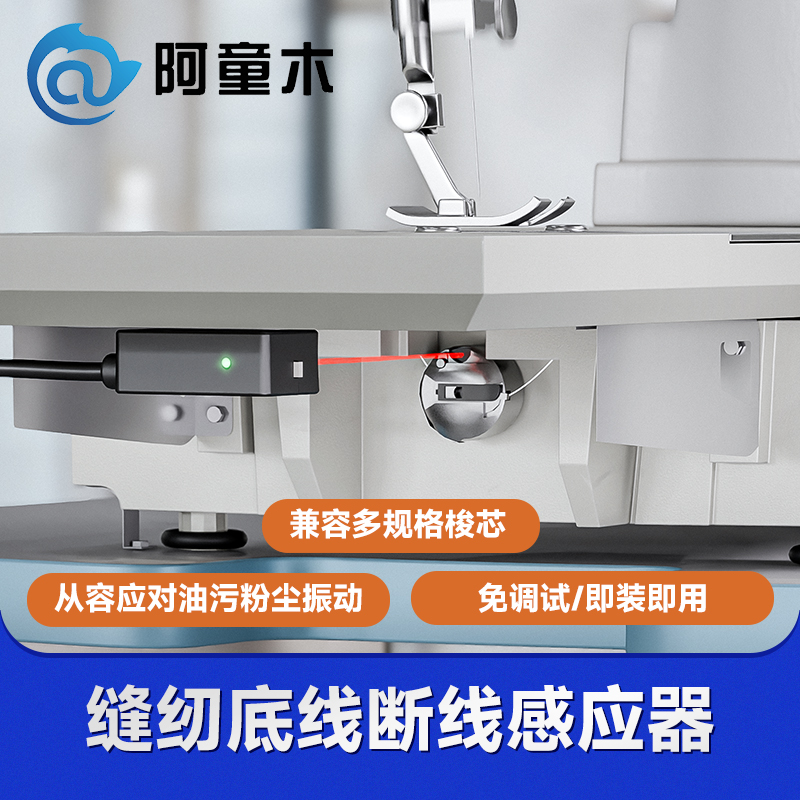
Taking the Atorm LS2 shuttle core bottom line breakage detector as an example, it is equipped with a dust shielding adaptive algorithm. Actual feedback shows that the probe does not rub or report false alarms for two or three weeks, which is completely different from the experience of "screaming around every other day".
2、 Should the shuttle core be replaced and readjusted to determine whether the detector can truly land on the ground
Many detectors cannot be used when bought back, not because the detection is inaccurate, but because replacing the shuttle core is too troublesome.
How many times does the clothing factory change the shuttle core per day? Taking a medium-sized knitting factory as an example, with 15 flat sewing machines, the shuttle core is changed 60-80 times a day. If the detector is changed to a different type of shuttle core, the sensitivity parameters will have to be recalibrated, and the machine maintenance will not care about adjusting them. The operator will not adjust them - if they are not adjusted properly, they will either not alarm or alarm randomly, and in the end, they will still be turned off.
Key points for selection:
The second thing to do when making a purchase: ask if the shuttle core needs to be recalibrated. The detector with distance adaptive algorithm does not need to be adjusted. The porous shuttle core, alumina shuttle core, and color coated shuttle core can be directly used and run when turned on.
LS2 has done a good job in this regard, with different specifications of shuttle cores switching without calibration, which directly determines whether the detector can be implemented in a real workshop.
3、 High speed sewing without missing detection -3000 revolutions per minute is the watershed
Many clothing factories use high-speed industrial sewing machines, with speeds ranging from 2500-3000rpm. Some detectors perform normally at low speeds but miss detection at high speeds - the bottom line is broken and the machine keeps running, causing the detector to fail to respond.
The reason lies in the sampling frequency and response speed. At low speeds, the shuttle core rotates slowly, but the sensor sampling is sufficient; When the spindle core speed doubles at high speed, detectors that cannot keep up with the sampling frequency will experience a situation of "broken wire but no response".
Key points for selection:
The third thing to choose from is to confirm the maximum speed that the detector is compatible with. The detector adapted to 3000rpm can cover the vast majority of industrial sewing machine operating conditions.
The detector purchased by a certain underwear factory was originally designed to adapt to 2000rpm, but in reality, it ran at 2800rpm in the workshop. The bottom line broke and the machine took off, but the detector did not respond at all. Later, the model adapted to 3000rpm was changed, and the response control for wire breakage shutdown was within 1-2 pins.
Several common questions asked by clothing factories
What if the sewing machine doesn't stop when the bottom line is broken?
The detector is either not installed or installed but not working. Three steps for troubleshooting: First, check if the probe is aligned with the observation window of the shuttle shell. If the angle is too deviated, it cannot be detected; Check if the signal line is connected correctly, as some machine shutdown signal interfaces do not match the detector; Check if the detector is compatible with enough speed, as high-speed missed detections are common pitfalls. If the detector is turned off due to frequent false alarms, it is a selection problem - switching to a model with dust shielding adaptive algorithm to fundamentally solve false alarms.
How to solve the problem of chaotic alarms from the sewing machine oil pollution detector?
Oil pollution false alarm is the most common problem. Two directions: one is to choose a detector with dust shielding adaptive algorithm, which automatically compensates for the impact of pollutants without having to wipe the probe every day; Secondly, the installation position should avoid the direct spray area of oil mist as much as possible, and the probe should be aimed at the shuttle shell window but not directly at the fuel inlet. In workshops where oil pollution is prevalent, when choosing a detector, it is important to consider this algorithm as a hard indicator, otherwise installing it would be in vain.
Summary
Choose a stable and error free baseline detector, remember to look at three things: anti oil contamination algorithm, calibration free shuttle core replacement, and high-speed adaptation speed. Anyone who has stepped into a pit knows that it's not scary to have a detector that doesn't work. It's the constant alarm that can be fatal - once the operator turns off the detector, it's like buying a decoration with money. Choose the right model, install it and truly use it, only then can the cost of reworking the gaps be calculated.
You May Be Interested
-
Atonm MDSC-9000T Dual-Channel, Single-Sensor Metal Double-Sheet Detector
2025-12-05
-
Non-Contact “One-to-Four” Double-Sheet Detector 1600S: A New Cost-Reduction and Efficiency Solution for Stamping Lines
2025-11-20
-
Mold damage, production delays? Atonm MDSC-8200T metal double-sheet detector protects automotive stamping lines
2025-10-30
-
Provincial Auto Industry Research Tour | Atonm Engages with the Automotive Supply Chain, Empowering Smart Manufacturing through Sensors
2025-10-11