




2026-04-20
What should I do when stacking aluminum foil bags? The packaging bag always follows the approach of handling two items together
summary:
The packaging bag with aluminum foil layer may have double bags, stacked bags, or two bags passing together in the conveying section. The real problem is not to "see the bag passing", but to determine as early as possible whether it is a single bag or multiple bags stacked together. The processing sequence should be: first confirm whether there is a continuous aluminum foil layer inside the bag, then move the detection point to a more stable conveying section, establish single bag and stacked bag thresholds using real bag samples, and finally link to remove or alarm. This is easier to form a stable closed loop than relying solely on manual monitoring or just adding one photoelectric sensor.
What should I do when stacking aluminum foil bags?
Answer: Don't rush to change the workstation in the later stage, and don't directly attribute the problem to the suction bag action. A more stable approach is to first confirm whether there is a continuous aluminum foil layer inside the packaging bag, then distribute the detection points to a more stable position in the conveying posture, conduct threshold testing with single bag and double bag samples, and finally link to eliminate or alarm. For packaging bags with aluminum foil layers, this path is usually more controllable than relying solely on manual inspection.
How to deal with packaging bags that always go together?
Answer: The processing sequence should be "investigate the cause first, and then establish a detection loop". The former focuses on static electricity, lamination, adhesion, and guidance; The latter depends on the detection position, bag sample testing, PLC linkage, and anomaly removal. If only actions are processed without judgments, the problem is likely to recur.
1、 Why do two packaging bags go together? There are usually several reasons why they cannot escape from the scene
People who do food packaging have seen this scene: a bag seems to pass through normally on the conveyor belt, but suddenly the bag opens abnormally, the filling is misplaced, or the rhythm is disrupted in the later stage. Looking back, it's not that the equipment in the later stage has a slow response, but rather that two bags have already been stuck together in the earlier stage. The question is not whether there is a bag or not, but whether there is one or two in the past.
This type of stacked bag is usually caused by several reasons:
Electrostatic adsorption: During dry seasons, rapid friction, and after stacking and transportation, the bag surfaces are easily attracted to each other.
Stacking deformation: Empty bags are compressed during packaging, storage, and transportation, and are more likely to be taken away together after local adhesion.
Slight adhesion of edge seal: The fluctuation of the bag making or heat sealing state in the front section may leave adhesive points that are not easily detected by the naked eye in a timely manner.
Unstable guidance: The conveying section shakes, the turning position is too close, and the bag posture fluctuates greatly, which makes it harder to distinguish bags that are already close together.
Manual re inspection cannot keep up with the pace: once the speed increases, it is difficult for the operator to continuously and stably monitor each bag.
| live performance | High probability reasons | What to check first |
| During a certain period, there was a significant increase in double bags | Static electricity, humidity, or changes in upstream bag storage status | Weather, anti-static measures, and bagging methods |
| Repeated adhesion of the same batch of bags | Edge sealing adhesion or bag body compression | Bag edge sealing, packaging stacking, and transportation methods |
| It is easiest to stack bags when first on the conveyor belt | Unstable posture and insufficient guidance | Check if the detection position is placed in the most chaotic position |
| Frequent code reporting in the later stage, but no problem detected in the earlier stage | Lack of single and double bag judgment loop | Is there only photoelectric detection without bag stacking recognition |
Common misconceptions on site:
Many production lines, when they see "two going together", their first reaction is to increase suction, add guide plates, or ask operators to keep a close eye on them. These actions may improve some phenomena, but without establishing an online judgment loop for "single bag or stacked bag", the problem is often just moving from one workstation to another.
2、 Don't reverse the processing order: first determine whether it is suitable for testing, and then decide what method to use to block it
For packaging bags with aluminum foil layers, what is truly valuable is not the color of the bag surface or the outline of the pattern, but the change in the total amount of metal layer inside the bag. That is to say, the first question to answer is whether there is a continuous aluminum foil layer inside this bag, and whether it can make the signal difference between single and double bags stable and open. If this condition is met, the subsequent detection and linkage will be meaningful.
Why can't ordinary optoelectronics distinguish between one or two?
Answer: Optoelectronics are better at determining whether an object has passed through, but their ability to distinguish between single and double bags in flexible packaging is limited. Because wrinkles, reflections, printing, and posture deviation can all interfere with appearance judgment. Aluminum foil layer packaging bags are more suitable for using metal layer signals for judgment, rather than just looking at the bag surface.
| live performance | High probability reasons | What to check first |
| During a certain period, there was a significant increase in double bags | Static electricity, humidity, or changes in upstream bag storage status | Weather, anti-static measures, and bagging methods |
| Repeated adhesion of the same batch of bags | Edge sealing adhesion or bag body compression | Bag edge sealing, packaging stacking, and transportation methods |
| It is easiest to stack bags when first on the conveyor belt | Unstable posture and insufficient guidance | Check if the detection position is placed in the most chaotic position |
| Frequent code reporting in the later stage, but no problem detected in the earlier stage | Lack of single and double bag judgment loop | Is there only photoelectric detection without bag stacking recognition |
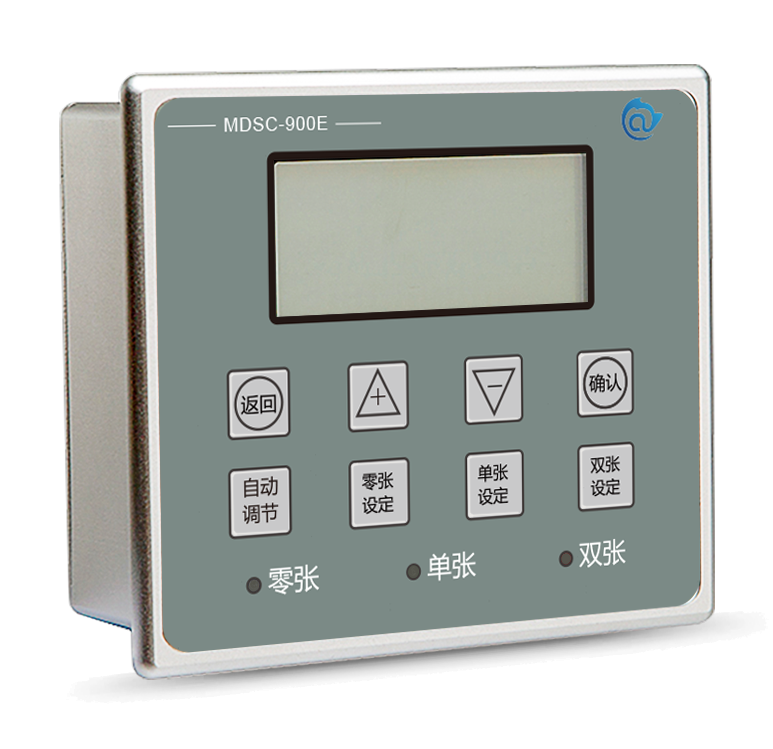
To put it more directly, if there is no continuous aluminum foil layer inside the bag, or if the posture changes too much when passing through the detection position, it is more important to confirm the conveying and bag boundary first, rather than asking the model first. If there is a stable aluminum foil layer inside the bag, thenAtonm MDSC-900EThis type of metal double detector has the opportunity to distinguish between single and double bags in the conveying section.
3、 A more stable approach: four steps to move the bag stacking problem forward for processing
The real solution that can be implemented is not a single device working alone, but rather a combination of "troubleshooting, testing, and linkage". For such scenarios, a more practical processing sequence is usually the following four steps.
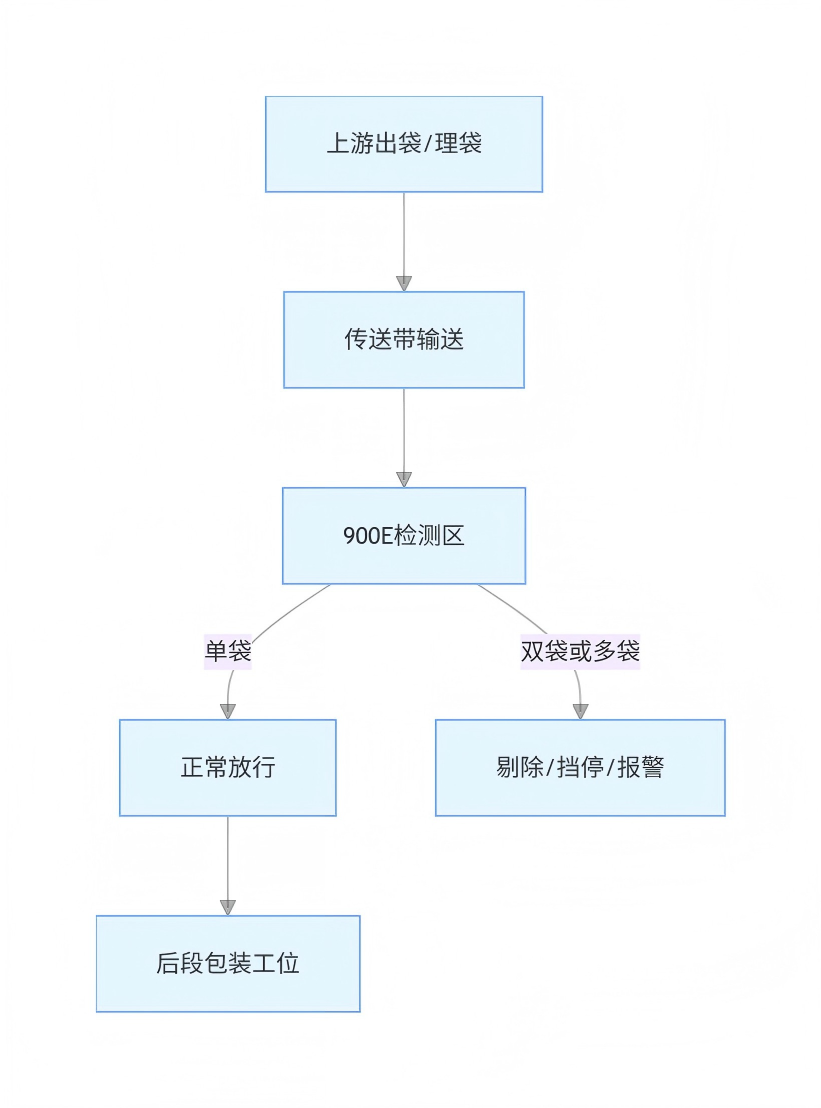
1. First, confirm whether the bag structure has a testing basis
Take a real bag sample and see two things: first, whether the internal aluminum foil layer is continuous; The second is whether there is enough difference in the detection signal when stacking single bags and double bags. Don't skip this step. Because 'just calling it an aluminum foil bag' does not necessarily mean it is suitable for testing, excessive edge seal hollowing, discontinuous aluminum layer, and too many local windows may all affect stability.
2. Place the detection point in a more stable posture position
Most of the failed cases are not due to the detector itself being malfunctioning, but rather due to the detection points being placed in the most disorderly positions of the bag. At the places where the bag has just been taken out, the strap has just fallen off, and the bend has just been made, wrinkles and fluttering are more pronounced. A more reasonable approach is to place the detection points in a straight conveyor area with better guidance and more stable bag posture, so that the judgment is based on a more reproducible state.
3. Use single bag, double bag, and abnormal bag samples together to create thresholds
When debugging, you cannot only take the most standard single bag sample. At least prepare samples of single bag, double bag, offset bag, folded bag, and bag with edge seal facing forward, and run these states once. Because the real problem on site is often not the "smoothest double bag", but a mixture of various irregular states.
4. Priority should be given to eliminating linkage logic, and do not stop the entire line as soon as it arrives
After detecting the stacking of bags, priority should be given to sound and light prompts, removal, diversion, or brief stoppage to allow abnormal bags to exit the normal rhythm first; Continuous anomalies will be upgraded to shutdown prompts. This can not only maintain the production line rhythm, but also facilitate on-site judgment of whether the problem comes from the bag warehouse, bag making, guidance or static electricity.
4、 Which scenarios are more suitable for this approach, and which situations require on-site optimization first
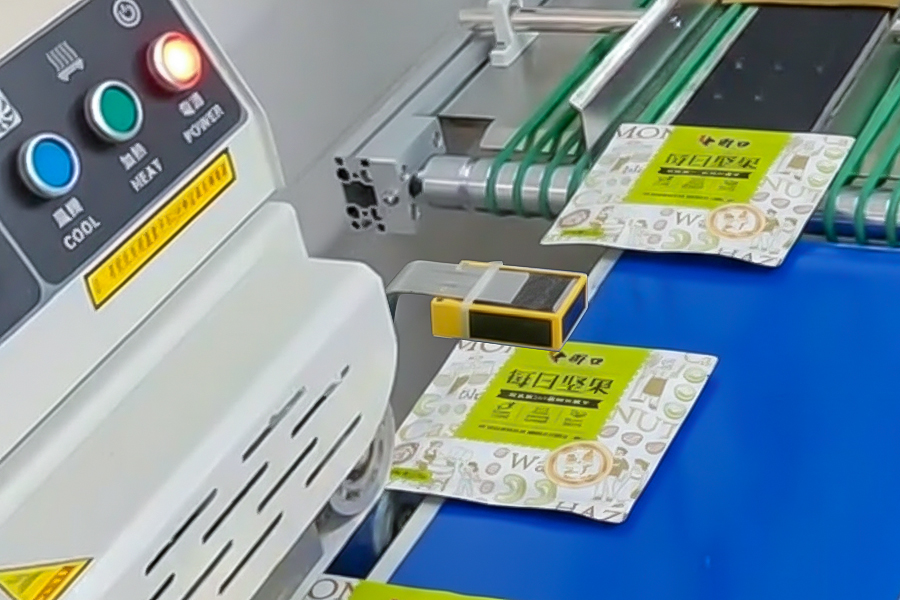
This approach is more suitable for packaging bag scenarios with continuous aluminum foil layers, relatively stable bag shapes, and controllable conveying posture. If the bag itself does not have a continuous metal layer, or if the posture is completely uncontrollable when passing through the detection position, then on-site optimization should be done first before discussing online detection.
| Bag type/working condition | Adaptation judgment | Handling suggestions |
| Standard food packaging bag with continuous aluminum foil layer | suitable | Prioritize conducting bag sample testing before setting the detection position and threshold |
| Printing is complex, but the internal aluminum layer is continuous | suitable | Don't dwell too much on the bag pattern, focus on the metal layer signal |
| Pure plastic bag or non continuous aluminum layer bag type | Not recommended to apply directly | Other detection logic should be used instead of forcefully following the aluminum foil bag approach |
| The bag body is severely wrinkled and there is a significant change in posture in the detection area | Need to optimize the site first | First, do guidance, bag pressing, tension or rhythm adjustment |
| Multi bag mixed running with large size differences | Can be done, but it needs to be divided into different formulas | Teach separately by bag type, do not share a set of thresholds |
Can aluminum foil bags be tested for single and double bags on a conveyor belt?
Answer: If there is a continuous aluminum foil layer inside the packaging bag and the posture is relatively stable when passing through the detection position, there is a high probability that single and double bag recognition can be completed on the conveyor belt. But before the official import, it is still necessary to use real bag samples for single bag, double bag, folded bag, and offset bag testing. First, open the window and then discuss online.
5、 The three easiest things to do wrong on site
1. Focus only on the alarm in the rear section and do not look back at the conveyor in the front section
Many subsequent malfunctions may appear to be issues with opening, filling, and sealing bags, but in reality, the root cause is a stack of bags that have already been placed in the front. The latter part is only the location where the results are first exposed, not necessarily where the problem begins.
2. Only perform improvement actions, without making judgments or closed loops
Removing static electricity, separating bags, and adjusting guidance are all worth doing, but these belong to "reducing the probability of occurrence", not "confirming whether the bags are currently stacked". If there is no online judgment, the site will remain in the stage of experience repair.
3. Only use standard sample bags to adjust parameters
The window obtained from the standard sample bag is often insufficient in real working conditions. What should truly be taught is a set of actual samples with different edge sealing states, postures, and folding degrees, rather than the most neat one in the laboratory.
One sentence summary of handling principles:
First, confirm whether the bag type has a detection basis, then move the detection point to a more stable position, establish a threshold using real abnormal sample bags, and finally link to eliminate or alarm. Once the order is reversed, there are usually many detours to take on site.
6、 Summary: Don't wait until later to discover the problem of stacking bags
What should I do when stacking aluminum foil bags? The core is not as simple as "adding another sensor", but moving the processing position forward. For packaging bags with aluminum foil layers, as long as the bag type has a detection foundation, controllable conveying posture, and completes real bag sample testing, there is a chance to first identify single bags and stacked bags in the conveying section, and then decide whether to release, reject or alarm.
A more effective approach is to let the front section see the problem first, rather than letting the rear section repeatedly take the blame. The packaging bags always come together, and what's really worth doing first is not chasing after faults, but moving the judgment point forward first.
Conduct bag sample testing first, and then determine the renovation plan
If you also have situations on site such as' packaging bags always come together ',' repeated errors in the later stages', or 'manual inspection cannot keep up', you can contact the Atorm technical team for bag sample evaluation.
We can first determine whether it is suitable for single and double bag testing of packaging bags with aluminum foil layers based on your actual bag samples, transportation methods, installation space, and online requirements, and then provide testing location and linkage suggestions.
You May Be Interested
-
Atorm has been awarded ISO three system certification, safeguarding quality and sustainable development with international standards
2026-10-12
-
Atonm MDSC-9000T Dual-Channel, Single-Sensor Metal Double-Sheet Detector
2025-12-05
-
Non-Contact “One-to-Four” Double-Sheet Detector 1600S: A New Cost-Reduction and Efficiency Solution for Stamping Lines
2025-11-20
-
Provincial Auto Industry Research Tour | Atonm Engages with the Automotive Supply Chain, Empowering Smart Manufacturing through Sensors
2025-10-11