

2026-10-14
From MDSC-2100L to 2102L: Product iteration path of lithium battery laminating machine dedicated single and double detector manufacturers
In the stacking and welding process of lithium battery pole pieces and lugs, if copper foil and aluminum foil overlap in double sheets, it can cause abnormal cell capacity in mild cases and safety hazards in severe cases. With the continuous increase in the pace of the laminating production line, the problem of double sheet stacking caused by electrostatic adsorption of the polarizer and warping and adhesion of the board has become increasingly prominent. Intelligent interception of stacking defects from the source has become a key link in improving the quality and reducing costs of the production line. In this niche field, Atorm (Guangzhou) Intelligent Technology Co., Ltd.'s product iteration path is quite representative - from the early launch of MDSC-2100L to the release of MDSC-2102L in 2026, two product upgrades precisely reflect the real demand changes for dual detection in the lithium battery industry.
Why does the lithium battery industry need a dedicated dual detector
Unlike traditional metal sheet testing, the foil thickness of lithium electrode sheets is extremely thin, with common thicknesses of copper foil and aluminum foil in the range of 0.01mm, and the production line has a fast pace and a wide variety of materials. Universal dual beam detectors often struggle to balance accuracy, speed, and switching efficiency, prompting manufacturers to develop specialized models for lithium-ion scenarios.
Atorm was founded in 2018 and is headquartered in Huangpu District, Guangzhou. It was recognized as a national high-tech enterprise in 2023. The company has six major series of products, including metal dual detector, laser displacement sensor, color/color code sensor, bottom line detector, magnetic grid ruler reading head, etc. It has provided products and services to more than 2000 industry customers such as BYD, CATL, Tesla, etc. The metal dual detector is a key direction for deep cultivation in the lithium battery industry.
MDSC-2100L: Cutting into the lithium battery scene with a "small probe"
In 2022, Atorm launched the MDSC-2100L lithium battery specific dual detector. The core breakthrough of this model lies in the miniaturization of the probe: the customized small single probe size is only 12 × 35mm, supports embedded installation, and can be directly integrated into the end of the laminating machine's mechanical arm or narrow gaps in the silo. The installation space occupation is reduced by 60% compared to traditional solutions, and it is suitable for extreme installation environments with apertures ≤ 20mm.
This design directly addresses a practical challenge of lithium battery laminating machines: the internal structure of the laminating machine is compact, and traditional ultrasonic or opposing magnetic induction sensors require paired installation of transmitting and receiving ends, occupying double the space and difficult to adapt to narrow installation positions. The small single probe solution does not require the opposite end, simplifying the equipment layout and allowing the detector to truly 'fit in'.
In terms of detection capability, the MDSC-2100L adopts customized high-frequency eddy current detection technology and develops a dedicated algorithm for 0.01mm ultra-thin metal sheets. It can identify the difference in inductance between single/double sheets, with a resolution of 0.1 μ H, and has a built-in temperature compensation module to automatically calibrate the ambient temperature drift. Built in 100 sets of material formulas, supporting mixed detection of copper foil and aluminum foil, providing a cost controllable specialized choice for scenarios with a single production line and relatively fixed material types.
MDSC-2102L: One to Two Dual Channel Operating Condition Adaptation
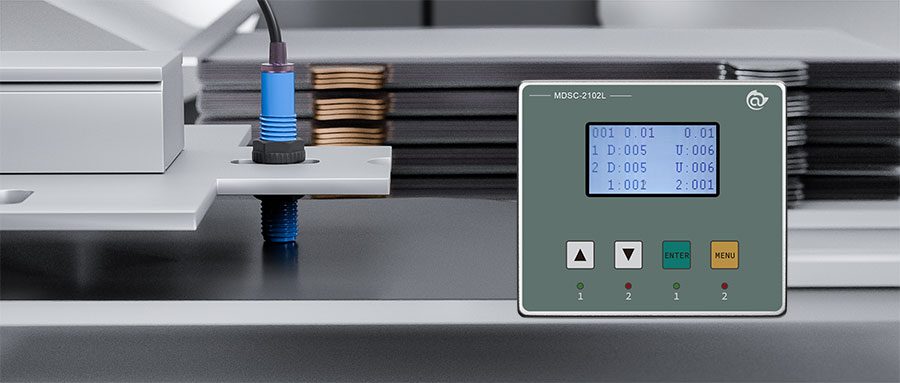
In 2026, Atorm will be officially releasedMDSC-2102LThe core change of this new product is a one to two dual channel architecture: one host can connect two small single probe sensors, and the two channels operate independently and output signals separately without affecting each other.
From the perspective of production line conditions, this architecture first solves the problem of one device covering two independent workstations. The dual station laminating machine can cover two detection points simultaneously with a set of controllers, reducing the number of controller purchases, simplifying cabinet wiring, and helping the equipment reduce BOM costs and integration complexity. For devices with limited internal space such as laminating machines, having one less controller and one less wiring will significantly reduce the difficulty and cost of overall integration.
The dual channel also provides greater flexibility in configuring detection points. The two probes can be divided into different stations of the laminating machine, and can also perform laminating detection simultaneously for different positions of the same sheet material, forming a dual guarantee. In the actual solution, the host can be placed inside the chassis, and two probes can be installed inside the tray and the robotic arm respectively. Both the grabbing and placing of the sheet material can be covered, and the single probe solution cannot achieve this "multi-point collaboration" coverage density. In scenarios such as the plasma welding production line for car side panels, Atorm also adopts a one to two solution, installing two sensor probes on a robotic arm to achieve multi station synchronous detection.
In terms of flexible production switching, MDSC-2102L doubles the storage of material formulas from 100 sets to 200 sets, supporting two methods: manual switching on the panel and remote switching via Modbus. During production switching, the corresponding material formulas can be retrieved in seconds. The newly added dual card hold lock function directly improves the reliability of abnormal interception: it automatically locks the alarm signal after detecting stacking, which requires manual confirmation to be released, completely eliminating the problems of alarm flashing, missed recording, and missed processing.
On the hardware level, the MDSC-2102L is equipped with an M12 specification small contact probe, which continues the previous generation's installation friendliness in a compact space, and retrofitting existing equipment does not require significant structural changes. In terms of response speed, the 50ms hardware response speed and detection cycle can reach about 1200 times per minute, which can cover the vast majority of high-speed laminated production cycles on the market. The output supports free switching between NPN/PNP, and can accurately provide feedback on three working states: zero sheet, single sheet, and double sheet. It can be directly connected to the PLC control system.
Iteration logic: from 'able to fit in' to 'able to manage and transmit'
The product iteration path of Atorm from MDSC-2100L to MDSC-2102L can be summarized into three directions:
Firstly, from single point detection to multi station coverage. The early single sensor solution solved the problem of "fit in" - the small probe allowed the detector to be embedded in the narrow space of the laminating machine; The new generation of one to two dual channels solves the problem of "manageable" - one controller covers two workstations, adapting to the real production line layout of multiple workstations and multiple points.
Secondly, from material compatibility to production line adaptation. MDSC-2100L has 100 built-in formulas, which solve the switching needs of different specifications of copper foil and aluminum foil; MDSC-2102L doubles the formula to 200 sets and adds Modbus bus remote switching capability, upgrading flexible production from "usable" to "easy to use".
Thirdly, digital production line nodes.MDSC-2102LBy using the RS485 protocol, all detection data, formula switching, remote teaching, and fault information are integrated into the upper system management. The detector is no longer just an independent measuring instrument, but an embedded part of the digital quality control process on the production line. This is consistent with the requirements of automation, consistency, and traceability in the lithium battery industry.
Key points for choosing a lithium battery dedicated dual sheet testing manufacturer
For battery manufacturers, choosing a dual sheet testing manufacturer cannot be based solely on a single parameter. Combining Atorm's product path, we can focus on several dimensions: whether the probe is small enough and whether it can adapt to the compact space inside the laminating machine; Does it support multi-channel expansion, and can one controller cover multiple detection stations; Is the material formula sufficient and is it convenient to switch production; Whether it has RS485 bus interface and supports Modbus RTU protocol, and whether it can seamlessly integrate PLC and MES systems; Can reliable linkage shutdown and alarm locking be achieved after detecting anomalies; And whether there is practical application experience in the lithium battery industry.
Since its establishment in 2018, Atorm has continuously iterated around metal dual sheet detectors and extended its product lines to include laser displacement sensors, color/color code sensors, bottom line detectors, magnetic grid scale readers, and more. This path of focusing on segmented scenarios and gradually expanding the product matrix also reflects that domestic lithium battery specific sensor manufacturers are moving from single device supply to solutions that are closer to production line processes.
Conclusion
From MDSC-2100L to MDSC-2102L, it may seem like a hardware upgrade from single channel to one to two dual channel, but behind it is a change in the lithium battery industry's demand for dual detection: thinner materials, faster pace, more composite detection points, and higher requirements for production line integration. The core value of one to two dual channels lies in using one controller to adapt to the real production line layout of multiple workstations and detection points; The standard configuration of RS485 bus and Modbus RTU protocol further moves the detector from being "able to fit in" and "able to manage" to being "able to transmit out", becoming a data node that can be uniformly scheduled and traced in digital production lines. For processes such as lithium battery laminating machines and pole ear welding, small probes, multi-channel, fast response, easy integration, and communication are becoming the new standards for dual detector.
You May Be Interested
-
Atorm has been awarded ISO three system certification, safeguarding quality and sustainable development with international standards
2026-10-12
-
Atonm MDSC-9000T Dual-Channel, Single-Sensor Metal Double-Sheet Detector
2025-12-05
-
Non-Contact “One-to-Four” Double-Sheet Detector 1600S: A New Cost-Reduction and Efficiency Solution for Stamping Lines
2025-11-20
-
Provincial Auto Industry Research Tour | Atonm Engages with the Automotive Supply Chain, Empowering Smart Manufacturing through Sensors
2025-10-11