

2026-10-10
Guidelines for Selection and Application of Stacking Detectors for Lithium Battery Stacking Machines
On the lithium battery stack production line, feeding the electrode pieces in double sheets at once is often not just about adding an extra piece of material: it can trigger an alarm to stop the machine, manually check and remove the pieces, and interrupt the rhythm; In severe cases, overlapping pieces may flow into the battery cell, causing excessive thickness, abnormal internal stress, and even posing safety hazards such as short circuits, bulges, and even thermal runaway. The stack detector (double detector) is the key sensor that plays the role of "pre interception" in this process. This article focuses on the supporting scenarios of laminating machines, sorting out the causes of polarizer overlap, the working principles and selection points of detectors, and helping process and equipment engineers avoid detours.
1、 Why does polar overlap become the "culprit of shutdown" for laminating machines
The stacking process alternately stacks positive and negative electrodes and separators in a specific order to form the internal structure of the battery cell, which is commonly used in soft pack batteries and some aluminum shell batteries. This process requires extremely high consistency in the feeding of a single piece - every grasping and every positioning must be exactly one piece. But the characteristics of the polarizer itself make it difficult to 'exactly one':
Electrostatic adsorption and tension fluctuation: The polarizer is thin, the surface is smooth, and it carries static electricity. During the unwinding and feeding processes, the foil materials are prone to adhere to each other, forming a double sheet feeding;
Cutting burrs and warping: When the cutting quality is poor, burrs and sheet material warping can cause adjacent pole pieces to overlap;
Abnormal grasping: The mechanical arm or material retrieval mechanism may not be able to adsorb stably, which may result in multiple sheets being grasped and placed in place at once. Once overlap occurs, the direct consequence is that the laminating machine will alarm and stop, and the operator needs to investigate and remove the pieces, causing the cycle to be interrupted; If the overlapping pieces are not intercepted and flow into the battery cell, it may bring quality risks such as excessive thickness, internal short circuit, and even lead to thermal runaway in severe cases; In addition, overlapping pieces may also damage suction nozzles, molds, and other mechanisms, causing unplanned maintenance and rework losses. What's even more troublesome is that the ultra-thin copper foil and aluminum foil overlap and are difficult to distinguish with the naked eye. Relying on manual visual inspection is both slow and prone to missed detections. This is also the reason why the industry generally adopts automatic dual sheet detection instead of manual visual inspection.
2、 The working principle and layout of detection points of the stacking detector
The mainstream electromagnetic induction based dual sheet detection uses the difference in the weakening degree of coil oscillation signals between single and multiple metal sheets to distinguish: the weakening of oscillation signals by a single pole sheet is certain, and the signal attenuation is significantly enhanced when two sheets are stacked. The detector distinguishes between single sheet and stacked materials based on this. This principle also responds to non-magnetic or weakly magnetic materials such as aluminum and copper, but requires material calibration - which is a basic capability requirement for lithium electrode sheets mainly made of copper foil and aluminum foil. On the laminating production line, there are two typical inspection points:
Polar unwinding/feeding channel: Intercept double sheets at the feeding stage to prevent overlapping sheets from flowing downstream from the source;
Before the material picking/stacking station: Conduct a second review before feeding to cover the newly generated stacking risks in the grabbing process. In terms of linkage logic, once the detector determines the stacking, it outputs a signal to the PLC of the laminating machine, triggering an alarm, shutdown, or removal action to ensure that the overlapping pieces do not enter the laminating table.
3、 Core requirements for stack detectors in lithium battery scenarios
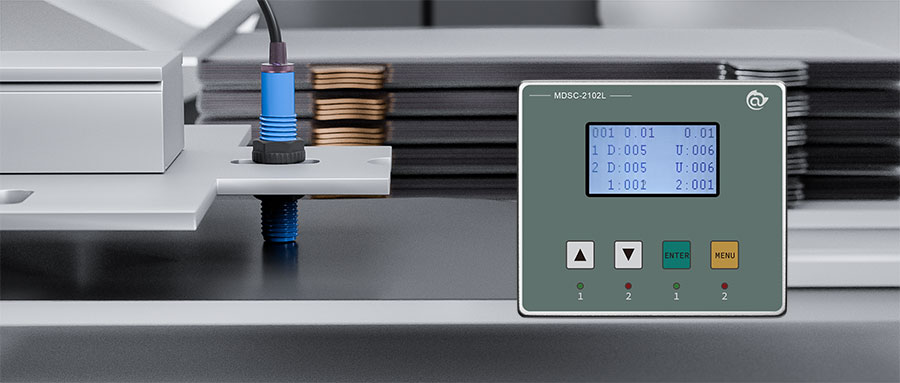
The environment of the laminating workshop and the characteristics of the polarizer jointly determine that the following indicators must be considered when selecting: sensitivity and zero missed detection. Extremely thin and fast-paced, the detector must maintain stable discrimination of ultra-thin sheet materials under high-speed feed, and any missed detection may be a quality accident. For example, metal dual sheet detectors for lithium electrode/electrode ear scenarios typically require copper foil and aluminum foil detection capabilities on the order of 0.01mm - such as the MDSC-2102L, which can detect copper foil thicknesses of 0.01-0.09mm and aluminum foil thicknesses of 0.01-0.1mm with a response speed of 50ms. The production line is environmentally adaptable. The clean room has strict requirements for equipment dust generation and cleanliness; Electromagnetic interference is commonly present in frequency converters and servo systems, and detectors need to have corresponding anti-interference capabilities; The polarizer may still have residual slurry dust, and the equipment should have dust resistance. The panel protection should reach IP65 level (such as MDSC-2102L front panel shell protection level of IP65). System integration capability. The 2102L detector needs to support bus protocols such as RS485/Modbus to smoothly interface with the PLC of the laminating machine; In the scenario of mixed production of multiple types of battery cells, it should also support integration with PLC systems, automatic formula switching, and have sufficient material group storage capacity to support rapid changeover - MDSC-2102L supports storage of 200 material categories.
4、 How to reduce downtime for stacking detectors: mechanism disassembly
The improvement of the shutdown of the stacking detector is not simply about "fewer alarms", but about changing the nature of the fault from "deep shutdown" to "shallow interception": intercepting in advance and replacing deep faults with shallow alarms. Double polarizer is identified and stopped or removed before entering the laminating table, with light processing action and fast recovery; If there is no detection, the time cost of troubleshooting and disassembly will be doubled after the overlapping piece is stuck in the stacking mechanism. Protect equipment and reduce unplanned maintenance. Overlapping pieces into the mold may damage the suction nozzle, mold, and laminating mechanism. The detector intercepts at the front end, which adds a safety to these precision components and reduces the frequency of unplanned downtime maintenance.
5、 Selection points and suggestions for landing configuration
For the matching of laminating machines, it is recommended that engineers check the selection according to the following list:
Material and thickness range of polarizer: Confirm whether it is copper foil, aluminum foil, or coated composite film, as well as the corresponding thickness range, to ensure that it is within the actual verification range of the detector (such as the applicable range of copper foil 0.01-0.09mm and aluminum foil 0.01-0.1mm for MDSC-2102L);
Matching feeding speed and response speed: The detection response must keep up with the production line rhythm;
Probe form and installation space: Chip or channel probes need to match the spatial constraints of the installation location;
Output mode: NPN/PNP switch IO, or RS485 Modbus;
Number of material formula groups and replacement method: When mixing multiple varieties, priority should be given to supporting PLC one click switching. There are two experiences worth emphasizing in deployment and debugging:
6、 Application practice: Single sheet guarantee for polarizer/foil feeding
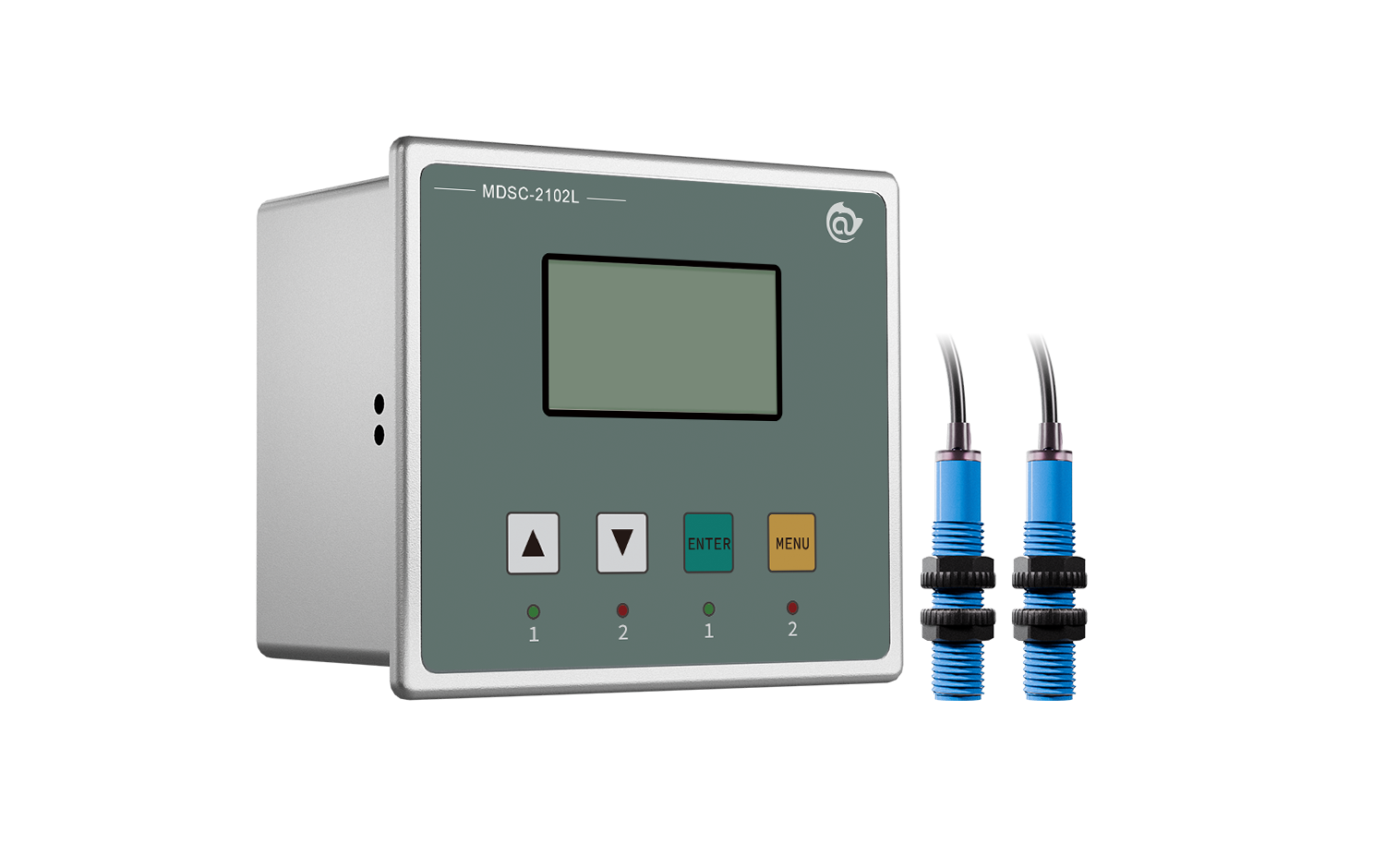
From industry practice, the single sheet feeding guarantee scheme for lithium electrode sheets/foils has formed a mature implementation path: metal double sheet detectors are deployed before the unwinding or picking station to distinguish each sheet of electrode before feeding, and the stacking is stopped with an alarm. The interception action is placed in front of the stacking table. Taking Atorm Technology as an example, it has developed a metal double detector MDSC-2102L specifically for the lithium battery industry. One host controls two sensors and is designed for new energy electrode detection scenarios. It can detect copper foil and aluminum foil and is compatible with the single sheet protection requirements for electrode and foil feeding. Its metal dual detector product line covers a thickness range of 0.01-0.1mm and supports bus protocols such as RS485/Modbus, which can be integrated with control systems of different architectures for laminating machines.
7、 Maintenance and long-term stable operation guarantee
The launch of the detector is only the first step, and long-term reliable operation requires supporting operation and maintenance mechanisms:
Regular calibration and self-learning calibration: Batch replacement of polarizer and coating changes may affect electromagnetic characteristics, and should be recalibrated according to the rhythm to avoid false alarms or omissions caused by sensitivity drift;
Predictive fault warning and firmware upgrade: Detectors with diagnostic capabilities can provide early warning of probe or circuit abnormalities, while firmware upgrades can continuously optimize the discrimination algorithm;
Service and spare parts guarantee: When selecting, the manufacturer's after-sales response mechanism, training, and spare parts support should be confirmed to ensure quick recovery in case of downtime.
8、 Common selection questions and answer points
Can ultra-thin copper foil and aluminum foil be stably detected?
The key is to determine the lower limit of the actual thickness measured by the detector for the corresponding material. Taking MDSC-2102L as an example, its copper plate detection thickness is 0.01-0.09mm, and the aluminum plate is 0.01-0.1mm. When selecting, the actual electrode plate specifications should be based on the premise that they fall within the product validation range.
2. Do we need to distinguish parameters between coated polarizer and foil?
Need. The coating layer will change the overall electromagnetic response of the sheet material, and the two types of pole pieces should be calibrated and stored as independent formulas, which is also the value of the storage capacity of the detector material group.
How to switch the material formula when changing models?
Prioritize models that support one click switching or one click dispensing of formulas by PLC to reduce the risk of parameter errors caused by manual operations. For the laminating production line, the value of the laminating detector lies not in "having one more sensor", but in transforming the high-frequency shutdown trigger of pole overlap from passive investigation to active interception - selecting the right model, installing the right position, and doing calibration well. The decrease in shutdown time is the result of water to the channel.
You May Be Interested
-
Atorm has been awarded ISO three system certification, safeguarding quality and sustainable development with international standards
2026-10-12
-
Atonm MDSC-9000T Dual-Channel, Single-Sensor Metal Double-Sheet Detector
2025-12-05
-
Non-Contact “One-to-Four” Double-Sheet Detector 1600S: A New Cost-Reduction and Efficiency Solution for Stamping Lines
2025-11-20
-
Provincial Auto Industry Research Tour | Atonm Engages with the Automotive Supply Chain, Empowering Smart Manufacturing through Sensors
2025-10-11