

2026-09-29
How to prevent overlapping of pole pieces on the stacking machine: on-site deployment ideas for overlapping detection of lithium battery stacking machine
Introduction
The electrode feeding process is the first line of defense for battery quality control in the production of power battery laminations. The positive and negative electrode pieces, copper foil, and aluminum foil are thin and light in texture. When taking materials from the silo, factors such as electrostatic adsorption, coating adhesion, and unstable separation airflow can easily cause two or even multiple electrode pieces to be simultaneously sucked up by suction cups. Once the overlapping pole pieces flow into the stacking table, it will cause the thickness of the battery cells to exceed the standard, the pole pieces to wrinkle, and in severe cases, it may cause internal short circuits in the battery cells, leading to mass scrapping and safety risks.
The traditional protection method relying on mechanical sorting and manual sampling is difficult to stably intercept overlapping defects in high-speed laminating production lines. Optoelectronic and infrared sensors often miss detection when facing micron level ultra-thin metal foil materials, and cannot meet the signal interaction requirements of lithium battery production. This article focuses on the on-site implementation of material overlap detection on laminating machines, introducing mainstream deployment solutions in the industry and AtormMDSC-2102L metal dual detectorThe application approach.

1、 The causes of overlapping stacking stations and on-site pain points
The standard loading process of the laminating machine is as follows: material storage in the silo → suction cup retrieval → transfer to the alignment table → visual correction → feeding into the laminating table. The root cause of the overlap problem lies in the suction cup feeding process, where the micro adhesion between the polar pieces cannot be completely peeled off by the mechanical sorting mechanism, resulting in both sheets being sucked together. The main pain points of on-site production are as follows:
1. The material is ultra-thin and difficult to detect: the thickness of lithium copper aluminum foil and coated pole pieces is only 0.01~0.1mm, with strong flexibility. Ordinary optical detection is difficult to identify the small gaps between two pole pieces;
2. The high-speed cycle has strict requirements for the detection timing: the mainstream laminating machine has a production capacity of 20-40pcs/min, and the detection action needs to be embedded in the original workstation timing and cannot occupy additional production cycles;
3. Complex electromagnetic interference in the workshop: the servo drive of the laminating machine, dust removal fan, and variable frequency power supply work continuously, and the strong electromagnetic environment can easily cause false alarms and signal drift of ordinary sensors;
4. Frequent changeover of multiple specifications: The same production line needs to switch between different thicknesses and materials of pole pieces, and manual on-site modification of detection thresholds is inefficient and prone to errors.
2、 On site standard deployment plan: visual alignment table fixed synchronous detection
At present, mainstream equipment manufacturers and battery factories in the lithium battery industry generally adopt a visual alignment table fixed synchronous detection scheme.
The probe is fixedly installed under the visual alignment table, and the suction cup places the sucked polarizer on the alignment table. The device performs two tasks in parallel: the visual camera takes photos to complete polarizer positioning and correction, and the MDSC-2102L completes single/double polarizer overlap detection. The two processes share the original timing sequence of the alignment station, without adding additional action time, and are suitable for high-speed laminated mass production.
Advantages of the plan:
1. Stable detection status: The polarizer remains stationary after falling onto the stage, with a fixed detection gap and no signal fluctuations caused by suction cup movement shaking. The detection has high repeatability and accuracy;
2. Mature timing logic: synchronized and linked with visual positioning system, simple integration of equipment PLC program, which is a common and mature structure in the industry;
3. Easy installation and maintenance: The space below the alignment table is spacious, the probe is firmly fixed, and daily cleaning, calibration, and maintenance operations are simple, without interfering with the original mechanical movement of the equipment.
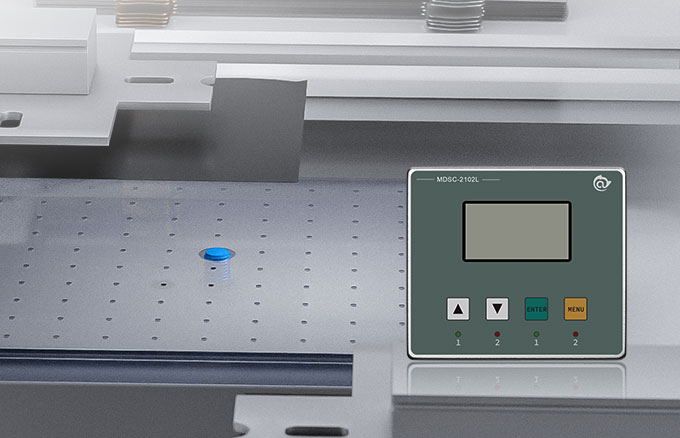
3、 AtomMDSC-2102LProduct advantages for adapting to laminated loading scenarios
Atonm MDSC-2102L metal dual detectorSpecially designed for identifying the number of layers in metal sheets, compatible with the installation conditions of the alignment table for lithium battery laminating machines:
1. Compatible with magnetic/non-magnetic metals, capable of stably detecting copper foil, aluminum foil, positive and negative electrode coating plates, and identifying single, double, and multiple stacked materials;
2. Millisecond level fast response, completing the judgment within a short window of visual photography, meeting the high-speed stacking cycle of up to 40pcs/min;
3. Built in anti-interference circuit, optimized for electromagnetic interference of servo and frequency conversion equipment, reducing the probability of false alarms on site;
4. Support the storage of multiple process formulas, input the detection parameters of different types of polarizer in advance, and directly call the formula for product changeover, reducing on-site manual calibration;
5. Communication configuration: Equipped with RS485 communication and IO switch dual output, it can be directly connected to PLC to achieve signal interaction, formula reading and writing, and detection result uploading;
6. The probe structure is compact, making it easy to install and fix in the narrow space below the visual alignment table.
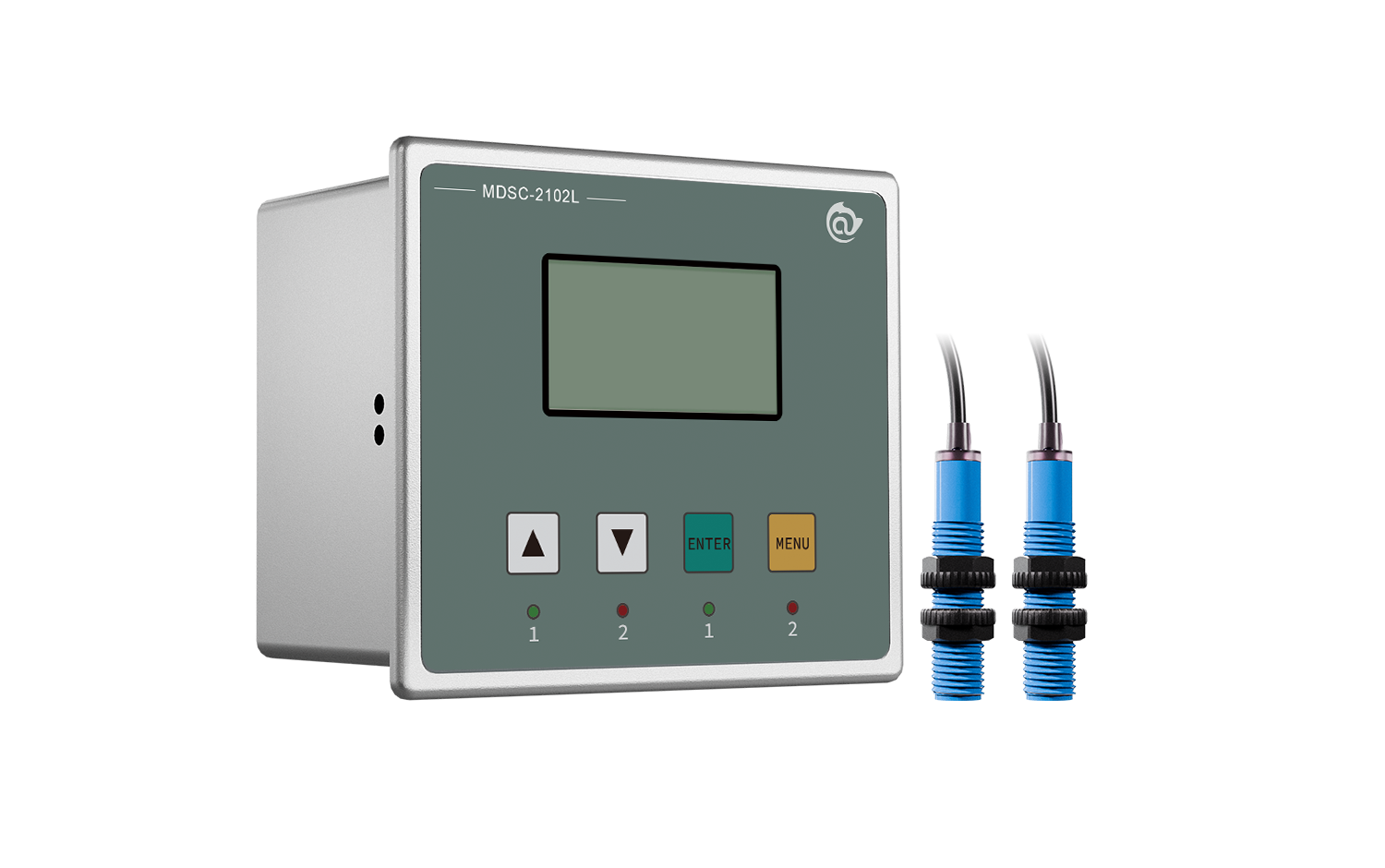
4、 Two landing modes
Mode 1: IO hard signal error prevention (easy application)
The detector is connected to the PLC of the laminating machine through IO switch signals. When double overlapping pole pieces are detected, an NG signal is immediately output, and the PLC locks the process to prohibit the pole pieces from being sent to the stacking table. At the same time, an equipment alarm is triggered to remind the operator to handle and intercept the defective pole pieces at the source of the workstation. The transformation is simple, the investment cost is low, and it is suitable for upgrading existing production lines.
Mode 2: RS485 and PLC linkage (recommended mainstream solution)
MDSC-2102L Stacked DetectorDirectly connect to PLC through RS485 bus.
1. Recipe call: The PLC issues instructions to switch the pre stored product recipe in the detector, and the PLC automatically switches the detection parameters when the production line is changed;
2. Feedback of detection results: After each detection is completed, the layer determination results, equipment status, and alarm information are transmitted back to the PLC;
5、 On site debugging steps
1. On site investigation: confirm the installation space of the alignment table, the gap between pole piece detection, the PLC communication type, and the specifications of the pole piece in production;
2. Hardware installation: Fix the probe under the alignment table, calibrate the detection distance, and avoid mechanical interference;
3. Calibration library: Use single or double standard polarizer for on-site calibration and input multiple sets of product formulas;
4. Single machine testing: Repeatedly test single and double samples, adjust filtering parameters, verify detection and anti false alarm performance;
5. Electrical joint debugging: Connect with PLC, debug alarm and shutdown logic, complete RS485 communication reading and writing, formula switching, and detection result collection;
6. Small batch trial production verification: continuous mass production trial operation, statistical detection rate, false alarm rate, parameter solidification.
VI. Summary
The core of the prevention and control of overlapping on the polarizer is to stably identify and timely intercept defective stacking before the polarizer enters the stacking forming station. The fixed synchronous detection of visual alignment table is a mature and reliable on-site deployment solution for lithium battery laminating machines.
AtonmMDSC-2102L metal dual detectorAdapting to the detection requirements of ultra-thin metal pole pieces, supporting IO switch quantity and RS485 communication access to PLC, it can achieve automatic formula switching and overlapping defect interception. If MES traceability is required, PLC can be used as a relay to upload data. The product is suitable for the renovation of existing production lines and the construction of new production lines, reducing the risk of overlapping polarizer inflow from the source, minimizing battery cell scrap, and improving the yield rate of laminating processes.
You May Be Interested
-
Atorm has been awarded ISO three system certification, safeguarding quality and sustainable development with international standards
2026-10-12
-
Atonm MDSC-9000T Dual-Channel, Single-Sensor Metal Double-Sheet Detector
2025-12-05
-
Non-Contact “One-to-Four” Double-Sheet Detector 1600S: A New Cost-Reduction and Efficiency Solution for Stamping Lines
2025-11-20
-
Provincial Auto Industry Research Tour | Atonm Engages with the Automotive Supply Chain, Empowering Smart Manufacturing through Sensors
2025-10-11