



2026-09-15
The digital transformation of Jiangxi's lithium battery industry is accelerating, and there are opportunities for upgrading production line testing behind the billion dollar cluster
Key Points
The revenue of Yichun's lithium battery industry will exceed 109.6 billion yuan in 2025, officially entering the trillion yuan industrial cluster and driving continuous investment in digitalization of the lithium battery belt in western Jiangxi.
53 lithium battery companies in Xinyu have completed digital transformation, and the coverage of intelligent production lines has rapidly increased. Testing equipment has become a standard for the transformation.
Leading companies such as Ganfeng Lithium Battery are tackling solid-state battery technology, and the new generation of production lines are demanding higher precision and speed in electrode detection.
The application of magnetic induction dual sheet detection technology in lithium electrode ear and electrode sheet production lines is becoming increasingly mature. The detection accuracy of ultra-thin materials reaches 0.1mm level, and the detection speed is 1200 pcs/min, approaching full standard reliability.
The digital transformation dividend of Jiangxi's lithium battery industry cluster is being transmitted from top enterprises to downstream supporting enterprises, and the market space for testing equipment continues to expand.
By 2025, the revenue of Yichun's lithium battery industry will exceed 109.6 billion yuan, officially entering the ranks of a hundred billion level industrial cluster. From Yichun, known as the "Asian Lithium Capital," to Xinyu, known as the "New Energy City," the Jiangxi lithium battery industry belt is undergoing a profound digital transformation. Behind the completion of digital transformation by 53 Xinyu lithium battery enterprises is the urgent demand for intelligent production lines and precise testing in the entire industry chain - and this is precisely the strategic opportunity period for testing equipment enterprises.
The Digital Background of Jiangxi Lithium Battery Industry Cluster
Jiangxi is one of the core clusters of the national lithium battery industry, relying on abundant lithium mineral resources and a complete industrial chain supporting facilities. It has formed a full industrial chain layout from lithium salts, positive and negative electrode materials to power batteries and energy storage batteries. Among them, Yichun, with its resource endowment as the "Asian Lithium Capital", continues to expand the scale of the lithium battery industry, with revenue exceeding 109.6 billion yuan by 2025, officially entering the trillion yuan industry camp; Xinyu focuses on the manufacturing of power and energy storage batteries, gathering a large number of lithium battery midstream and downstream enterprises.
109.6 billion revenue from Yichun lithium battery industry in 2025
53 Xinyu lithium battery companies have completed digital transformation
Scale level of Jiangxi lithium battery industry cluster with a scale of billions
Digital transformation is not simply a "machine for human" upgrade, but a comprehensive upgrade from production management, quality control to supply chain collaboration. According to public information from the Department of Industry and Information Technology of Jiangxi Province, the penetration rate of digital research and development design tools in the lithium battery industry in the province has exceeded 75%, the CNC rate of key processes has increased to over 68%, and the intelligent investment growth rate in the production line testing process ranks among the top in various processes.
The digital transformation cases of 53 lithium battery enterprises in Xinyu are quite representative. These enterprises cover multiple links such as battery cell manufacturing, electrode processing, and PACK assembly, with a focus on online testing, data acquisition, and MES system integration. Among them, visual and sensing detection equipment such as dual sheet inspection, weld seam inspection, and online thickness monitoring have become the first intelligent equipment categories to be implemented in the upgrading of production lines.
The lithium battery industry in Jiangxi is shifting from scale expansion to quality improvement, and digital transformation is a necessary path. As the first line of defense for production line quality, the intelligence level of testing equipment directly determines product yield and production efficiency
——White Paper on the Development of Lithium Battery Intelligent Manufacturing by China Electronics Standardization Institute
The core link of digital transformation - intelligent production line detection
In the production process of lithium batteries, electrode manufacturing is a key process that determines battery performance and safety. From coating, rolling to slitting, laminating/winding, every process cannot be separated from precise detection and control. Especially for dual pole detection - once two pole pieces overlap and enter the next process, it can cause equipment jamming and shutdown, and in severe cases, it can lead to internal short circuits in the battery cells, posing a risk of thermal runaway.
The traditional testing method for lithium battery production lines mainly relies on manual sampling and simple mechanical testing, which has three major pain points: firstly, the testing speed cannot keep up with the pace of the production line. High speed slitting machines can produce thousands of pole pieces per minute, which cannot be covered by manual testing; Secondly, the detection accuracy is greatly affected by human factors, and the missed detection rate fluctuates significantly; Thirdly, the detection data cannot be precipitated, making it difficult to support quality traceability and process optimization.
Under the background of digital transformation, production line inspection is shifting from "post inspection" to "online full inspection", and upgrading from "manual judgment" to "intelligent decision-making". Magnetic induction ultra-thin material detection equipment, represented by the Atorm MDSC-2100L dual detector, is becoming a standard selection for lithium electrode ear/laminate production lines due to its mounting design, ultra-thin detection accuracy, and high reliability.
From the perspective of industrial implementation, multiple lithium battery companies in Xinyu have installed dual detectors on key equipment such as slitting machines, die-cutting machines, and laminating machines. After the transformation, the equipment failure rate caused by electrode stacking has significantly decreased, and the overall equipment efficiency (OEE) of the production line has been significantly improved. During the expansion of Yichun's billion yuan industrial cluster, almost all newly built production lines are equipped with online detection equipment, and this trend is spreading throughout the entire industrial chain.
Magnetic induction dual sheet detection: selection of ultra-thin materials for lithium electrode ear/laminated production line
In the lithium battery industry, the dual detection of electrode ears and thin electrode plates is recognized as a technical difficulty - with extremely thin thickness, soft material, easy deformation, limited installation space for conventional beam detection probes, and difficulty in ensuring detection accuracy. The current mainstream technology routes include ultrasonic testing, photoelectric testing, and magnetic induction testing. Among them, magnetic induction detection has become the most widely used dual sheet detection solution in the lithium battery industry due to its high sensitivity to metal materials, immunity to dust and light environments, and adaptability to high-speed production lines.
Taking the Atorm MDSC-2100L dual detector as an example, this is a mount detection solution designed specifically for ultra-thin materials in the lithium battery industry. It adopts a single probe mounting design, and the sensor is installed closely to the side of the metal sheet material, without the need to be arranged on the upper and lower sides, especially suitable for workstations with limited internal space in laminating machines and die-cutting machines. The detection principle is magnetic induction, which accurately distinguishes between single and double sheet states through high sensitivity inductance resolution. The detection range covers ultra-thin materials of 0.1-0.5mm, fully matching the thickness specifications of lithium electrode ears and thin electrode sheets.
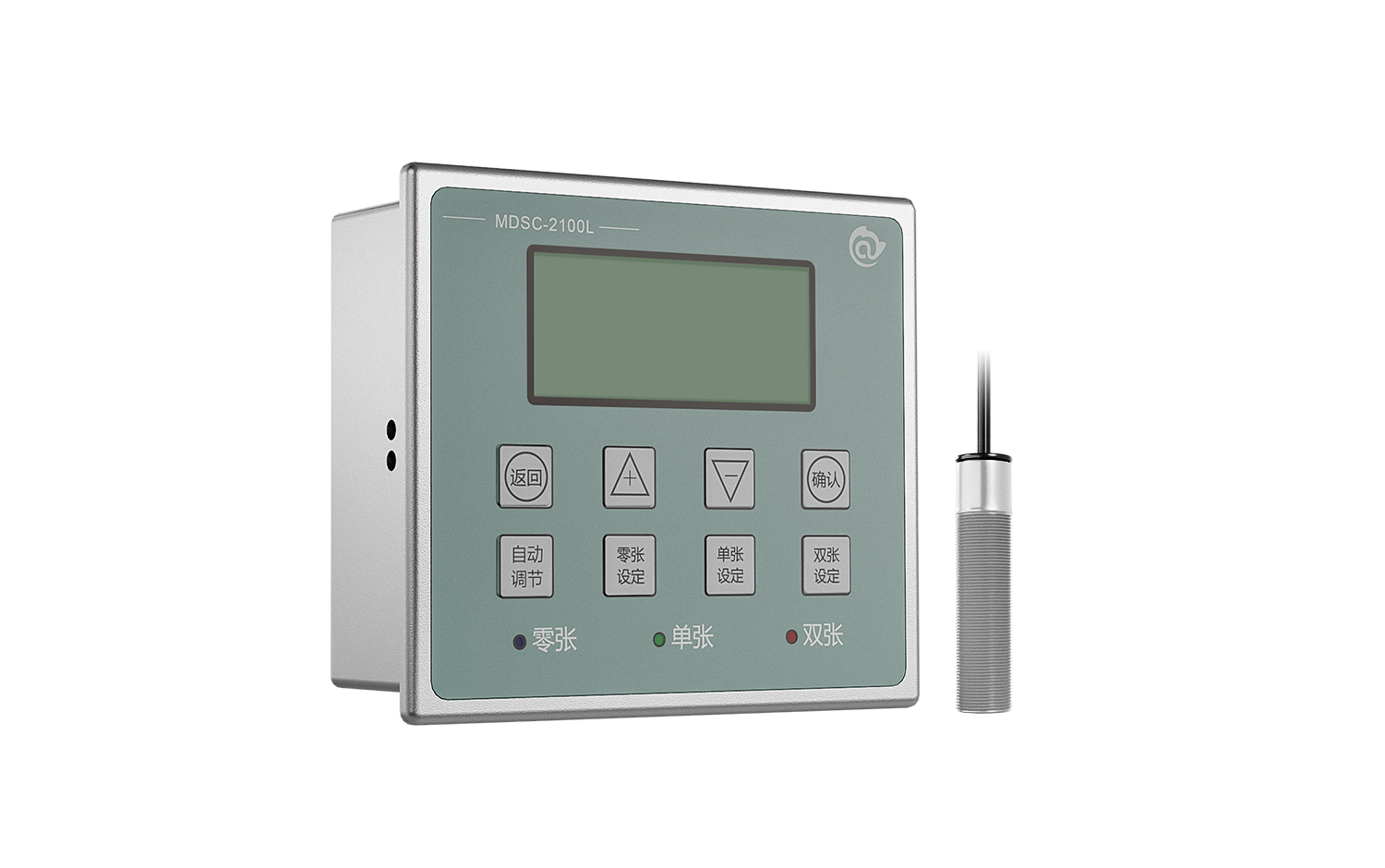
Adhesive ultra-thin material dual sheet detection scheme
Specialized for ultra-thin materials of lithium batteries, with a single probe design for mounting, suitable for pole ear/stack detection scenarios
Magnetic induction testing principle, non-contact non-destructive testing
SMT single probe design, preferred for workstations with limited space
Detecting thickness of 0.01-0.5mm, precise identification of ultra-thin materials
1200 pcs/min response speed, matched with high-speed laminating production line
100 sets of formula storage, one click switching between multiple specifications of products
Supports communication and can interface with PLC and MES systems
In the practical application of lithium battery production lines, detection accuracy and installation flexibility are the core pain points. The internal space of the laminating machine is compact, and conventional aiming probes are often difficult to arrange. The placement type single probe design of Atorm MDSC-2100L perfectly solves this problem - the sensor can be attached to the side of the material channel to complete the detection, without occupying the space of the upper and lower layers, and the transformation cycle is extremely short. The detection response speed can reach 1200 pcs/min, fully covering the beat requirements of high-speed laminating production lines, and the detection accuracy is approaching full standard, effectively avoiding downstream process failures caused by pole ear double opening.
In addition, digital transformation requires testing equipment to have data interaction capabilities. MDSC-2100L supports communication interfaces and can be connected to PLC control systems and MES systems to achieve real-time uploading, storage, and analysis of detection data, providing data support for production line quality traceability and process optimization. The device is equipped with 100 sets of formula storage, and the parameters of different thicknesses and specifications of polar ear products can be switched with one click, adapting to the production characteristics of multi specification and small batch in the lithium battery industry.
From single point equipment to whole line intelligence: digital advancement of detection equipment
The digital transformation of lithium battery production lines is not an upgrade of individual equipment, but an evolution from single point detection to intelligent detection systems for the entire line. The difference between traditional detection and intelligent detection lies in three dimensions: detection coverage, data utilization, and decision-making autonomy.
Comparison dimension: Traditional detection mode, intelligent detection mode (after digital transformation)
Testing method: manual sampling+mechanical testing, online full inspection+magnetic induction intelligent testing
The detection speed is about 200-300 pcs/min, and the manual efficiency can reach 1200 pcs/min, matching the high-speed production line
Data utilization: scattered data, no systematic sedimentation, full data upload to MES, supporting quality traceability and SPC analysis
The misjudgment/missed detection rate is affected by personnel status and fluctuates greatly. The algorithm adapts to calibration and approaches full standard stability
Equipment linkage single machine operation, signal incompatibility Modbus 485 connected to the production line PLC, triggering automatic rejection
Manual adjustment of parameters for changeover efficiency, taking about 15-30 minutes to store 100 sets of formulas, one click switching, completed in seconds
From the renovation practices of 53 lithium battery companies in Xinyu, it can be seen that the input-output ratio of intelligent detection equipment is very considerable. The data of the slitting process renovation of a leading battery cell enterprise shows that after installing a magnetic induction dual sheet detector, the equipment downtime caused by the dual sheet problem decreased by more than 85%, the scrap rate of pole pieces decreased by about 40%, and the annual cost savings of a single production line exceeded one million yuan.
It is worth noting that industry leaders such as Ganfeng Lithium are accelerating the layout of solid-state battery technology. The thinner electrode plates and higher process precision requirements of solid-state batteries pose new challenges to the sensitivity and stability of detection equipment. This means that with the industrialization of next-generation battery technology, the demand for upgrading and iterating detection equipment will continue to be released, and suppliers with high-precision detection and digital interface capabilities will gain a larger market share.
The mass production of solid-state batteries is imminent, and extremely thin electrode sheets and new materials pose higher requirements for detection technology. A detection solution that can simultaneously meet high-speed, high-precision, and data interconnection requirements will take the lead in the new round of production line upgrades
——Report on the Development Trend of Lithium Battery Testing Technology in 2025 by China Battery Industry Association
Trend Summary
The digital transformation wave of Jiangxi's lithium battery industry is a microcosm of the intelligent upgrading of the national lithium battery industry. From the billion yuan industrial scale of 109.6 billion yuan in Yichun, to the transformation practices of 53 enterprises in Xinyu, and to the breakthroughs in solid-state battery technology by leading companies such as Ganfeng Lithium Battery, every signal points to the same conclusion: intelligent production line testing is a necessary path for the high-quality development of the lithium battery industry, and the market space for testing equipment is accelerating.
For testing equipment enterprises, to seize the digital dividend of Jiangxi's lithium battery industry cluster, they need to continue to make efforts in three directions: first, to improve testing speed and accuracy, match the needs of high-speed production lines and new generation battery technology; Secondly, strengthen data interaction capabilities and deeply integrate into intelligent manufacturing systems; The third is to provide scenario based solutions, extending from single point devices to whole line detection services.
In the field of magnetic induction dual sheet detection, the patch type ultra-thin material detection solution has been validated in multiple ultra-thin material scenarios such as lithium electrode ears and laminations, thanks to its single probe mounting design, 0.01-0.5mm level detection accuracy, 1200 pcs/min high-speed response, and digital communication interface. It is a noteworthy selection direction in the digital transformation of lithium battery production lines.
Learn more about magnetic induction dual sheet detection solutions
Atorm Sensor · Lithium Battery Production Line Testing Professional Supplier
thirteen billion three hundred and forty-two million eight hundred and fourteen thousand two hundred and ninety-one
Service Hotline · Technical Consultation · Free Samples
You May Be Interested
-
Atonm MDSC-9000T Dual-Channel, Single-Sensor Metal Double-Sheet Detector
2025-12-05
-
Non-Contact “One-to-Four” Double-Sheet Detector 1600S: A New Cost-Reduction and Efficiency Solution for Stamping Lines
2025-11-20
-
Mold damage, production delays? Atonm MDSC-8200T metal double-sheet detector protects automotive stamping lines
2025-10-30
-
Provincial Auto Industry Research Tour | Atonm Engages with the Automotive Supply Chain, Empowering Smart Manufacturing through Sensors
2025-10-11