



2026-04-22
How to detect overlapping food packaging bags? Clear explanation of applicable bag types and on-site boundaries in one go
Guide
Faced with the situation of "single bag seemingly fine, but always reporting errors in the later stage" on the packaging line, engineers often ask: Should I choose photoelectric, visual, or metal detection? This article clearly explains the applicable bag types, typical on-site boundaries, and debugging points for each method, facilitating a quick assessment of the feasibility of implementation.
1、 First, divide into scenarios: common types of overlapping (bagging)
Completely stacked: Two bags are tightly attached, with a thickness approximately twice that of the bag, and there are no obvious gaps on the bag surface.
Half overlapping: The bags are partially stacked together, with limited variation in local thickness.
Misalignment and overlap: The bag body may be misaligned, wrinkled, or the bag opening may be flipped up, which may be more obvious visually but the thickness difference is irregular.
Slight stacking: The films are adhered to each other, with low optical contrast and weak weighing differences.
2、 Comparison of various testing schemes (advantages, disadvantages, and applicable bag types)
1. Photoelectric sensor (reflection/reflection)
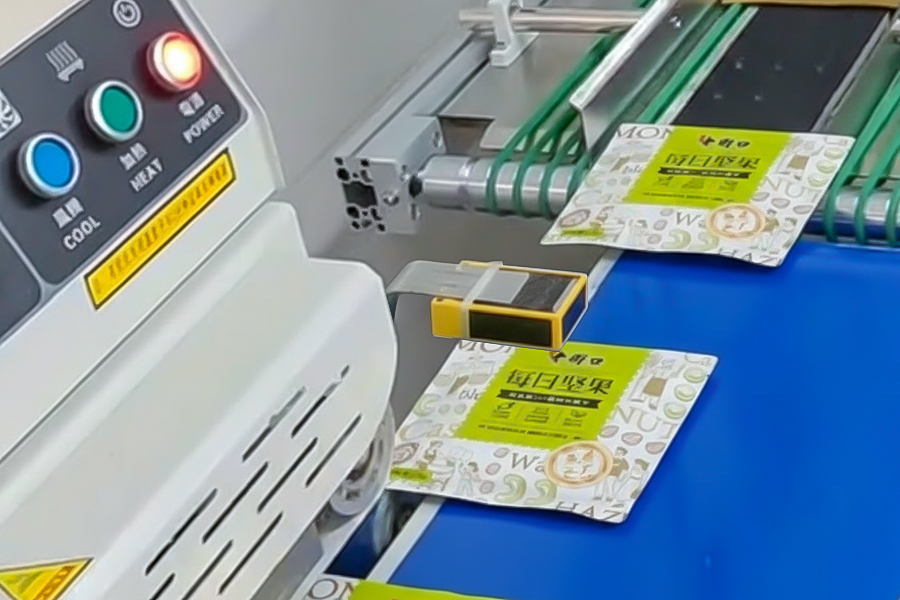
Advantages: Low price, fast response, easy access to PLC. Disadvantages: Dependent on surface reflection/occlusion, unstable to aluminum foil or high reflective surfaces, greatly affected by angles and wrinkles.
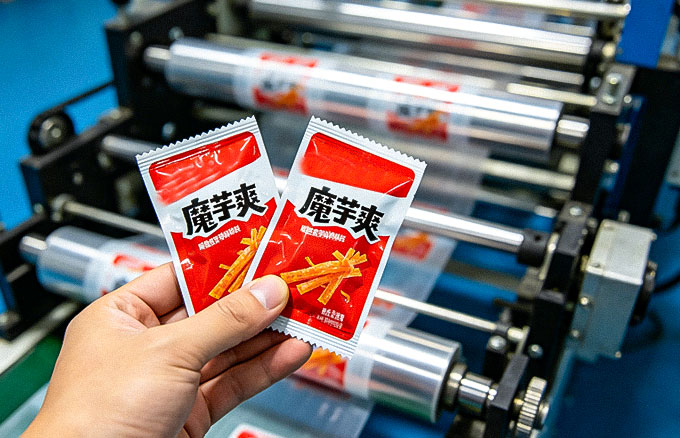
Applicable: paper bags, matte plastic bags, bag types with obvious surface textures; Not applicable: continuous aluminum foil layer, mirror plastic, severely wrinkled soft film.
2. Machine vision (camera+algorithm)
Advantages: Able to recognize the relationship between form, color, and position, suitable for determining misalignment, overlap, and semi overlap; Support recording and evidence collection. Disadvantages: Poor robustness to aluminum foil bags that are transparent, reflective, or have no significant appearance differences, greatly affected by lighting and angles, high computing power and development costs.
Applicable: Bags with obvious appearance differences, printed patterns, or structural features; Not applicable: High reflective aluminum foil layer, transparent film, near featureless scenes.
3. Weighing/Loading Method (Weighing Platform or Speed Comparison)
Advantage: Directly utilizing quality differences, suitable for situations with large quality differences. Disadvantages: Need for deceleration zone, land occupation, high cost, low sensitivity to differences in lightweight bags.
Applicable: Packaging with significant differences in bag weight (containing liquids or large amounts of solids); Not applicable: Extremely thin and light bags, small weight difference scenarios.
4. Double sheet metal detection (for aluminum foil layers)
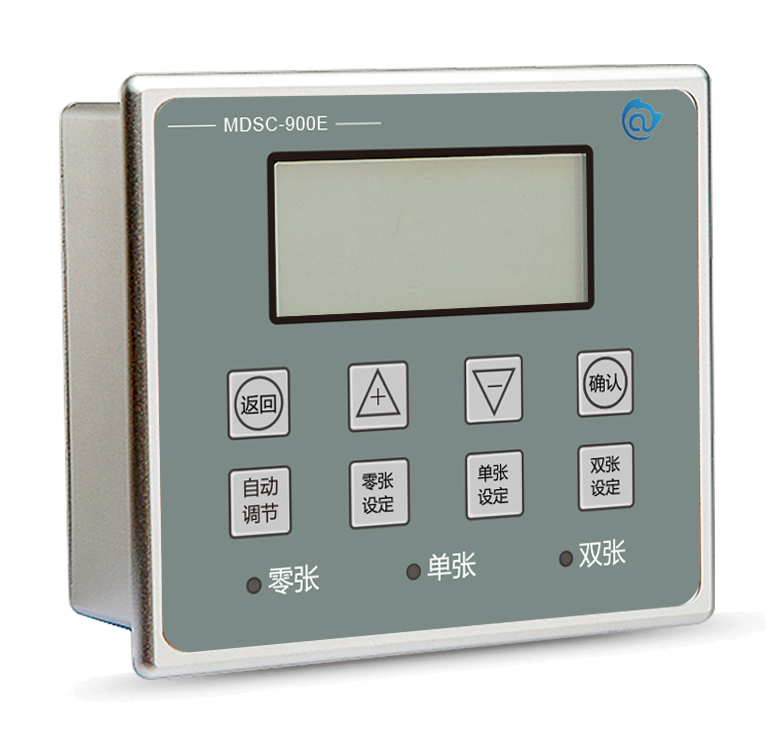
Advantages: Stable for bags containing metal layers, detection principle related to metal content, not affected by surface reflection and color; Can form robust amplitude differentiation between single/double bags. Disadvantage: Only applicable to bags containing continuous metal layers or perceptible metal quantities.
Applicable: Bag type with continuous aluminum foil layer or metalized film; Not applicable: Paper bags without any metal layer, pure transparent film.
3、 How to determine the 'on-site boundary' - a one sentence decision tree
Is there a continuous metal layer inside the bag? If available, prioritize conducting metal detector testing.
2. Is the surface of the bag made of high reflective aluminum foil or mirror finish? If so, the priority of optoelectronics and vision will decrease.
3. Is it acceptable to slow down/increase the weighing area? If possible, the weighing method can be used as an alternative.
4. Are there sufficient lighting and stable installation surfaces on site for visual solutions? If not, use visual inspection with caution.
4、 Debugging and Implementation Points (5 Things Engineers Must Do)
1. Collect representative bag samples (at least 5 working conditions: single bag, double bag, semi overlapping, misaligned, containing stains/wrinkles), and save sample photos and test data.
2. Conduct comparative tests on site based on the actual conveying speed: Some sensors perform well at slow speeds, but distort at high speeds.
If a metal detector is selected, first measure the amplitude difference between a single bag and a double bag on the detector output to confirm that there is a stable and separable threshold.
4. For optoelectronic/visual solutions, establish lighting and occlusion tests, record false positive/false negative rates, and evaluate whether external light sources or enclosures are needed.
5. Design linkage strategy: Alarm, deceleration, and elimination actions are defined according to risk priority to avoid one action being too heavy and affecting production capacity.
5、 Quick Implementation Example (Engineering Practice)
In a food packaging line renovation, the customer frequently misjudged using reflective photoelectric technology. After on-site evaluation, it was found that there was a continuous metallization layer inside the bag. The engineering team selectedMetal double detectorAnd the detection position was moved forward by 0.6m, combined with the deceleration zone and elimination mechanism. After trial operation, the false alarm rate decreased from more than ten times a day to 0 times.
VI. Conclusion
There is no universal solution: the selection of detection methods should be based on bag structure, production line speed, on-site space, and acceptable false alarm costs. For packaging bags containing aluminum foil layers, priority should be given to conducting metal detection and comparative testing; For bag shapes with significant differences in appearance, visual and optoelectronic methods can be combined to improve accuracy.
Do you need us to conduct bag sample testing on-site or provide a testing machine? Please contact Atorm engineers, we can provide prototype testing and free preliminary evaluation. Contact information: 13342814291
You May Be Interested
-
Atonm MDSC-9000T Dual-Channel, Single-Sensor Metal Double-Sheet Detector
2025-12-05
-
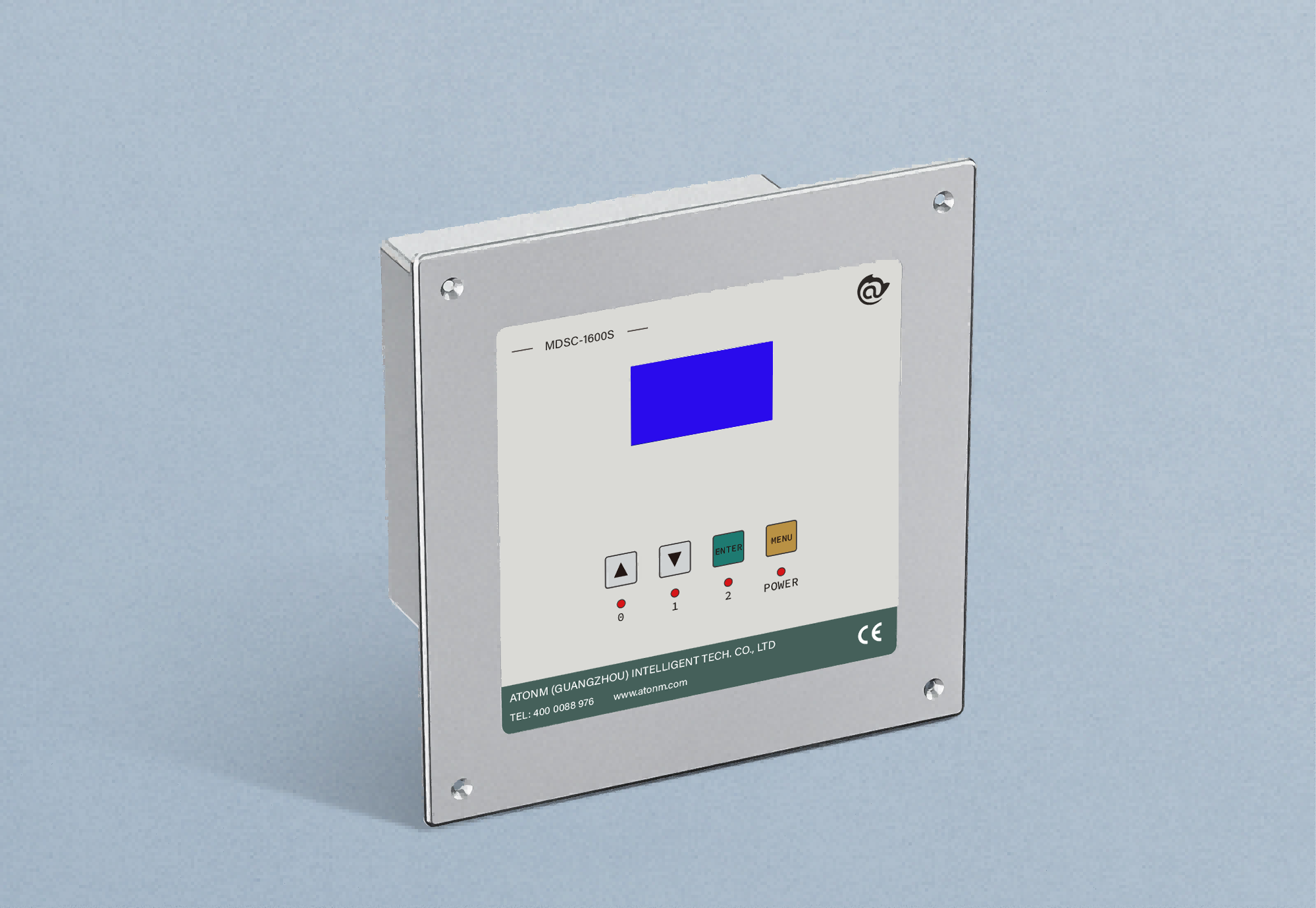
Non-Contact “One-to-Four” Double-Sheet Detector 1600S: A New Cost-Reduction and Efficiency Solution for Stamping Lines
2025-11-20
-
Mold damage, production delays? Atonm MDSC-8200T metal double-sheet detector protects automotive stamping lines
2025-10-30
-
Provincial Auto Industry Research Tour | Atonm Engages with the Automotive Supply Chain, Empowering Smart Manufacturing through Sensors
2025-10-11