



2023-06-11
How Do Capacitors Store Charge?
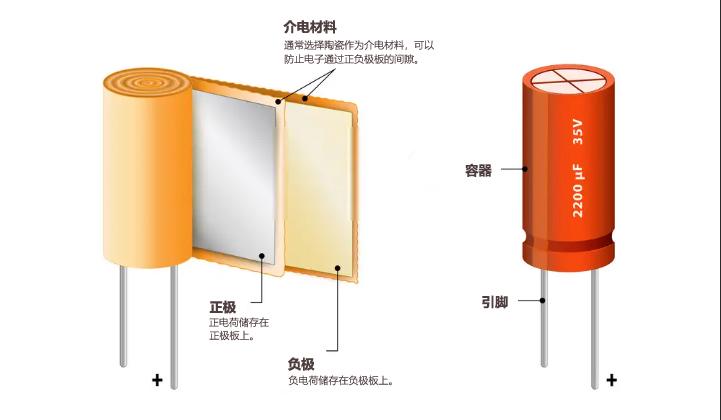
A device that stores charge is called a capacitor. The simplest capacitor has two flat conductive plates separated by a gap. The charge stored is proportional to the voltage across the plates. Capacitance is the quantity describing charge storage ability, equal to the charge stored per unit voltage. Its unit is the farad (F), named after Michael Faraday: a device with 1 F stores 1 coulomb of charge at 1 volt. One coulomb equals the charge moved by 1 ampere in one second.
To increase efficiency, plates can be stacked or wound, and the gap is made very small and filled with an insulating dielectric. This increases stored charge while preventing short circuits. Capacitors appear in circuits that use oscillating currents, such as radios. Capacitors can charge and discharge almost instantaneously, enabling them to generate or filter specific signal frequencies. They pass high-frequency signals and block lower-frequency ones; capacitance determines cutoff frequency. Multiple capacitors can form filter networks to isolate or remove certain frequencies.
Supercapacitors use nanotechnology and materials like graphene to achieve capacitance 10–100× that of conventional capacitors of the same size but have slower response times and are unsuitable for very high-frequency charge/discharge.
You May Be Interested
-
Atonm MDSC-9000T Dual-Channel, Single-Sensor Metal Double-Sheet Detector
2025-12-05
-
Non-Contact “One-to-Four” Double-Sheet Detector 1600S: A New Cost-Reduction and Efficiency Solution for Stamping Lines
2025-11-20
-
Mold damage, production delays? Atonm MDSC-8200T metal double-sheet detector protects automotive stamping lines
2025-10-30
-
Provincial Auto Industry Research Tour | Atonm Engages with the Automotive Supply Chain, Empowering Smart Manufacturing through Sensors
2025-10-11