

Project Services
Solution Design
Application Validation Support
Parameter Optimization Guidance
Commissioning Support
By clicking on the button “I accept” or by further usage of this website you express consent with usage of cookies as well as you grant us the permission to collect and process personal data about your activity on this website. Such information are used to determine personalised content and display of the relevant advertisement on social networks and other websites. More information about personal data processing can be found on this link Cookie Policy.
Agree


Single Sensor
Double Sensor
Image Sensor
2026-08-26
A Foshan manufacturer specializing in industrial sewing equipment has previously installed several types of bottom line breakage detectors for supporting customers, with frequent false alarms, poor stability, and continuous after-sales service. After learning about AtonMLS2 online, I first bought 2 units for testing, and the results were satisfactory. Later, we will provide bulk matching.
This factory in Foshan has been producing industrial sewing equipment for over a decade, with main products including computerized pattern machines and synchronous sewing machines. Our customers cover industries such as clothing, leather goods, and luggage. When the equipment leaves the factory, some customers may require installationShuttle core bottom line detection device——Automatic shutdown when the bottom line is broken to prevent material leakage from gaps.
This requirement itself is not complicated, but it gives them a headache to execute.
We have used several bottom line detectors before, ranging in price from tens to hundreds of yuan, but none of them have satisfied us, "said the factory manager.
The pit I stepped on before
When the problem was most serious, I received more than ten after-sales calls a month, all aboutBottom line breakage detectorFalse or missed detections. The factory not only incurs the costs of labor, travel, and parts replacement, but also loses the trust of customers.
We don't need a detector, we can't find one that can be installed and stabilized. "This is their most genuine feeling.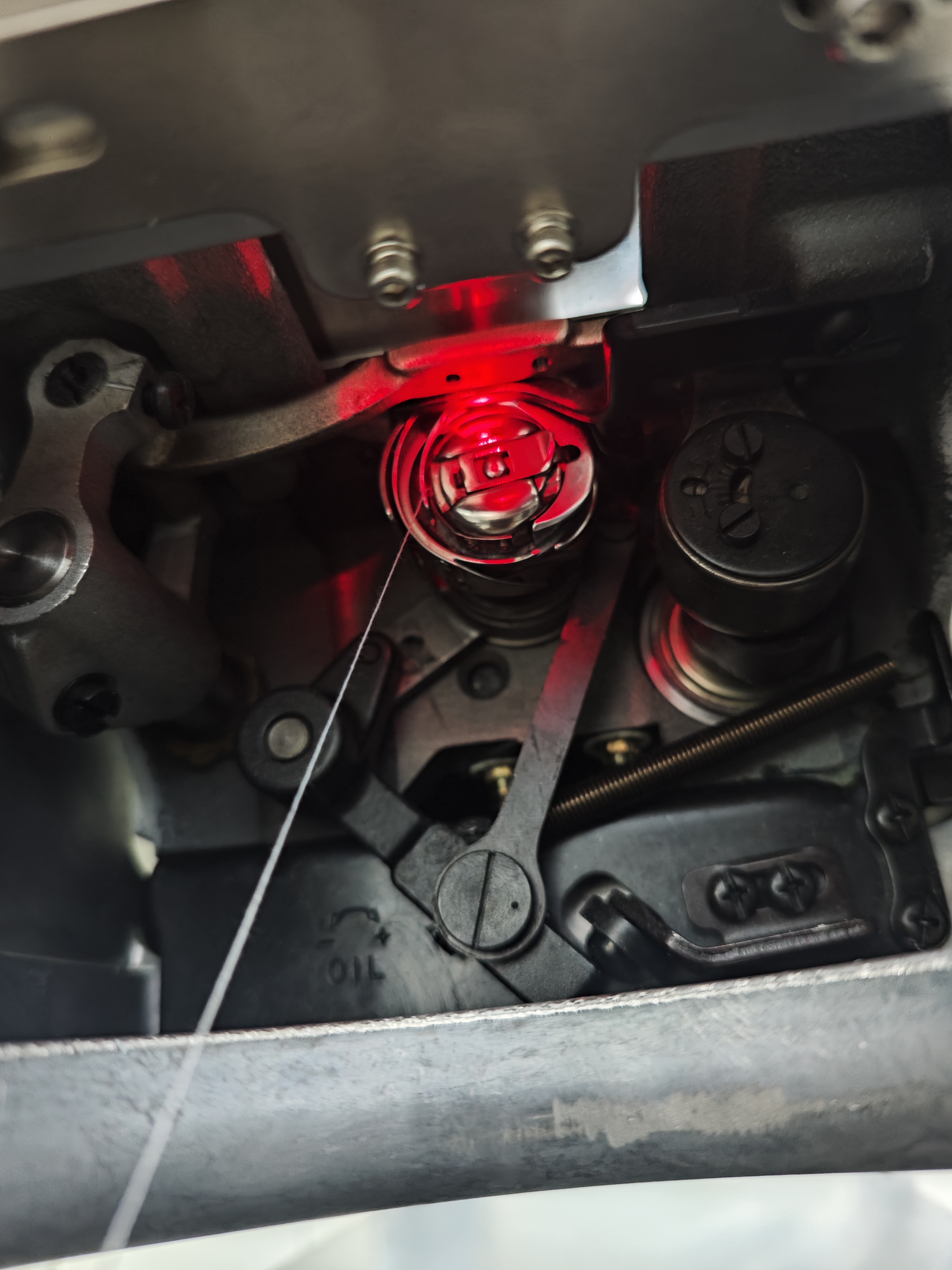
In the second half of 2025, the technical supervisor of the factory searched online“Which brand of bottom line detector is goodAt that time, I saw relevant information about AtonMLS2. What attracted him were two points:
One is three sets of adaptive algorithms.Distance adaptive - changing the shuttle core does not require parameter adjustment; Dust shielding adaptive - oil resistant cotton wool; Light adaptive - resistant to changes in ambient light. These three correspond exactly to the three pitfalls they have stepped on before.
Secondly, it has a wide range of adaptability.LS2's adaptive speed coverage150-4000rpmSensing distance50-200mmCompatible with the vast majority of conventional and non-standard shuttle cores on the market. Their computerized pattern machine and synchronous car can both use the same model.
At that time, when I saw the introduction of three sets of adaptive algorithms, I felt that someone had finally figured out the actual working conditions of the sewing workshop. The previous detectors had good laboratory data, and as soon as they entered the workshop, they would collapse
——Factory Technical Supervisor
With a trial and error mentality, they bought it from Atorm first2 units of LS2-NP01(NPN output type), ready to be installed on my two pattern machines for actual working condition testing.

Summary of Test Plan
| project | Content |
|---|---|
| test equipment | AtonMLS2-NP01 x 2 units |
| Installation model | Computer pattern machine (for daily production in the workshop) |
| Daily RPM | 2500-3000rpm |
| Test duration | 60 consecutive days+ |
| workshop environment | Typical sewing workshop - oil stains, cotton dust, and multi machine vibrations |
| Record indicator | Number of missed detections, number of false alarms, and whether parameter tuning is required after replacing the shuttle core |
LS2 adopts an external installation, fixed near the rotary shuttle, with 3 wires - the red wire is connected to the positive pole of DC12-24V, the black wire is connected to the negative pole, and the yellow wire NPN signal output is connected to the sewing machine shutdown port. Two machines can be repaired in less than an hour. Once installed, start up and run without calibration or debugging.
Focus on false alarms and missed detections. There was one false alarm in the first week - the operator reported that the green light was on but the wire was not broken. After investigation, it was found that the initial installation position of the shuttle core was offset, and it was adjusted to be normal. It did not appear again afterwards.
The device has entered a stable state. The workshop is operating normally, and oil contaminated cotton fibers still exist. LS2 testing is stable. After replacing the shuttle core (both porous and alumina materials are available), there is no need to readjust the parameters, and it can be used immediately after startup. within 30 daysZero false alarms and zero missed detections.
Continue running for one month, covering switching scenarios of different fabrics and different shuttle core specifications. Consistent results——Zero false alarms, zero missed detections, no parameter tuning requiredThe test conclusion is clear.
Number of missed detections in 60 days
0
Number of false alarms after the running in period
0
Number of times to change shuttle core and adjust parameters
0
After sales phone number (related to detectors)
0
After 60 days of testing data, the factory manager made a direct decision:Subsequent computer pattern machines and synchronous cars will be equipped with LS2 baseline wire breakage detector as standard.
The previous detector was installed and customers started making phone calls within two weeks. The Atorm baseline sensor has been installed for over two months, but there hasn't been a single after-sales call. This comparison is too obvious. "
——Factory Manager
Comparison before and after batch matching
| Dimension | Previously (other brands) | Now (LS2 supporting) |
|---|---|---|
| After sales phone number (related to bottom line detector) | 10-15 per month on average | Approaching zero |
| End customer feedback | Multiple false alarms, inability to adjust, and desire to dismantle | Just forget to install it, don't worry |
| Shuttle change core base note reference | Yes, customers complain if they don't know how to operate | Parameter free, adaptive |
| After sales labor+travel costs | Thousands of yuan per month on average | significantly reduce |
| Equipment competitiveness | The detector is an "optional accessory" and the customer is hesitant | Standard selling points, recognized by customers |
The more direct benefit is that the bottom line detector has changed from being a "spare part that customers hesitate to install" to a "selling point that comes standard with the factory". A customer specifically asked, 'Is your machine equipped with Atorm detectors?' This indicates that the reputation has already spread in the industry.
The detectors used by this factory in Guangdong before had essentially the same problem:The laboratory parameters are good, but the workshop conditions cannot withstand themThe environment in the sewing workshop is extremely unfriendly to sensors - oil splatters, cotton fluff spreads, equipment vibrations, frequent changes in ambient light, and any variable can cause the detector to malfunction.
Practical problems solved by three sets of adaptive algorithms
| Algorithm | problems solved | What would happen without this algorithm |
|---|---|---|
| Distance adaptive | Switching to different specifications of shuttle core eliminates calibration and automatically adapts to installation distance | Every time the shuttle core is changed, the parameters need to be readjusted, and end customers complain if they don't know how to adjust them |
| Dust shielding adaptive | Automatic compensation for surface oil stains and cotton wool attenuation on the optical path of the probe | If the probe is dirty, it will falsely report or miss detection, and the workshop needs to clean it every day |
| Light adaptive | Automatically counteract changes in workshop lighting and fluctuations in sunlight exposure angles | Frequent false alarms occur during afternoon sun exposure or seasonal changes, and sensitivity needs to be readjusted |
The core parameters of LS2 are also worth noting:
Q1: Is the installation of the sewing machine bottom line detection device complicated? Do you need to change the internal wiring of the device?
No need. LS2 is an external installation, fixed near the rotary shuttle, with 3 wires - red wire power supply positive pole, black wire negative pole, yellow wire NPN signal output connected to the sewing machine shutdown port. Do not dismantle the casing or modify the internal wiring. This factory in Foshan completes two machines in less than one hour of machine repair. For equipment manufacturers, the installation process can be directly written into the production operation manual.
Q2: How did LS2 solve the problem of false alarms when the previous detector had large oil stains?
rely onAdaptive algorithm for dust shieldingWhen oil stains and cotton fibers accumulate on the surface of the probe, the optical path signal of traditional detectors will attenuate, leading to false positives of wire breakage. The LS2 algorithm will automatically compensate for this attenuation without the need for frequent manual wiping of the probe. The oil pollution environment in the workshop of this factory in Foshan is not small. After 60 days of testing, there were zero false alarms after the break in period, indicating that this algorithm is working.
Q3: Provide matching services to end customers. Will customers call to ask how to adjust the shuttle core after replacing it?
No. LS2 has a distance adaptive algorithm that automatically adapts to different specifications of shuttle cores (porous, alumina, coated) without the need for manual calibration. After replacing the shuttle core, the end customer can start running without waiting for the machine repair to come and adjust the parameters. After the mass matching of this factory in Foshan, the number of after-sales calls related to detectors has decreased from an average of more than ten per month to almost zero.
Choosing a bottom line detector for sewing equipment manufacturers is different from using it for terminal factories - you need to consider not only whether it can be inspected, but also whether it is convenient for end customers to use.
Equipment selection checklist
| Checklist | focus | The consequences of dissatisfaction |
|---|---|---|
| Stability | Can it operate stably for a long time in an environment with oil pollution and dust | Multiple false positives → End customer complaints → After sales costs |
| No adjustment required | Is manual calibration necessary after replacing the shuttle core | The customer won't be able to adjust → After sales phone calls keep coming |
| Scope of adaptation | Speed range and shuttle core compatibility | Incompatible → Model limited or multiple models required for stocking |
| Installation Difficulty | Do you need to modify the internal structure of the device | Complex installation → reduced production line efficiency |
| Procurement Cost | Is it suitable for the price range of bulk matching | High cost → Customers unwilling to choose |
| Technical Support | Can the manufacturer provide quick response technical cooperation | Slow cooperation → affecting the pace of equipment delivery |
SummaryThe case of this sewing equipment manufacturer in Guangdong illustrates a truth: whether the bottom line breakage detector can stand firm in the equipment matching scenario depends not on how high the parameters are marked, but on whether the end customers can use it easily. By achieving the three principles of fewer false alarms, no parameter adjustment required, and forgetting to install, the after-sales costs and customer reputation of equipment manufacturers have been improved.
Whether it is a computerized pattern machine, synchronous sewing machine, or other industrial sewing equipment, the matching ideas for bottom line detection are interconnected. If you have any questions regarding selection, installation, or stability, please feel free to contact us at any time.
Solution Design
Application Validation Support
Parameter Optimization Guidance
Commissioning Support