

Project Services
Solution Design
Application Validation Support
Parameter Optimization Guidance
Commissioning Support
By clicking on the button “I accept” or by further usage of this website you express consent with usage of cookies as well as you grant us the permission to collect and process personal data about your activity on this website. Such information are used to determine personalised content and display of the relevant advertisement on social networks and other websites. More information about personal data processing can be found on this link Cookie Policy.
Agree


Single Sensor
Double Sensor
Image Sensor
2026-09-01
| Project Information | content |
| Application Industry | New energy vehicles | Stamping of battery pack heat exchanger (water-cooled plate) |
| Material Detection | 3 series aluminum alloy aluminum plate, thickness 1.0-1.5mm |
| core issue | Aluminum plate static electricity+stretching oil film adhesion, mechanical arm vacuum suction cup generates stacking material and sends it into the mold |
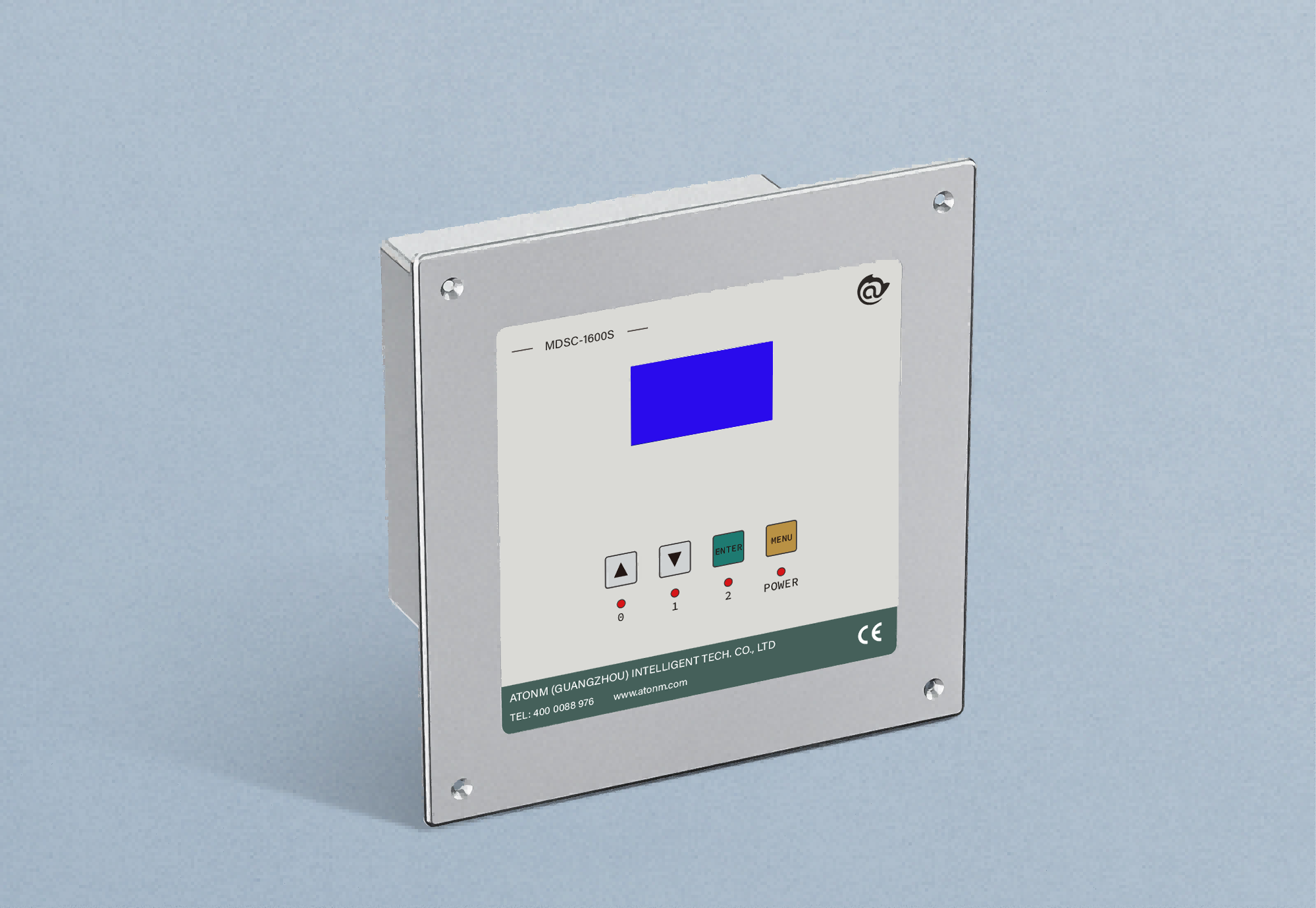
| Application products | MDSC-8500S dual detector |
| Key achievements | Monthly average of 6 cases of stacking defects → 0 cases; The frequency of mold maintenance has decreased by more than 60%; |
Introduction: In the stamping production of aluminum plates for new energy battery heat exchangers (cooling plates), the stacking of thin aluminum plates is a common problem in the industry. Aluminum plates are susceptible to adhesion caused by oil film and static electricity, and conventional detection methods often result in false alarms and omissions, making it difficult to adapt to production conditions. This case is a landing project for a leading domestic battery supplier. Through a dual sheet testing scheme, the stacking risk is intercepted from the source, avoiding chain quality accidents such as mold damage, batch scrapping, and brazing leakage.

This customer is a leading domestic battery manufacturer supplier, specializing in heat exchanger products for new energy vehicle battery packs. The production line adopts a mechanical arm automatic feeding and stamping forming process. The material is 1.0-1.5mm 3-series aluminum alloy thin plate, with a daily production capacity of about 300 pieces. After stamping, it enters the brazing process, with strict requirements for flatness and sealing performance.
Production line chronic disease: five core pain points caused by aluminum plate stacking
The surface of the aluminum sheet material adheres to a stretched oil film, and when stacked for a long time in a dry workshop environment with static electricity, two or even three aluminum sheets are easily tightly adhered. The vacuum suction cup of the robotic arm cannot recognize the number of layers in the sheet metal, and often sends the double-layer sheet metal into the stamping mold.
1. Severe oil film and electrostatic adhesion: The thin aluminum plate is tightly adhered, and reliable separation cannot be achieved through vacuum suction or manual sampling; In autumn and winter, the dry and static electricity intensifies, and the frequency of stacking defects doubles.
2. High cost damage risk of molds: When stacking materials into the mold, the actual material thickness doubles, and the punching force exceeds the limit, it is easy to cause edge cracking and concave mold cracking; The maintenance cost of precision molds for heat exchangers is high.
3. Chain failure of backend processes: The flatness and flanging size of the laminated stamping parts exceed the tolerance, and the sealing surface after brazing is poorly adhered, resulting in slight leakage, directly causing the scrapping of the heat exchanger product, and even the risk of recall of the customer's battery pack failure.
4. Limited manual interception capability: The production line has a fast pace, and manual inspection can only be done through sampling, which cannot achieve full piece interception; Often, batch defects are only discovered by quality inspection after they occur, accompanied by downtime, batch isolation, and quality traceability losses.
Stacking accidents are not just about scrapping a few workpieces, they can trigger a whole chain of losses: double-layer aluminum plates entering the mold → abnormal punching force, mold damage → stamping part size and flatness exceeding tolerance → brazing seal leakage → quality traceability, production line shutdown, and suspicious batch isolation.
Conservative annual comprehensive loss: 150000-200000 yuan
Scrap loss of stamping parts: 50000-80000 (monthly average of 6 defective parts)
Mold overhaul and maintenance cost: 40000 to 60000 yuan (2-3 major repairs per year)
Loss of production capacity and working hours due to downtime: 20000 to 30000 yuan (4-6 hours of downtime due to a single accident)
Hidden costs: brazing scrap, batch traceability, delivery delay.
Risk Warning: If defective parts are circulated to the battery factory's customer end, causing thermal management failure and recall of battery packs, the losses will reach millions.
A dedicated eddy current testing solution developed for non-magnetic conductive metals such as aluminum and copper, which is not affected by oil film, oxide film, reflection, or environmental vibration interference. It is suitable for small feeding stations of heat exchangers and can be connected to PLC to achieve fully automatic linkage and error prevention on the production line, perfectly adapting to the production conditions of aluminum plate stamping.
| project | Parameter Description |
| Detection Principle | Eddy current principle, specifically developed for non-magnetic conductive metals |
| Suitable material | Conductive metals such as aluminum and copper are not affected by oil or oxide films |
| Aluminum material testing thickness | 0.1‑2.5mm, Covering the working conditions of 1.0-1.5mm aluminum plate on site |
| Probe specifications | M18 small probe, suitable for narrow installation stations |
| Formula storage | 100 sets of formulas, quick changeover of multi specification boards |
| communication interface | RS485 Modbus‑RTU, Can be integrated with PLC and MES systems |
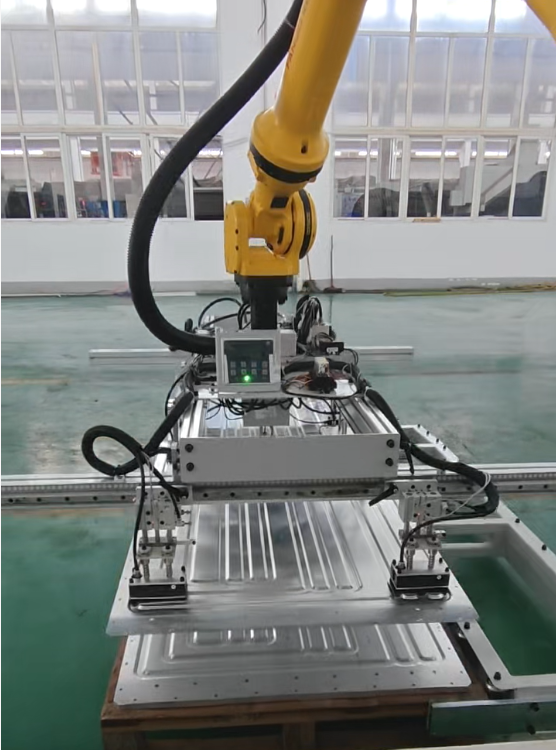
MDSC-8500SFor the exclusive detection series of single probe, the whole machine adopts a mechanical mobile phone carrier integrated installation solution. The host and probe are fixed in an integrated manner at the end of the mechanical arm equipment, and move synchronously and dynamically with the material picking action of the mechanical arm for detection. No need to modify the production line frame and feeding structure, fully adapted to the original automated production rhythm, and completed layer detection immediately after material retrieval, intercepting the risk of stacking and entering the mold in advance.
1. Onboard integrated installation: The detector host and M18 small probe are integrated and fixed at the operating end of the robotic arm, following the synchronous movement of the robotic arm. The detection of the number of layers of the board can be completed immediately after the material is taken, without the need to reserve a separate fixed detection station, which is suitable for compact production line layout.
2. Suitable for narrow workstations: With the M18 compact probe body and integrated onboard design, it does not occupy the space of the feeding channel and perfectly adapts to the narrow working conditions of the heat exchanger stamping production line, without installation interference problems.
3. PLC signal linkage access: The detector signal is directly connected to the production line PLC system, equipped with intelligent linkage logic: the mechanical arm automatically completes the detection after picking up the material, and if a single sheet is identified, it is sent to the mold for production normally; Identify the stacking and immediately trigger the sound and light alarm, lock the action of the robotic arm, prohibit entry into the mold, and prevent poor stacking and stamping from the source.
4. Calibration and formula storage: Accurately calibrate the three specifications of 1.0mm/1.2mm/1.5mm aluminum plates on site one by one, and store the parameters in 100 sets of formula libraries by classification. Product changeover only requires one click switching on the panel, and can be quickly completed in 30 seconds without mechanical adjustment or recalibration, greatly improving changeover efficiency.
Project cycle: The entire process adopts non-destructive airborne installation, without changing the production line, mechanical arm structure or original program. From equipment installation, parameter calibration, signal debugging to production and use, the overall time is less than 2 days, with fast landing and quick results. Zero missed detection of stacking can be achieved on the day of production.
| project | Before renovation | After deploying MDSC-8500S |
| Poor stacking quality | Monthly average ≥ 6 items | Stacking defects reduced to 0 |
| Stacking interception | The interception rate of manual sampling is less than 60% | Fully automatic full piece millisecond level interception |
| Mold overhaul | 2-3 times a year on average | Maintenance frequency has decreased by over 60% |
| Accident shutdown line | Single fault shutdown for 4-6 hours | Eliminate downtime and batch isolation caused by stacking materials |
| Type change operation | No standardized solution, tedious and time-consuming parameter tuning | 100 sets of formulas, fast switching in 30 seconds |
| data traceability | No testing records, unable to trace back | RS485 data output, connected to MES, |
✅ Quality benefits
The stacking defects have been completely eliminated, and the consistency of the dimensions and flatness of the stamped parts has been greatly improved. The leakage problem of the rear end brazing seal has been synchronously cleared. Thoroughly solve the batch quality problems caused by stacking materials, without the need for frequent batch isolation and quality traceability work, and greatly upgrade the stability of product quality.
✅ cost-benefit
The frequency of mold major repairs has been significantly reduced, and the previously high-frequency problems of blade breakage and concave mold deformation have been basically eliminated. The hidden costs of scrapped stamping parts, downtime loss, and quality traceability have been significantly reduced, resulting in a comprehensive annual savings of over 150000 yuan.
✅ Production compliance benefits
Millisecond level detection response, perfectly matching the high-speed rhythm of the production line, improving quality without compromising efficiency. The full process inspection data is automatically retained and can be uploaded to the workshop MES system, and each production inspection record can be traced.
Under the trend of lightweighting in new energy vehicles, aluminum plates are widely used in the stamping production of core components such as battery pack heat exchangers, structural components, and motor housings. Due to its material characteristics, aluminum plates are prone to adhesion caused by oil film and static electricity interference. Traditional manual sampling and ordinary testing equipment cannot achieve reliable error prevention.
The core of the stacking problem is not manual operation negligence, but the adhesion state of incoming materials exceeding the limits of manual perception and conventional equipment detection. The AtonmMDSC-8500S dual sheet detector is specifically designed to adapt to aluminum plate stamping conditions without the need to modify the original production line. It uses automated and precise detection instead of manual judgment to intercept stacking risks from the stamping source, completely avoiding problems such as mold damage, workpiece scrap, process chain defects, and customer after-sales recalls. It is an efficient, stable, and low-cost error prevention solution for new energy aluminum plate stamping production lines.
If your aluminum plate and copper plate stamping production line also has problems such as missed stacking, high defect rate, and severe mold loss, please feel free to contact Atorm Sensors. We can provide one-on-one exclusive selection suggestions and customized installation and testing plans based on your production line conditions, plate specifications, and equipment layout.
National Service Hotline | 13342814291
Solution Design
Application Validation Support
Parameter Optimization Guidance
Commissioning Support