

Project Services
Solution Design
Application Validation Support
Parameter Optimization Guidance
Commissioning Support
By clicking on the button “I accept” or by further usage of this website you express consent with usage of cookies as well as you grant us the permission to collect and process personal data about your activity on this website. Such information are used to determine personalised content and display of the relevant advertisement on social networks and other websites. More information about personal data processing can be found on this link Cookie Policy.
Agree


Single Sensor
Image Sensor
2026-04-02
summary:This case focuses on the assembly line of lithium battery cells and explains it to everyoneLaser displacement sensorWhy is it more suitable for detecting the height of the top cover and the difference in the shell opening, and how does the installation angle, teaching mode, and output method affect on-site stability.
The customer's original workstation needs to determine two things: whether the height of the top cover after pressing is within the window, and whether there is a significant gap around the shell opening. This action may not seem complicated, but it's not the same thing when placed on a lithium battery assembly line. When the beat is fast, the contact probe will face numerical fluctuations caused by wear, rebound, and slight shaking of the workpiece; Once there is a slight change in the fixture status, the threshold will be frequently adjusted on site.
Even more troublesome is that the surface of the battery cell is not always in an ideal state. The metal surface has reflections, and in some areas, due to process residues, color differences, or slight deviations in pressing, ordinary switch type detection methods can only provide a vague judgment. When engineers want to trace the source, they do not have enough data in hand.
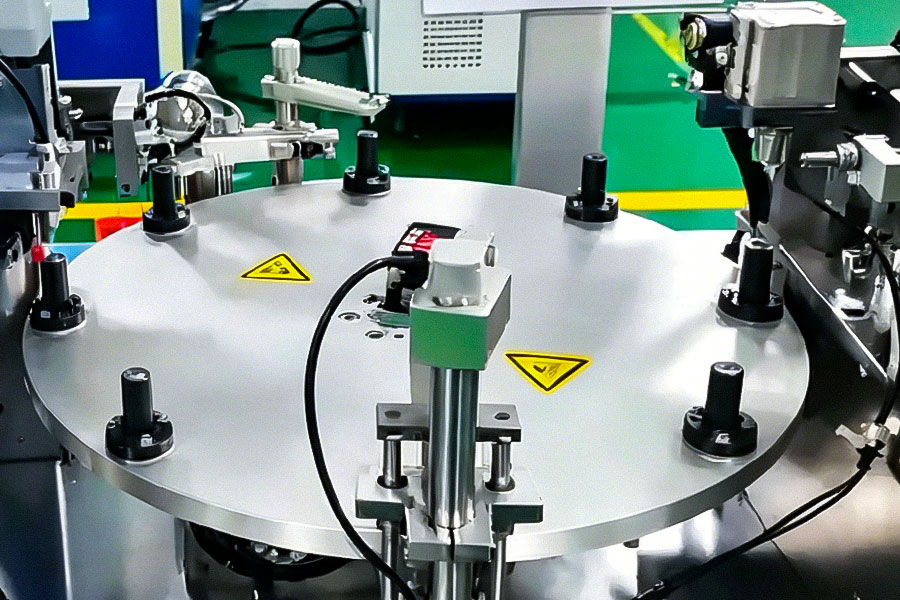
The customer ultimately chose AtormLD1 series laser displacement sensorThe judgment logic is not complicated, what this workstation really needs is continuous distance measurement, not simply the presence or absence of signals.
This time, the customer adopted a center distance specification of 50mm, which is more suitable for compact workstations. The response time is configured according to the standard mode, ensuring stability before pursuing the upper limit of speed. This judgment is correct. In on-site projects, it is more important to first stabilize the signal than to blindly follow 1.5ms.
Many people think thatLaser displacement sensorIt can be tested just by installing it, but what really determines the effect is whether you have figured out the source of the error clearly. In this project, the customer initially positioned the sensor directly towards the highly reflective edge, but the values occasionally fluctuated. Later, the light emission angle was adjusted and the measurement point was placed in a more stable reference area. Combined with the teaching mode setting of upper and lower limit windows, the fluctuation immediately converged.
This is also one of the reasons why products like Atorm LD1 are suitable for lithium-ion workstations. It doesn't just give you a switch result, but can hand over continuous distance changes to you, letting engineers know whether the problem lies in the product, fixture, or installation posture. For equipment manufacturers, this is more important than passing a single inspection, as it relates to the maintainability of the entire line in the future.
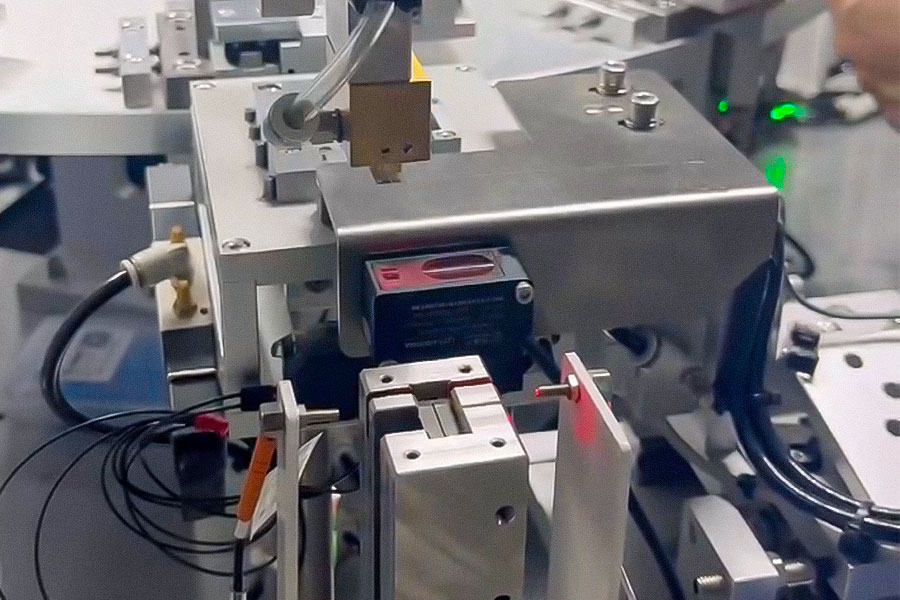
After a month of trial operation, the customer's feedback was very direct: there were fewer alarms, the machine adjustment time was shorter, and the engineer was more likely to locate the source of the abnormality. Previously, when encountering unstable pressing, we could only suspect the mechanism first; Now by directly looking at the displacement curve and the judgment window, we can know whether it is a single cell exceeding the tolerance or if the fixture status is biased.
| Customer's original pain points | Changes after renovation |
|---|---|
| The contact probe fluctuates greatly at high-speed workstations, and the threshold often needs to be readjusted | After switching to non-contact measurement, the detection window became more stable and the number of on-site parameter adjustments significantly decreased |
| It can only be judged whether it has been or not, and it is difficult to trace the specific source of the abnormality | By using continuous displacement data, it is possible to distinguish between product anomalies and fixture anomalies more quickly |
| Compact workstations have limited installation space | The 50mm center distance specification is more suitable for short distance detection positions on assembly equipment |
The conclusion is clear:If your workstation needs to measure continuous dimensions such as height, pitch, and flatness, and the production line has a fast pace and the surface condition of the parts is complex, thenLaser displacement sensorUsually more worthy of priority evaluation than contact measurement. On the other hand, if only rough confirmation is needed on site without size window requirements, there is no need to make the plan too heavy.
The reason why the lithium battery industry is a large-scale industry for laser displacement sensors is here. It is not simply pursuing high precision, but requires a more stable and easily accessible data-driven detection method under high beat rate, small size, and complex surface conditions.
If you are also evaluating lithium battery assembly, polarizer, shell, or post weld inspection stations, first look at three things: the surface condition of the measured object, installation distance, and whether you need switch quantity or continuous displacement data. Think about these three items first, the selection will be much faster.
Solution Design
Application Validation Support
Parameter Optimization Guidance
Commissioning Support