

Project Services
Solution Design
Application Validation Support
Parameter Optimization Guidance
Commissioning Support
By clicking on the button “I accept” or by further usage of this website you express consent with usage of cookies as well as you grant us the permission to collect and process personal data about your activity on this website. Such information are used to determine personalised content and display of the relevant advertisement on social networks and other websites. More information about personal data processing can be found on this link Cookie Policy.
Agree


Single Sensor
Double Sensor
Image Sensor
2026-03-18
This project was initiated on a stamping line of a certain automotive parts supplier: when the robotic arm/robot grabs the steel plate for feeding, there will be a situation where multiple pieces of material are taken away together. The dual material was fed into the mold, causing a series of subsequent problems:
Mold tooth breakage, mold breakage (long maintenance cycle, high cost)
Scrap and rework of stamped parts (combined with material and labor costs)
Production line shutdown (OEE decrease, delivery delay)
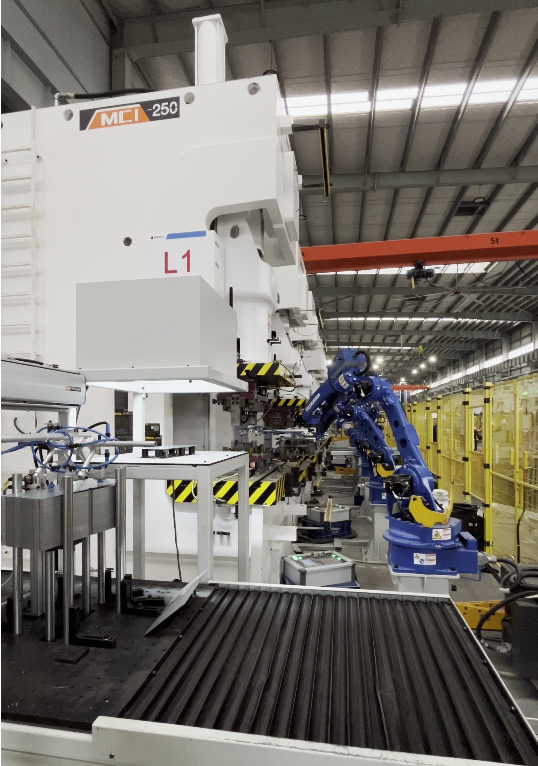
This case involves installing a set between the end of the robotic arm and the feeding mechanismMDSC-1000C dual beam detectorWhenever the robotic arm delivers the material in place, the detector first determines whether there are double/multiple sheets:
Single sheet → output OK, continue feeding
Double/multiple sheets → output NG, trigger material return/alarm/rejection
This solution does not require any changes to the robot's grasping logic, only adding detection and judgment at key nodes, so the transformation cycle is short and the risk is low.
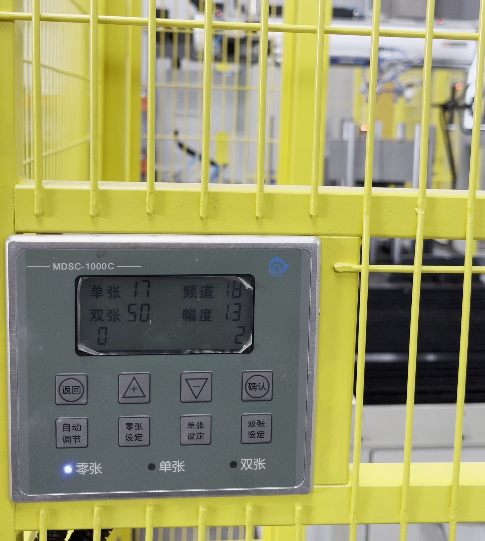
Mold damage frequency: tooth breakage/mold breakage caused by double tension decreased from 1-2 times/month to 0 times (lasting for 3 months)
Number of downtime: reduced from 8 times/week to 0 times/week
Production line utilization rate: more stable rhythm, efficiency improvement of about 3-5%
Debugging hours: 1-2 on-site debugging sessions can complete a single teaching demonstration and ensure stable operation
At the customer's site, the application of this solution has significantly improved reliability and stability compared to relying on manual inspection or ordinary optoelectronics in the past, and does not require complex modifications.
Installation position and spacing
Suggest setting the detection point at "after the mechanical arm grabs the material and before feeding" as the last step before entering the mold
Suggested probe spacing is 30-50mm (40mm recommended)
When space is limited, install near the feeding port
PLC/Robot Linkage Approach
Material arrival signal triggers 1000C detection
OK signal allows feeding/discharging through PLC
NG signal triggers material return, alarm or jump, and records abnormalities
Key points of on-site debugging
Verify "single/double/empty load" with real samples
If there is a false alarm, you can re execute the 'learning demonstration'
Suggest combining line edge inspection: record alarm conditions and analyze the reasons
This plan can effectively reduce the risk of mold damage and downtime caused by double tension, improve delivery stability, and provide clear investment returns. The equipment adopts standard NPN/PNP/I/O output, which can be easily connected to PLC and robot control systems, and has functions of disconnection alarm and abnormal judgment; During installation, only one set of detection points needs to be added to the feeding path, without changing the structure of the robotic arm. When the material changes, it can be adapted by re teaching. Comparing mold repair with downtime losses, it is a low-cost and high-yield protection solution

Solution Design
Application Validation Support
Parameter Optimization Guidance
Commissioning Support