

Project Services
Solution Design
Application Validation Support
Parameter Optimization Guidance
Commissioning Support
By clicking on the button “I accept” or by further usage of this website you express consent with usage of cookies as well as you grant us the permission to collect and process personal data about your activity on this website. Such information are used to determine personalised content and display of the relevant advertisement on social networks and other websites. More information about personal data processing can be found on this link Cookie Policy.
Agree


Single Sensor
Double Sensor
Image Sensor
2025-03-10
In today's highly competitive manufacturing industry, stamping equipment serves as a fundamental production tool, and its efficient and stable operation is crucial to enterprises' production efficiency. The customer is a professional manufacturer of stamping equipment. In the stamping process, accurate sheet detection is directly related to the safe operation of stamping dies—double sheets must never enter the die. Otherwise, the risk of die damage will be greatly increased, leading to production shutdowns and soaring costs.
Previously, the company had been using double sheet detectors of a Japanese brand for sheet inspection. However, with changes in the market environment and the enterprise's higher pursuit of cost control and product performance optimization, it has become an urgent task for the customer to seek a cost-effective domestic alternative. The customer's stamping production line uses 0.4mm-thick stainless steel sheets with dimensions of 80*60cm.
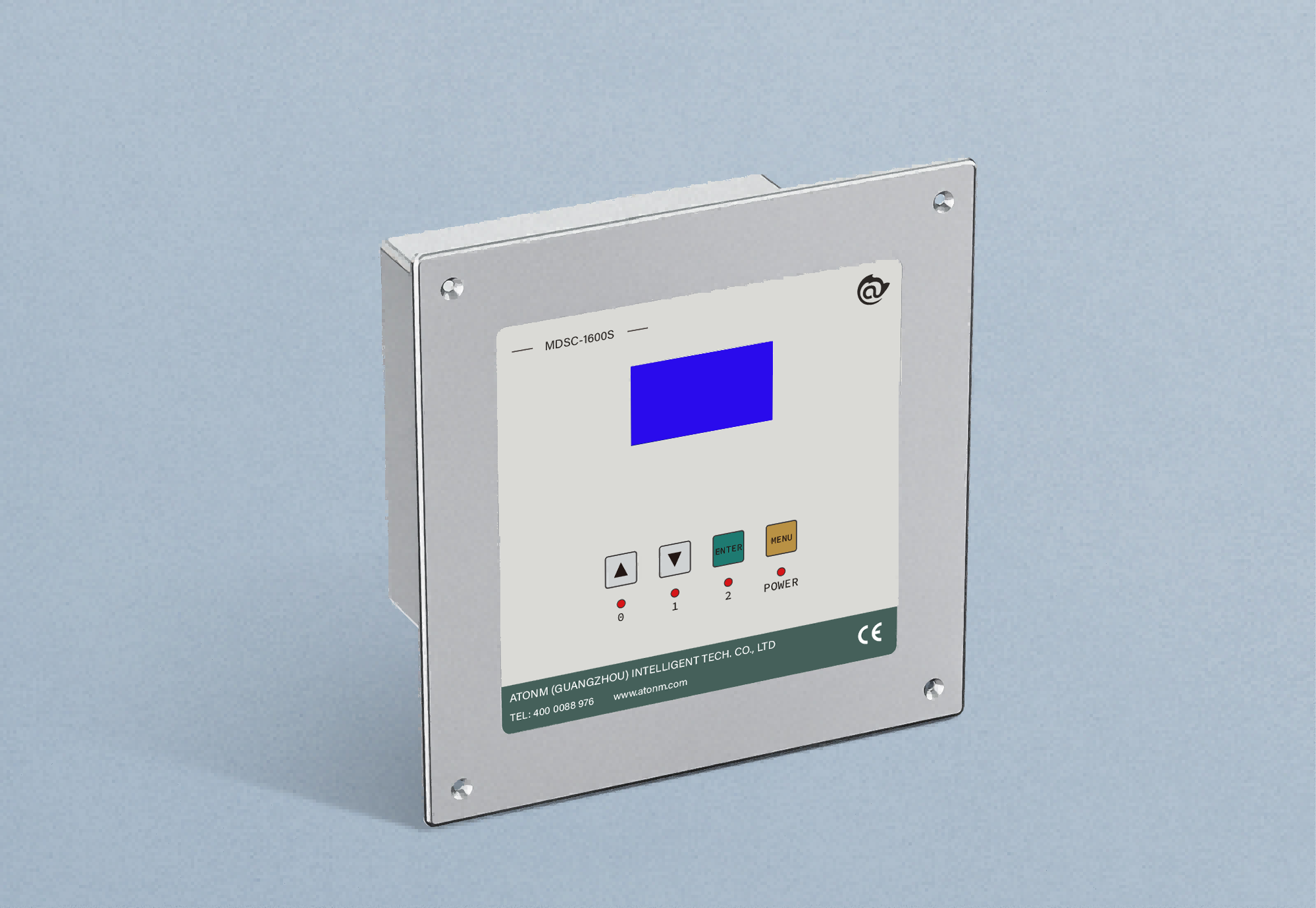
After communicating with the customer and clarifying their needs and working conditions, Atonm recommended the following solution: the through-beam metal double sheet detector MDSC-1000B paired with a square probe sensor.

Installation Layout
The double sheet detection sensor is mounted on the alignment platform. When a sheet passes through the alignment platform, the sensor quickly detects the sheet and outputs the corresponding signal. Once an abnormal double-sheet signal is detected, the host computer immediately sends an instruction, and the robot will promptly transfer the abnormal sheet to the adjacent stack and re-handle a new sheet for re-inspection. If a single-sheet signal is detected, the sheet is smoothly released to proceed to the subsequent production processes.
Significant Improvement in Production Efficiency
With the terminal sheet teaching and remote teaching functions of the MDSC-1200C Double Sheet Detector, operators can quickly complete the teaching process for sheets of different sizes, eliminating the need for time-consuming on-site debugging as in the past. When switching sheet sizes, the recipe storage function allows direct retrieval of stored recipes, greatly shortening parameter setup time. This enables the handling system to rapidly switch between sheets of varying dimensions, significantly improving overall production efficiency and greatly accelerating project delivery cycles.
Effective Reduction in Production Costs
The shortened setup time for size switching means more handling tasks can be completed within the same timeframe, thereby reducing the production cost per unit product. Meanwhile, the MDSC-1200C Double Sheet Detector’s high stability and strong anti-interference capability have drastically reduced equipment downtime caused by malfunctions, further lowering maintenance costs and production losses due to shutdowns. In addition, simplified operational procedures have cut down labor costs.
Substantial Optimization of Product Quality
The accurate and reliable double sheet detection function has successfully prevented double sheets from entering subsequent processing procedures, effectively reducing product quality issues caused by sheet anomalies. Improved product quality has enhanced the competitiveness of the customer’s products in the market, creating favorable conditions for the customer to capture a broader market share.
Enhanced System Intelligence
The remote teaching function allows operators to perform sheet teaching operations for the equipment remotely, greatly facilitating the management and maintenance of the production site by technical personnel. The intelligence level of the entire handling system has been significantly improved, which is more aligned with the development trend of modern industrial automated production, laying a solid foundation for the customer’s future expansion of automated production business.
Solution Design
Application Validation Support
Parameter Optimization Guidance
Commissioning Support