

Project Services
Solution Design
Application Validation Support
Parameter Optimization Guidance
Commissioning Support
By clicking on the button “I accept” or by further usage of this website you express consent with usage of cookies as well as you grant us the permission to collect and process personal data about your activity on this website. Such information are used to determine personalised content and display of the relevant advertisement on social networks and other websites. More information about personal data processing can be found on this link Cookie Policy.
Agree


Single Sensor
Double Sensor
Image Sensor
2025-01-02
In automotive manufacturing, the quality and efficiency of component stamping directly affect the overall vehicle quality and cost. The customer is a large-scale manufacturer of mechanical presses and forging equipment, undertaking a renovation project of a fully automated stamping line for auto parts. This stamping line processes stainless steel sheet stamping parts with a thickness of approximately 3mm, imposing stringent requirements on die precision.
The feeding process is a critical step in stamping production. If double or multiple sheets enter the stamping process, the die may be damaged or even crushed. Dies are expensive and have a long manufacturing cycle; damage to them will result in high maintenance costs and prolonged downtime, causing substantial losses to the enterprise. Therefore, it is crucial to accurately and real-time detect the single or double-sheet status of the plates during feeding, issue timely alarms in case of abnormalities, and intercept defective plates to ensure the stable operation of the stamping line.
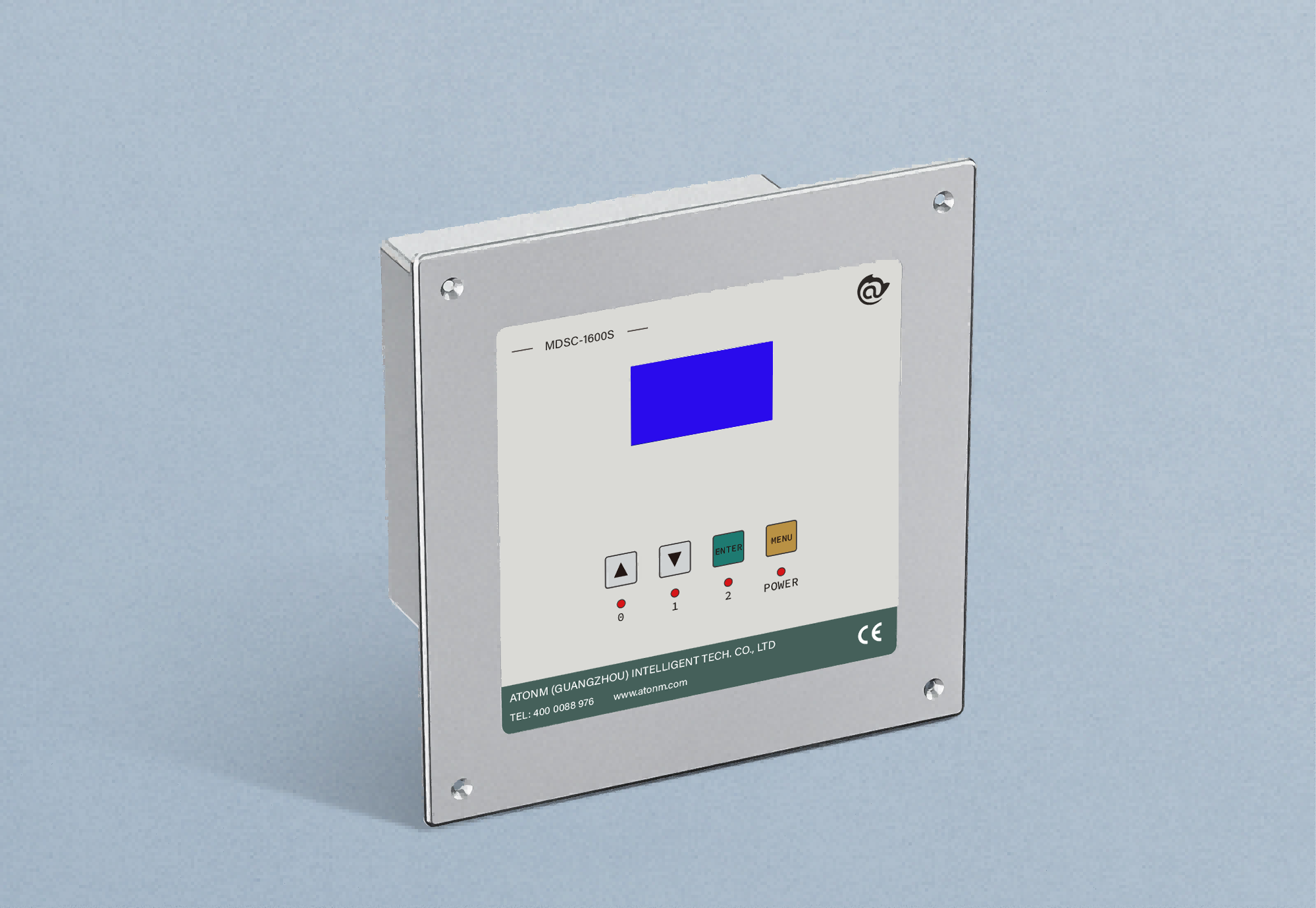
Atonm's engineering team responded promptly to the customer's needs. After gaining a detailed understanding of the production line speed, plate characteristics, robotic feeding process, and workshop interference factors, the team customized a solution for the customer: the Atonm contact-type single-probe metal double-sheet detector MDSC-8200S was selected as the core equipment for single and double-sheet detection of stainless steel plates in the feeding process.

Wide Detection Thickness Range
The MDSC-8200S can accurately detect magnetically conductive metal plates with a thickness of 0.2–4mm, easily meeting the customer's production line requirement for detecting 3mm stainless steel plates and adapting to diverse stamping process needs.
High-Efficiency Dual Channels
Featuring a unique dual-channel design, one main unit can connect to 2 sensors and detect sheet overlapping in two stamping processes simultaneously. Compared with traditional single-sensor detectors, it greatly improves detection efficiency, matches the synchronous production rhythm of multi-process stamping lines, and saves time.
Mass Formula Storage Capacity
With a built-in storage capacity of 200 sets of sheet material formulas, it can store and manage various material parameters. The metal materials used in industries such as automotive and home appliances are diverse. The host computer can quickly switch the metal formulas to be detected as needed, enabling convenient operation and eliminating frequent calibration, thus ensuring continuous production.
Superior Anti-Interference Performance
Adopting next-generation sensor technology and upgraded algorithms, it boasts excellent anti-interference capability.
Versatile Communication Compatibility
Supporting communication protocols such as Profinet and 485, it can seamlessly connect to upper computers like PLCs to realize system control and data interaction. In case of detection abnormalities, it can provide real-time feedback and trigger linked equipment responses, such as alarms and suspending robotic feeding.
Since the MDSC-8200S Metal Double-Sheet Detector was put into use, remarkable results have been achieved. The error rate of double or multiple sheet misfeeds in the stamping line feeding process has dropped from several times per month to zero. The frequency of die damage caused by sheet overlapping has plummeted, leading to significant reduction in maintenance and replacement costs. The downtime of the production line has been shortened substantially, and production capacity has increased steadily. The stable production process has also improved the consistency of product quality, reduced the defective rate, and enhanced the customer's competitiveness in the market.
Solution Design
Application Validation Support
Parameter Optimization Guidance
Commissioning Support