

2026-08-18
Sewing machine shuttle core no thread alarm: the most common questions asked by workshop masters
Many factories hire parking workers who need to inspect 4 to 6 machines per person, and the bottom line of when to use them up depends entirely on hand feel and experience. The thick material process is particularly obvious - fabrics such as sofas, bags, and car interiors have visible thread marks of tens of centimeters when they run out of needle, and the cut pieces are directly scrapped.
The term 'sewing machine shuttle core no thread alarm' is actually the most commonly searched colloquial expression by parking lot drivers and mechanics on Taobao and Baidu. What everyone really wants is one thing: when the thread on the shuttle core is almost used up or has already been broken, the machine can stop immediately and give a clear signal, instead of waiting for the next flip to discover a gap.
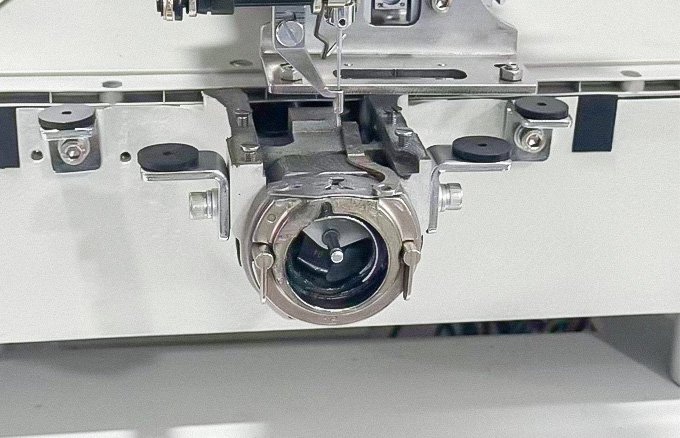
The core of the alarm is to "see" whether the shuttle core can still turn or not
The bottom line is rotated by the spinning shuttle in the shuttle core. If the thread is used up or broken, the shuttle core will lose the tension of the thread and stop rotating or the speed will be abnormal. What the alarm needs to do is to keep an eye on this status change.
There are currently two common testing methods for industrial sewing machines:
Mechanical contact type: shrapnel/lever contacts the shuttle core, and when the wire is broken, the shrapnel bounces up to trigger the structure, which is simple. However, when the thick material vibrates greatly, it is easy to trigger by mistake, and the cotton wool and oil stains accumulate and get stuck
Non contact photoelectric type: The light source illuminates the spinning shuttle area, and the reflected signal is used to determine whether the shuttle core is rotating without contacting the moving parts. The oil resistant cotton wool is used, and the shuttle core can be replaced without recalibration
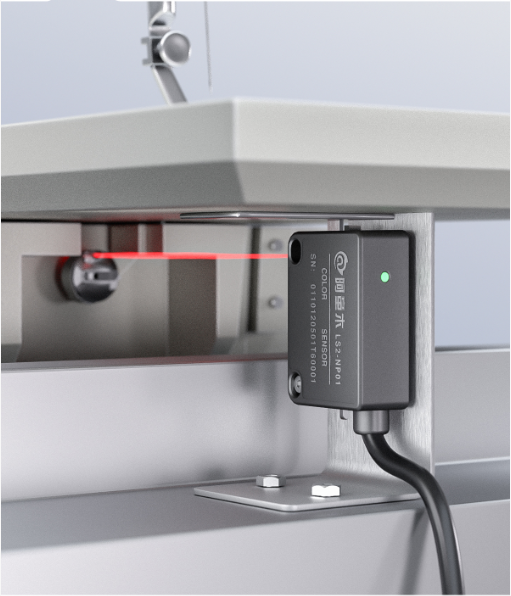
Optoelectronic technology has become the mainstream in new installation and modification workshops in recent years. Taking the Atorm LS2 bottom line breakage detector as an example, a 650nm laser is used as the detection light source. During operation, the shuttle core rotation signal is compared in real time. Once it is determined that the bottom line is exhausted or broken, the signal end flips, and the machine's electronic control receives the signal to cut off the sewing action and sound an alarm.
There is a detail that is easily overlooked here: the "alarm" itself is just a signal source, and it is the electrical control system of the sewing machine that really stops the machine. So before selecting a model, it is necessary to confirm whether the electronic control support of your machine does not support external shutdown signals, whether it is triggered by high or low levels, and then decide whether to choose NPN or PNP output models.
The wiring is not complicated, just identify the three wires
The workshop master is most concerned about wiring. Taking NPN normally open type as an example, it comes standard with 3 wires at the factory:
Red line: connected to the positive pole of a DC 12V~24V power supply
Black wire: connected to 0V (negative pole of power supply)
• Yellow wire: NPN signal output wire, disconnected from 0V during normal sewing, conducts to 0V when stopping is detected
Connect the yellow thread to the external stop signal terminal of the sewing machine main control, and the machine will automatically stop sewing when an alarm is triggered. The power supply can directly take DC24V from the internal control of the machine, and most industrial sewing machine motherboards reserve this interface. The PNP output version has the opposite logic and needs to be wired according to the machine's electrical control manual. The NPN connection method cannot be directly copied.
The installation position is usually hung near the rotary shuttle, and the tightening torque is controlled below 0.5N · m to avoid vibration loosening and damage to the plastic shell. When adjusting, let the reflected light spot fall on the mirror area of the product, and the indicator light should display normally. The entire process does not require changing the major mechanical structure, and regular machine maintenance can be completed according to the instructions.
Several high-frequency issues
Q: Should we re adjust the shuttle core with different colors and specifications?
A: Models with adaptive algorithms do not need to be recalibrated after changing lines or shuttle cores. It relies on real-time learning of rotational signal features, rather than fixed threshold comparison. Before making a purchase, you can inquire whether distance adaptation and light adaptation are supported.
Q: Can one model cover thick material machines with low speed and thin material machines with high speed?
A: It depends on the sensing speed range. The target speed supported by products like LS2 is between 150-4000rpm, ranging from low-speed thick material synchronous cars to high-speed flat sewing machines. If the speed of your machine is particularly low or high, you should report the actual speed to the manufacturer for confirmation when selecting.
Q: What should I do if there is a lot of cotton fluff and heavy oil stains in the workshop, and the alarm frequently reports false alarms?
A: The protection level should be at least IP54, which can block daily cotton fluff and splashing oil droplets. If false alarms increase after a period of time, first wipe the detection lens and then check if the installation position is blocked by oil stains. Pressing the button again to reset the sensitivity setting usually restores it.
Q: What is the reason for the alarm but the machine not stopping?
A: First check if the yellow wire signal has reached the main control terminal, and then confirm if the external shutdown function inside the main control is turned on. Some machines have external signals turned off by default at the factory and need to be turned on in the parameters.
Write these parameters into the purchase order when selecting
Output type: NPN or PNP, matched with the machine's electronic control
• Working voltage: DC12V~24V. Does it cover the power supply in your workshop
• Speed range: 150-4000rpm. Does it cover your model
• Protection level: Starting from IP54, do not use anything lower in the sewing workshop
• Environmental temperature: -20 ℃ to+55 ℃ is an industrial grade basic plate
• Warranty: 12 months is the industry standard
Choose the 'alarm' as an independent workstation component instead of buying a cheap sensor switch to install - one less gap rework, and the price difference will come back.
You May Be Interested
-
Atorm has been awarded ISO three system certification, safeguarding quality and sustainable development with international standards
2026-10-12
-
Atonm MDSC-9000T Dual-Channel, Single-Sensor Metal Double-Sheet Detector
2025-12-05
-
Non-Contact “One-to-Four” Double-Sheet Detector 1600S: A New Cost-Reduction and Efficiency Solution for Stamping Lines
2025-11-20
-
Provincial Auto Industry Research Tour | Atonm Engages with the Automotive Supply Chain, Empowering Smart Manufacturing through Sensors
2025-10-11