



2022-06-13
Overview of Automotive Metal Parts Stamping Processes
An ordinary automobile consists of tens of thousands of parts, with metal parts forming a major portion. Stamping processes are widely applied in the automotive industry.
1. Stamping workshop process flow
Raw material (sheets and coils) arrival → coil unspooling → cleaning and oiling of blanks, uncoiling and cutting small parts → stamping production line → first part qualification and die setup → mass production → rust protection for qualified parts → warehousing.

2. Concept and characteristics of cold stamping
1. Cold stamping is a pressure forming method that uses dies mounted on a press to apply force to material at room temperature to produce separation or plastic deformation and obtain the desired parts.
2. Characteristics of cold stamping: stable part dimensions, high accuracy, light weight, good rigidity, interchangeability, high efficiency and low consumption, simple operation, and ease of automation.
3. Classification of basic cold stamping processes
Cold stamping includes forming operations and separation operations.
1. Forming processes shape the blank without fracture, producing plastic deformation. Forming includes deep drawing, bending, flanging and trimming.
Deep drawing uses a drawing die to convert a flat blank into an open hollow part.
Bending forms sheet, section or rod into a desired angle and shape.
Flanging turns the sheet along a curvature into a vertical edge for planar or curved regions.
2. Separation processes cut the sheet along a contour to obtain the required shape, size and cut quality. Separation includes blanking, punching, notching and trimming.
Blanking separates the area inside a closed contour as the desired blank.
Punching separates the material outside a closed contour as the punched hole.

(Cold stamping process)
4. Process names and codes
Some stamped parts are body panels such as engine hoods, roof panels and doors.
5. Requirements for exterior panels
1. Dimensions and shape must meet gauges and mating welded assemblies.
2. Surface quality must be free of waviness, wrinkles, dents, scratches or impressions; crease lines must be clear and edges smooth and even.
3. Adequate rigidity. Panels must have sufficient plastic deformation during forming to ensure rigidity.
4. Good processability. To reduce stamping and welding production costs, panels should have good stamping and welding process characteristics, especially for deep-drawing steps to be stable and producible.
6. Components of a typical die
1. Working parts, such as punch and die.
2. Locating parts, including stop pins, locating pins and cut-off blades.
3. Holding, stripping and ejecting parts, including stripper plates, ejectors and pneumatic ejectors.
4. Guiding parts: guide posts, guide bushes and guide plates.
5. Support parts: upper and lower bolster plates and die mounting plates.
6. Fastening parts: hex screws, ejector screws, etc.
7. Cushioning elements: return springs, polyurethane pads and nitrogen cylinders.
8. Safety and auxiliary parts: safety side pins, safety screws, stroke limiters, storage limiters, loading racks, scrap chutes, lifting lugs and eyelets.
9. Safety side pins prevent the upper die hold-down screws from loosening or breaking and avoid serious loss from dropping hold-down plates.
10. Storage limiters prevent elastic elements from being overloaded for long periods and protect edge life, commonly implemented with polyurethane pads.
11. Stroke limiters restrict the feeding depth of punch and die.

(Stamping die)
7. Stamping single/double-sheet detection system
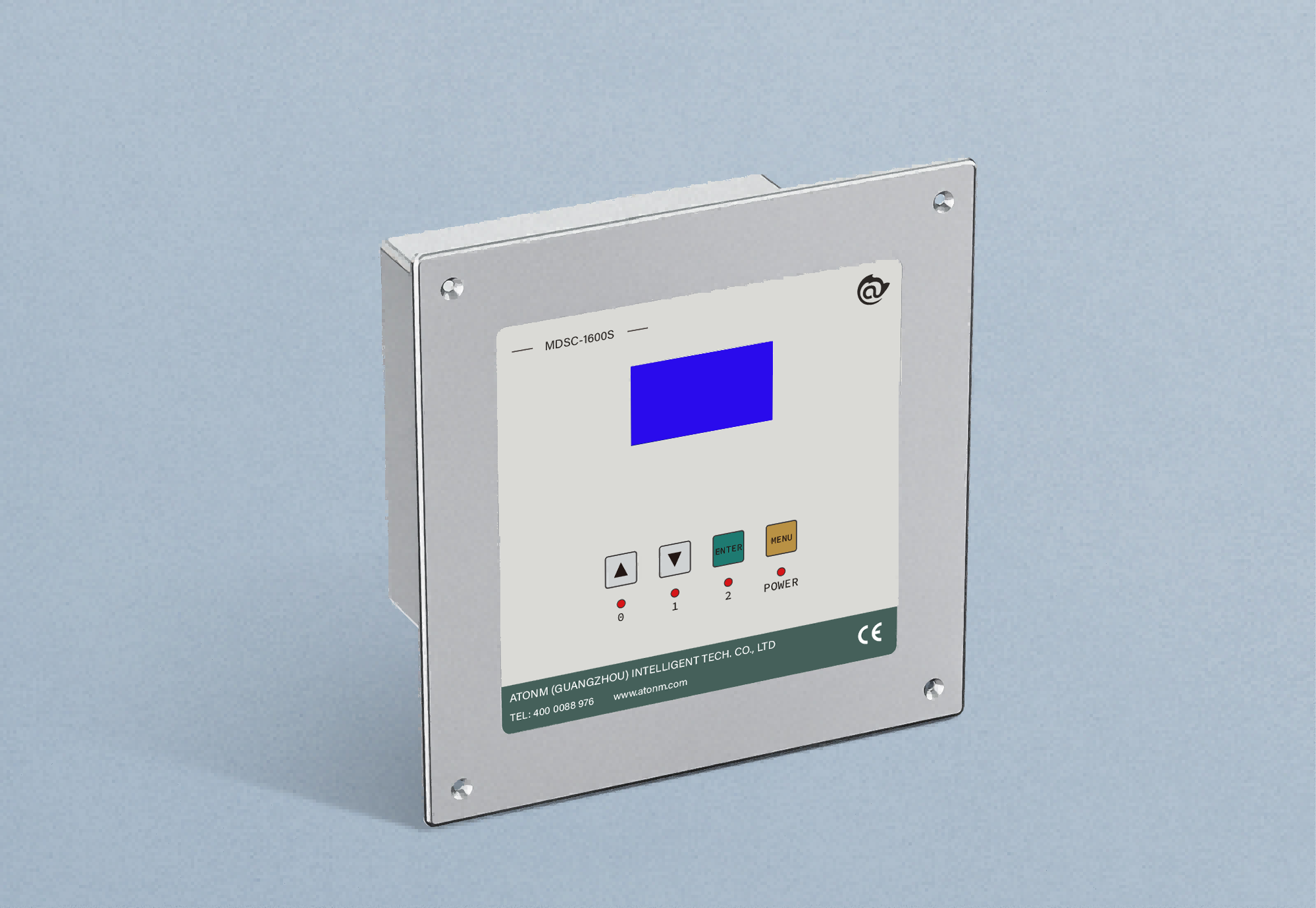
When using automatic stamping robots, double-sheet overlap may occur due to surface tension of metal blanks. Overlapped sheets can damage dies in the stamping line. The Atonm double-sheet detector accurately identifies whether the robot is gripping a single sheet or stacked double sheets.

Atonm Metal Double-Sheet Detector
You May Be Interested
-
Atorm has been awarded ISO three system certification, safeguarding quality and sustainable development with international standards
2026-10-12
-
Atonm MDSC-9000T Dual-Channel, Single-Sensor Metal Double-Sheet Detector
2025-12-05
-
Non-Contact “One-to-Four” Double-Sheet Detector 1600S: A New Cost-Reduction and Efficiency Solution for Stamping Lines
2025-11-20
-
Provincial Auto Industry Research Tour | Atonm Engages with the Automotive Supply Chain, Empowering Smart Manufacturing through Sensors
2025-10-11