

Project Services
Solution Design
Application Validation Support
Parameter Optimization Guidance
Commissioning Support
By clicking on the button “I accept” or by further usage of this website you express consent with usage of cookies as well as you grant us the permission to collect and process personal data about your activity on this website. Such information are used to determine personalised content and display of the relevant advertisement on social networks and other websites. More information about personal data processing can be found on this link Cookie Policy.
Agree


Single Sensor
Double Sensor
Image Sensor
2026-07-16
The appearance inspection of new energy battery packs before leaving the factory is a key step in ensuring product safety and consistency. Whether there is virtual welding in the weld seam, whether there are scratches on the surface, whether the sealant coating is continuous and uniform, whether the bolt installation is in place, and whether the pole position is accurate - these quality indicators directly affect the service life of the battery pack and the safety of the entire vehicle.
Currently, more and more battery pack production lines are introducing machine vision inspection solutions to replace traditional human eye inspection and improve inspection efficiency and accuracy. However, in the actual implementation process, a fundamental and critical issue often becomes a bottleneck in system efficiency: whether the measured object stops at a precise and repeatable position when the camera takes a picture?
Position deviation will directly lead to field of view deviation and focal plane misalignment, resulting in a decrease in image quality and difficulty in ensuring the detection accuracy and stability of the visual system.
In response to the above issues, the AtonmMRR series magnetic grid ruler reading head works in conjunction with visual equipment to construct a linkage scheme of "mobile positioning → in place triggering → instant photography", which has been successfully implemented on a new energy battery production line, achieving synchronous improvement of detection rhythm and accuracy.
Test object: New energy power battery pack
Inspection content: appearance indicators such as weld quality, surface defects, sealing strip status, bolt installation in place, pole installation position, etc
Testing method: The battery pack is transported by a roller conveyor to the testing station, and an industrial camera array is deployed above and on the side to comprehensively capture and analyze the appearance of the battery pack
Rhythm requirement: The total duration of a single battery pack staying at the inspection station is ≤ 30s (including positioning, photography, image analysis, result output, and release)
The battery pack is transported by a roller conveyor line and is affected by mechanical inertia, roller friction differences, and other factors, resulting in a deviation of several millimeters at each stop position. High resolution industrial cameras typically have a depth of field range of only a few millimeters when detecting subtle defects, such as 0.1mm level weld defects. Once the actual parking position of the battery pack deviates from the preset position, the image may become defocused or the field of view may shift, causing the visual system to be unable to output reliable detection results.
The industrial vision system does have a certain positioning ability, but it faces three limitations in this scenario:
Field of view coverage: A single camera has limited field of view, and multiple cameras need to be spliced or scanned by moving cameras to cover large-sized battery packs. Regardless of the method, it is required to predict the precise position of the measured object;
Depth of field constraint: High magnification detection of the focal plane position is extremely sensitive, and a deviation of a few millimeters can cause image failure;
Beat pressure: If the battery pack is in place and then the visual system executes the "positioning focusing taking" process, it will consume 2-3 seconds and create significant pressure on the total 30 second beat.
Therefore, it is necessary to achieve precise positioning during the movement of the battery pack and trigger photography directly after it is in place, eliminating the need for the visual system to search for its position.
Using a magnetic grid ruler reading head as a position sensing and triggering signal source, the precise position is read in real-time during the transportation of the battery pack; When the preset shooting trigger point is reached, the PLC outputs a trigger signal to the vision system, achieving "instant shooting" without waiting or secondary positioning.
This scheme decouples the tasks of "position perception and triggering" and "image acquisition and analysis", and assigns them to the magnetic grid ruler system and the visual system to independently complete, each exerting their optimal performance.
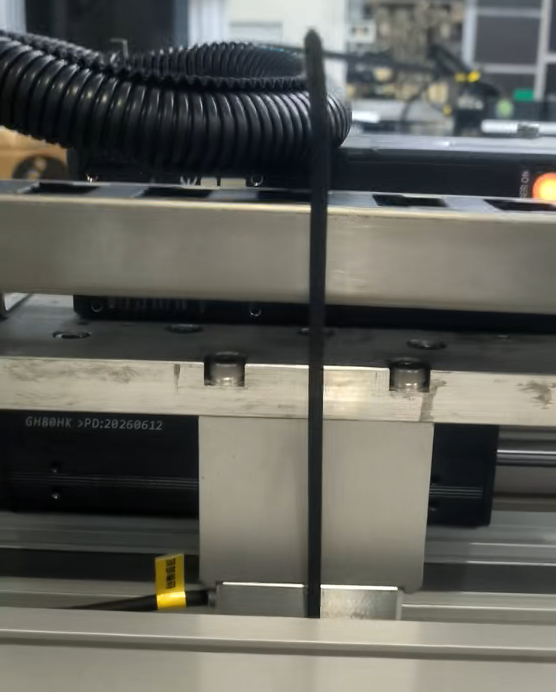
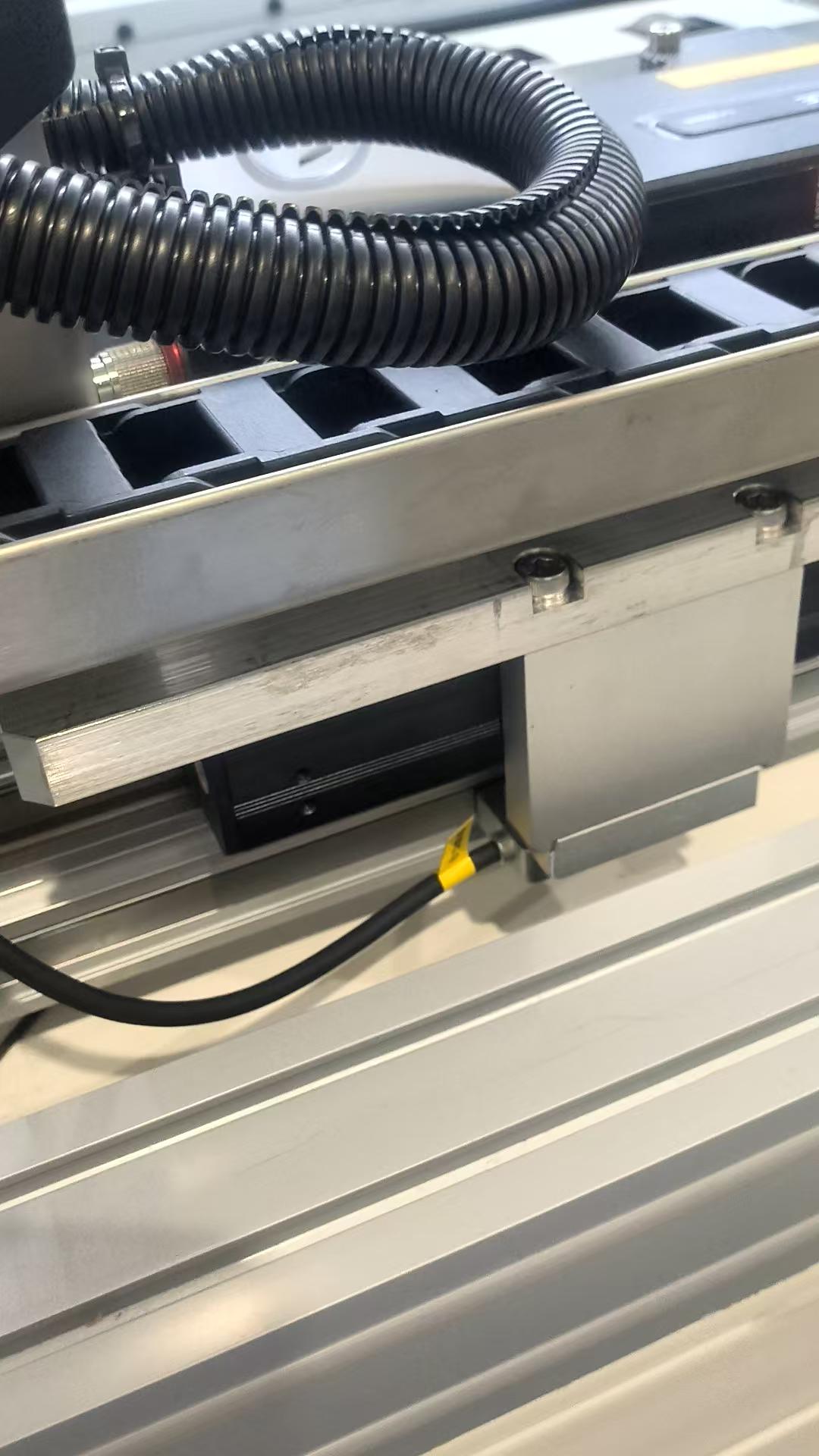
Position sensing unit: Atorm MRR series magnetic grid ruler reading head, installed along the side guide rail of the conveyor line, moves synchronously with the battery pack carrying fixture
Control unit: PLC, receives the position signal of the reading head and executes the triggering logic
Detection unit: Industrial camera array (multi camera combination), covering the entire appearance of the battery pack
The battery pack enters the inspection station area, and the conveyor line automatically decelerates;
The magnetic grid ruler reading head provides real-time feedback on the current position of the load-bearing fixture to the PLC;
When the position value reaches the preset photography trigger coordinate, the PLC immediately outputs a trigger signal to the visual system;
The visual system receives signals and synchronously triggers all cameras to complete photography;
Visual software analyzes and processes images, and outputs detection conclusions (qualified/unqualified/requiring retesting);
PLC controls the conveyor line based on the test results: qualified products are released, and unqualified products are diverted to the re inspection channel.
The entire process of "in place judgment signal triggering camera photography" is controlled within 1 second, fully meeting the requirements of the production line rhythm.
| Requirement dimension | MRR series features |
| Trigger position accuracy | Micron level resolution, excellent repeat positioning accuracy, ensuring consistent height of the photographed position |
| response speed | Millisecond level position feedback, meeting the requirements of dynamic positioning and real-time triggering of transmission lines |
| environmental adaptability | Not sensitive to oil stains and dust, strong resistance to electromagnetic interference, suitable for complex working conditions in battery pack production lines |
| Reliability | Compared to grating rulers, there is no need to frequently clean the ruler surface and adjust the gap, ensuring stable long-term operation |
After the actual implementation of the plan, three core indicators have significantly improved:
| indicator | Before improvement (limit switch scheme) | Improved (magnetic grid ruler triggering scheme) |
| Success rate of photography | About 85% (about 15% of waste films require reshoot or manual inspection) | ≥ 99% |
| Workstation Takt Time | 28s/piece | 22s/piece |
| Re examination rate | The proportion of misjudgments in retesting is relatively high | significant decline |
Specific analysis:
Improved success rate of photography: The magnetic grid ruler scheme increases the accuracy of positioning by an order of magnitude, significantly improves imaging stability, and reduces the waste rate from 15% to less than 1%;
Beat optimization: eliminates 2-3 seconds of positioning and focusing time after the visual system is in place, and compresses the total time for single piece inspection from 28s to 22s, providing surplus for the release of production line capacity;
Improvement in consistency detection: The stable shooting position ensures image consistency, reduces the misjudgment rate of visual algorithms, and significantly reduces the workload of the re inspection station;
Reduced operation and maintenance costs: The non-contact and pollution resistant characteristics of the magnetic grid ruler significantly reduce the frequency of daily cleaning and calibration maintenance.
The core value of this solution lies in using a magnetic grid ruler to solve the "position" problem, allowing the visual system to focus on the "recognition" problem.
By decoupling positioning and detection, the overall efficiency of the system is maximized. The visual system does not require computing power and time for position search, but instead uses all resources to improve image quality and defect discrimination accuracy.
This linkage scheme is not limited to battery pack detection scenarios and can be widely applied to high-precision online detection of various mobile workpieces
Online measurement of dimensions for large structural components
PCB board AOI automatic optical inspection
Defect detection of flat panel display panel
Any industrial scene that requires high tempo and high precision for "moving in place+precise triggering+visual detection"
The magnetic grid scale reading head is often regarded as a simple position feedback component in industrial automation. But in high tempo, high-precision visual inspection systems, it plays a key role as the "trigger trigger" - reliable, accurate, and real-time position triggering, which is the prerequisite guarantee for the visual system to maximize its efficiency.
The Atorm MRR series magnetic grid scale reading head provides a set of "spot and shoot" solutions validated by production lines for new energy battery packs and more industrial visual inspection scenarios, with micrometer level accuracy, millisecond level response, and strong anti-interference ability.
If you need further product details or technical support, please feel free to contact us.
Solution Design
Application Validation Support
Parameter Optimization Guidance
Commissioning Support