

Project Services
Solution Design
Application Validation Support
Parameter Optimization Guidance
Commissioning Support
By clicking on the button “I accept” or by further usage of this website you express consent with usage of cookies as well as you grant us the permission to collect and process personal data about your activity on this website. Such information are used to determine personalised content and display of the relevant advertisement on social networks and other websites. More information about personal data processing can be found on this link Cookie Policy.
Agree


Single Sensor
Double Sensor
Image Sensor
2026-07-15
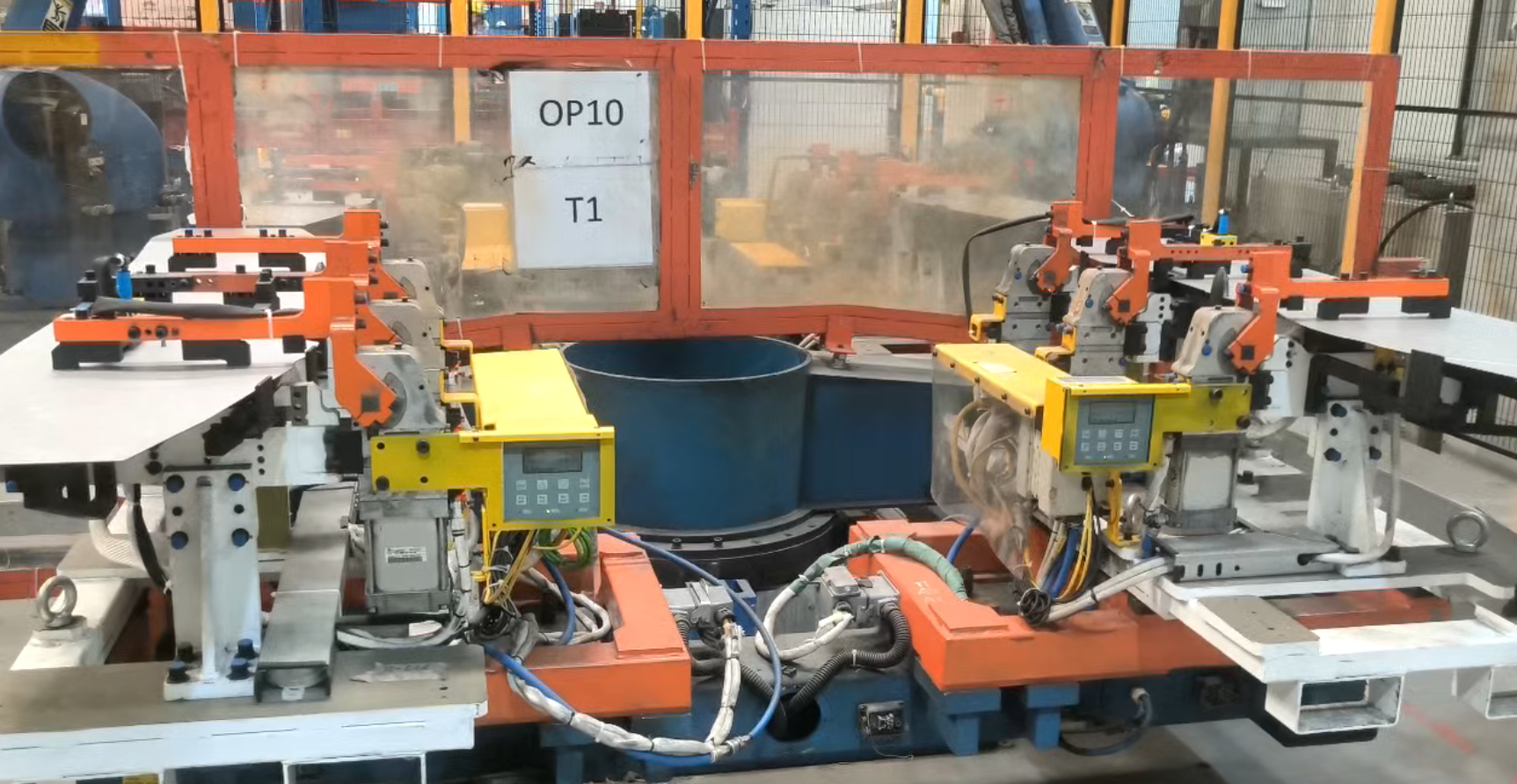
This project is a core welding production line for a certain automotive component. The production line is mainly responsible for the automated welding and processing of body patch panels. The overall production cycle is compact and the mass production load is high. The daily average sheet metal feeding amount reaches 400 sheets. The raw materials for the production line are galvanized steel plates with different thickness specifications ranging from 1.2mm to 2.0mm. All patch plate materials are manually placed at two independent workstations on the left and right, and after completion of loading, they enter the welding process.
Due to the presence of a lubricating oil film on the surface of galvanized steel plates, as well as factors such as electrostatic adsorption and negative pressure in the stacking gap during production, there are frequent occurrences of two or more plates sticking and stacking during the material loading process. If the adhesive double material is not identified in advance and directly enters the welding station, it will cause batch quality defects such as virtual welding, welding spatter, weld porosity, and insufficient melting depth. At the same time, it will also cause equipment failures such as electrode cap wear and mold damage, which not only increases the product defect rate, but also leads to production line shutdown, maintenance and replacement problems, seriously affecting the production stability and efficiency of the production line.
In order to avoid the risk of stacking welding from the source, establish a production error prevention mechanism, and ensure the quality of product welding and equipment operation safety, this production line urgently needs to deploy high-precision, anti-interference, and mass-produced single and double sheet dedicated detection equipment in the feeding process.
2.1 Precise Equipment Selection
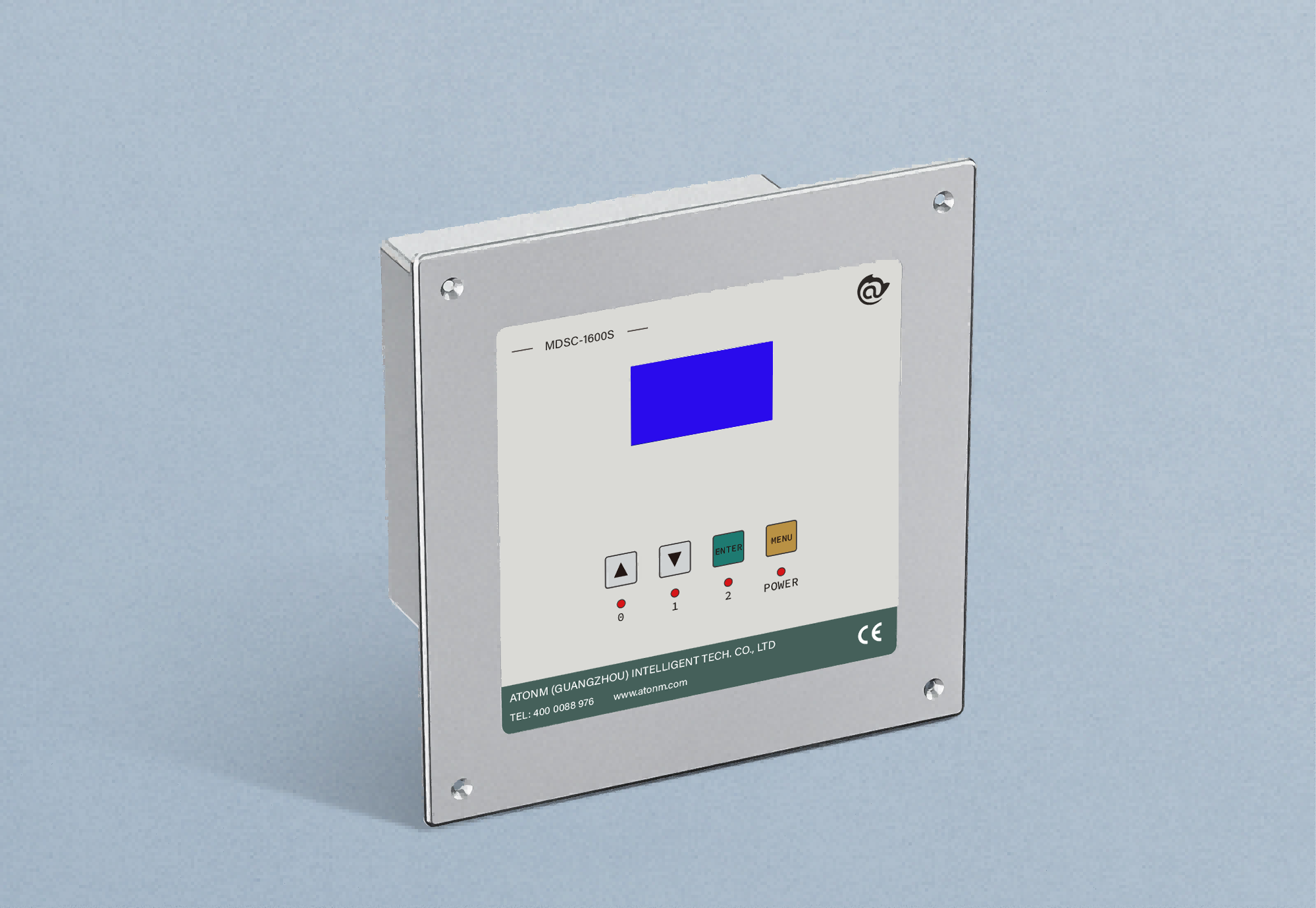
Based on the material specifications, working conditions, and production pace requirements of the production line, Atorm was ultimately selected for the projectMDSC-1000B dual detectorThe dual material detection sensor for injection type metal is suitable for complex production scenarios in automotive welding production lines.
This device works based on the principle of electromagnetic induction detection, and constructs a stable electromagnetic field through two sets of opposing probes. It can accurately capture the differences in thickness parameters when metal sheets pass through, and quickly and accurately determine whether the material is in a single or double sheet state. The official testing range of the equipment is 0.05mm-4.5mm (for iron metal materials), fully covering the testing requirements of 1.2mm-2.0mm galvanized steel plates on this production line, with strong adaptability.
At the same time, the device is equipped with a dedicated anti-interference circuit, which has been specially optimized for complex working conditions such as strong electromagnetic interference, workshop equipment vibration, and dust generated during the operation of welding robots. It can operate stably in harsh environments in the welding workshop for a long time, with no deviation in detection data and no faults in equipment operation.
2.2 Scientific Installation Layout
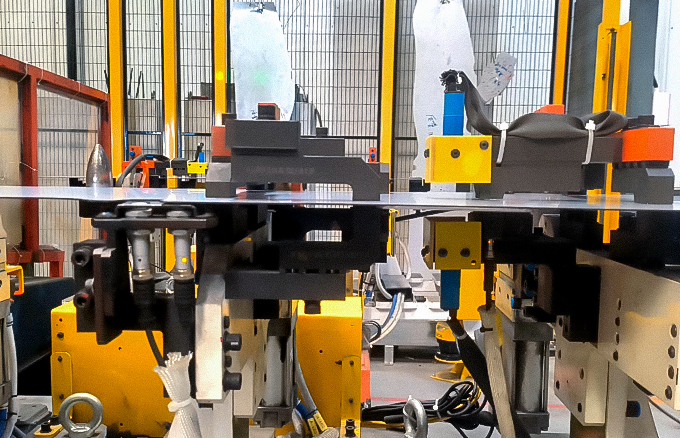
Based on the original layout of symmetrical operation of the left and right workstations on the production line, the project adopts a one-to-one adaptive installation scheme, with each workstation independently deployed with a setMDSC-1000BDual material detection system, achieving precise detection of different specifications:
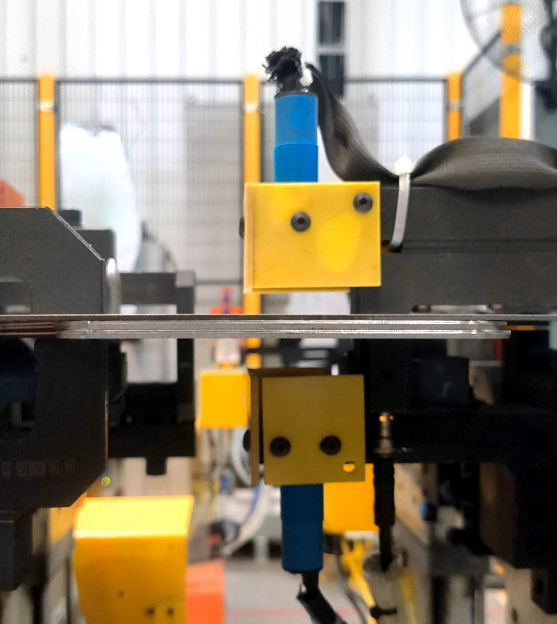
Each workstation adopts a top-down shooting installation structure, with the lower probe of the sensor fixed to the bottom of the workbench and the upper probe integrated and installed on the movable fixture of the equipment. After manually completing the placement and positioning of the sheet metal, the fixture automatically moves to the standard inspection station, ensuring that the sheet metal to be inspected is accurately located in the detection center area of the upper and lower shooting probes, providing stable working conditions for high-precision inspection.
2.3 Standardized operating procedures
After the equipment deployment is completed, the production line forms a standardized closed-loop operation process of "feeding detection judgment operation/interception", which is fully adapted to the original production rhythm without the need for significant changes to the original production process. The specific process is as follows:
1. Manual precise feeding: Operators place body patch panels of different specifications in designated positioning areas on the left and right workstations, completing the orderly placement of materials.
2. Automatic triggering detection: After confirming that the sheet metal is placed in place and there is no deviation, the operator starts the detection program,MDSC-1000B sensorQuickly complete electromagnetic field scanning and automatically determine the dual sheet status of the material list.
3. Intelligent signal feedback: The device outputs corresponding signals based on the detection results, forming an intelligent error prevention mechanism. When detected as a single sheet metal, the system outputs a compliance signal, unlocks workstation permissions, and allows the material to enter the next process; When detected as double stack material, the system immediately triggers a buzzer alarm, locks the workstation process, intercepts abnormal materials, and prevents defective materials from flowing into the welding process.
4. Compliant material welding: Single patch plates that have passed inspection are automatically transferred to the welding station through a rotating worktable, and standardized welding operations are completed by welding robots. Abnormal materials are manually removed and re loaded for testing by operators until they pass the inspection.
3.1 Source control quality to avoid welding defects
Relying on the high-precision dual material detection capability of MDSC-1000B, the production line achieves pre stacking interception, solving quality problems such as virtual welding, splashing, weld porosity, and insufficient penetration caused by adhesion stacking of galvanized steel plates from the production source. It significantly improves the welding quality of body patch panels, achieves a significant increase in weld qualification rate, effectively reduces product rework and scrap rates, and stabilizes product quality at the factory.
3.2 Protecting production equipment and reducing fault losses
Double sheet metal mistakenly entering the welding station is one of the core causes of electrode cap damage, mold deformation, and equipment jamming faults in welding tongs. After the equipment is installed, it completely avoids the hard damage of stacking to the core welding equipment, greatly reduces the frequency of equipment failure and spare parts replacement, effectively extends the service life of welding equipment and molds, and reduces equipment maintenance losses.
3.3 Adapt to the production pace and improve production efficiency
This sensor has millisecond level rapid detection response capability, and the detection process does not require additional production hours, fully adapting to the original efficient production pace of the production line. Under the daily production and feeding scale of 400 sheets, the downtime caused by double material abnormalities, such as emergency shutdown, rework and repair, and equipment maintenance, has been solved, ensuring continuous and efficient production of the production line and steadily improving the overall production flow efficiency.
3.4 Domestic substitution to reduce costs and optimize production costs
As a cost-effective domestic testing equipment, MDSC-1000B has significant price and service advantages, while benchmarking imported similar products in terms of testing accuracy, anti-interference ability, and operational stability. The equipment procurement cost is lower, the later maintenance is simple, and the accessories are easy to obtain, greatly reducing the enterprise's equipment procurement cost and long-term operation and maintenance cost, providing strong support for cost reduction and efficiency improvement of the production line.
In response to the industry pain points of easy adhesion and difficulty in troubleshooting stacking of galvanized steel plates in the automotive welding production line, the AtonmMDSC-1000B dual material detection system was deployed this time, combined with a differentiated detection layout of left and right dual stations, to establish a pre quality error prevention system of "detection first, welding later", solving the problem of stacking control in the manual feeding process.
The complete solution does not require significant modifications to the original production line process, has strong adaptability, low implementation difficulty, stable and reliable operation, effectively guarantees the welding quality of automotive parts, protects core production equipment, improves mass production efficiency, and controls production costs. For the dual material testing scenarios of various metal sheet welding production lines such as automotive body patch panels and sheet metal parts, it has strong applicability, feasibility, and industry promotion value.
Q1: Strong electromagnetic interference in the welding workshop, will there be false or missed detections of equipment?
No. AtonmMDSC-1000B is equipped with a dedicated anti-interference circuit architecture, which has been specially optimized for complex welding conditions such as high-frequency electromagnetic radiation from welding robots, frequency conversion interference from workshop equipment, mechanical vibration, and dust and oil pollution. The equipment can stably construct electromagnetic fields in strong electromagnetic environments, with no drift in detection parameters and no deviation in data. During actual mass production, it can continuously and accurately identify single or double sheet materials without any problems such as false detection, missed detection, or false alarms. It is fully compatible with the harsh production environment of automotive welding production lines.
Q2: Will the speed of equipment detection drag down the original production pace and affect production capacity?
It will not affect the production pace at all. This device adopts a millisecond level rapid detection response mechanism, with extremely short detection time per time. The detection process can be synchronized with the fixture positioning process on the production line, without the need for additional production hours. In the daily production scenario of 400 sheets per day in this project, the equipment is fully adapted to the original production rhythm, without the need to stop and wait for testing, completely solving the problem of capacity loss caused by traditional testing equipment lagging and ensuring efficient and continuous production on the production line.
Q3: Compared to imported dual material testing equipment, what are the advantages of domestic MDSC-1000B in long-term use?
On the basis of benchmarking the performance of imported products, this device has significant advantages in implementation and use. In terms of performance, the detection accuracy, stability, and anti-interference ability fully meet the mass production standards for automotive welding and assembly, and are suitable for the detection needs of 1.2mm-2.0mm conventional sheet metal plates; At the cost level, the equipment procurement price is much lower than that of imported brands, and there is no need for high annual or service fees; At the operation and maintenance level, domestically produced equipment accessories are easily available, easy to maintain, and have fast after-sales response, significantly reducing the long-term equipment operation and maintenance costs of enterprises. It is the most cost-effective import substitution solution.
Solution Design
Application Validation Support
Parameter Optimization Guidance
Commissioning Support