

Project Services
Solution Design
Application Validation Support
Parameter Optimization Guidance
Commissioning Support
By clicking on the button “I accept” or by further usage of this website you express consent with usage of cookies as well as you grant us the permission to collect and process personal data about your activity on this website. Such information are used to determine personalised content and display of the relevant advertisement on social networks and other websites. More information about personal data processing can be found on this link Cookie Policy.
Agree


Single Sensor
Double Sensor
Image Sensor
2025-08-22
Currently, the hardware and home appliance industry (e.g., production of stamped parts like washing machine inner tubs, refrigerator door panels, and air conditioner outdoor unit brackets) faces three core challenges: "high mold loss caused by double-sheet stacking, poor adaptability of traditional detection methods, and low efficiency in multi-variety production changeovers." These issues directly impact production efficiency and product quality. Based on Atonm’s through-beam magnetic induction double-sheet detector, this solution achieves quality control upgrades and cost optimization in the stamping feeding process through minimalist integration, accurate detection, and rapid production changeover design.
(I) Industry Core Pain Points
1. High Losses Caused by Double-Sheet Stacking
In hardware and home appliance stamping production, metal sheets (such as galvanized sheets and cold-rolled steel sheets) are prone to double/multiple sheet stacking due to issues like surface oil stains. When stacked sheets enter the mold, they cause mold edge chipping and cavity wear, with a single repair cost exceeding 100,000 yuan. The annual mold damage rate in the industry reaches 15%-20%. Meanwhile, stacking leads to stamped part deformation and dimensional deviations, increasing the scrap rate by 3%-5%. The annual production line downtime caused by double-sheet problems amounts to 120 hours, directly affecting order delivery.
2. Insufficient Adaptability of Traditional Detection Technologies
Mechanical contact detection (e.g., probes, rollers) easily scratches the surface of 0.2-1.2mm lightweight thin sheets, and it is difficult to control pressure on thin sheets, resulting in a false detection rate exceeding 8%.
Ordinary photoelectric detection is affected by surface reflection and stains on sheets, leading to poor detection stability for magnetic metals (accounting for over 80% of stamping materials in the hardware and home appliance industry) and inability to accurately identify double sheets.
Existing equipment lacks targeted recipe storage. During production changeovers, sensor positions and parameters need repeated adjustment, taking over 30 minutes—failing to meet the flexible production needs of "multi-variety, small-batch" orders.
3. Lack of Quality Traceability and Process Optimization
Traditional detection has no data recording function. When quality issues arise due to double sheets, key information such as specific batches and detection times cannot be traced, making it difficult to locate the root cause of problems. Additionally, the lack of detection data support prevents optimization of process parameters such as robotic arm gripping pressure and feeding speed, resulting in a persistently high material collision loss rate (approximately 5%).
(II) Core Goals of the Solution
1. Detection Performance Goals
Adaptable Materials: 0.2-3mm magnetic metal sheets (galvanized sheets, cold-rolled steel sheets, hot-rolled steel sheets, and other common materials in the hardware and home appliance industry).
Response Speed: ≤200ms, adaptable to high-speed stamping production lines of 1,200 sheets per minute, with no detection delay.
2. Production Efficiency Goals
Cost Optimization: Reduce annual mold maintenance costs.
Efficiency Improvement: Shorten production changeover time from 30 minutes to less than 1 minute.
(I) Core Equipment Selection and Technical Parameters
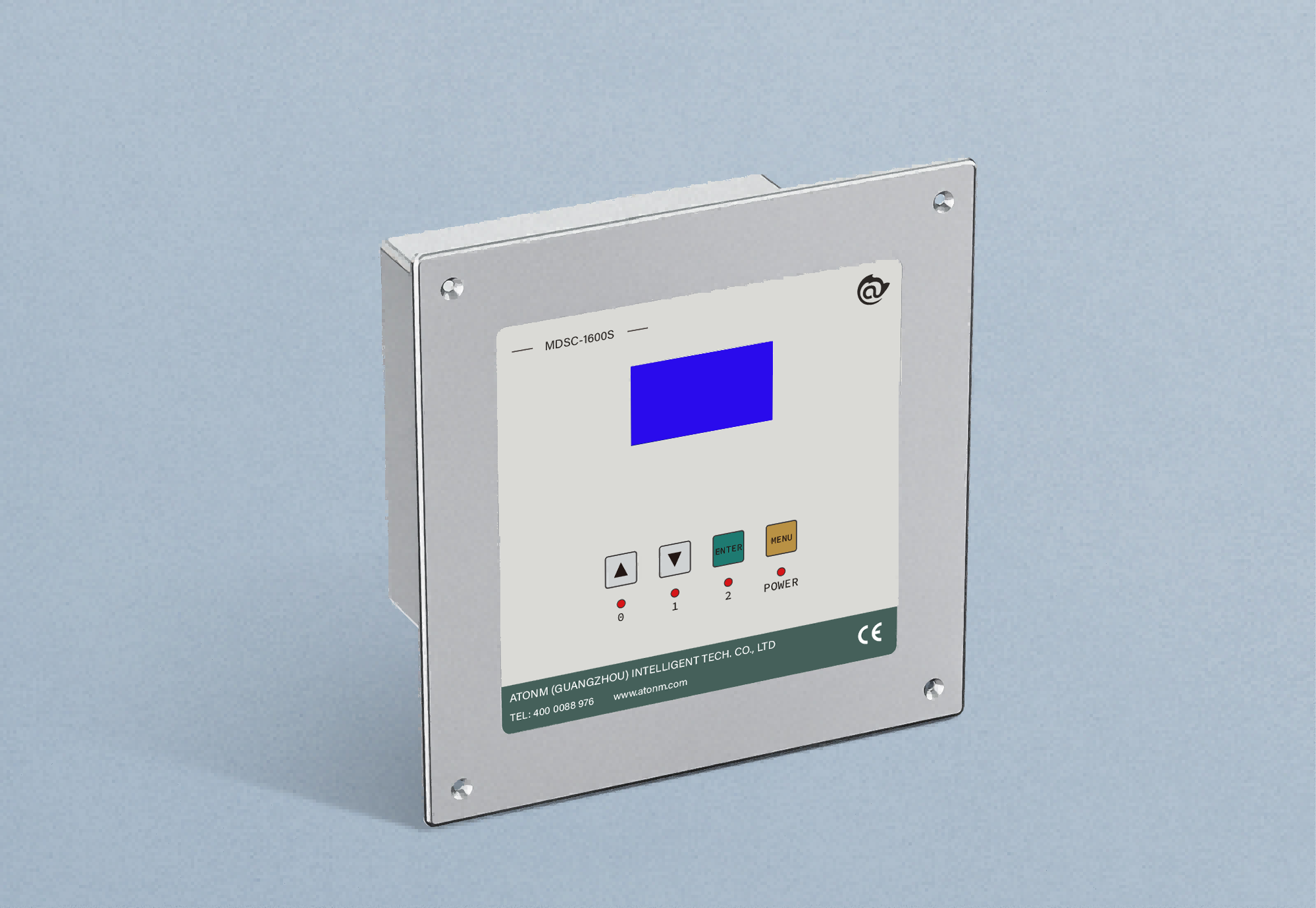
Atonm Through-Beam Double-Sheet Detector: Taking the MDSC-1000C as an example
| Technical Parameter | Specification Index | Industry Adaptability Description |
|---|---|---|
| Detection Principle | Magnetic induction principle (only applicable to magnetic materials) | Matches over 80% of magnetic stamping materials in the hardware and home appliance industry |
| Detection Range | Sheet thickness: 0.2-4.5mm | Covers all scenarios from lightweight thin sheets to medium-thick plates |
| Response Time | ≤50ms | Adapts to high-speed production lines of 1200 pieces/minute |
| Installation Method | Through-beam type (transmitter + receiver) | Adapts to fixing on both sides of the detection platform, no detection blind area |
| Protection Level | IP65 | Resists workshop oil stains and dust environments |
| Anti-Interference Capability | 50Hz power frequency interference suppression, signal-to-noise ratio ≥30dB | Avoids the impact of electromagnetic interference from stamping equipment |
| Communication Interface | RS485 | Directly connects to on-site PLC (e.g., Siemens S7-1500) and MES systems |
| Recipe Storage | 100 sets of material parameters (classified by thickness/material) | Supports rapid production changeover for multiple varieties |
| Working Voltage | DC 24V±10% | Adapts to industrial standard power supply |
(II) System Integration and Implementation Design
1. Installation Layout (Adapted to the Detection Platform Scenario After Robotic Arm Gripping)
Detection Point Positioning: Set above and below the detection platform or conveyor belt between the robotic arm gripping station and the stamping mold feeding port, ensuring the metal sheets to be detected pass through the effective induction area.
Sensor Installation:
The transmitter and receiver are respectively fixed on custom brackets of the detection platform, with the transmitter (T) placed above and the receiver (R) below. Their working surfaces (with black circular disks) are installed directly opposite each other.
The allowable installation distance between the working surfaces is 30-50mm, with a recommended installation distance of 40mm.
Calibration is required after installation: Test with a standard-thickness (e.g., 1mm) cold-rolled steel sheet to ensure stable detection signals without drift.
2. Control Logic and Workflow
(1) Normal Workflow
The robotic arm grabs a single sheet from the stack → moves to the sensor installation position → the sheet completely covers the detection area of the through-beam sensor → the detector completes magnetic induction detection instantly (≤50ms) → confirms "single sheet" → the PLC receives the qualified signal → the robotic arm grabs the sheet and sends it to the stamping mold → the detection platform resets to wait for the next detection.
(2) Double-Sheet Abnormal Workflow
The robotic arm places the sheet → the detector detects "double sheets" → immediately sends an abnormal signal to the PLC → the PLC controls the robotic arm to stop feeding and return to the safety area → the sound and light alarm is activated → the MES system synchronously records abnormal information (time, batch, sheet thickness) → operators confirm and remove the stacked sheets → press the reset button → the system resumes normal detection.
(3) Rapid Production Changeover Workflow
Operators select the "material recipe" corresponding to the product to be produced (e.g., "0.5mm galvanized sheet," "1.2mm cold-rolled steel sheet") via the industrial touchscreen.
The system automatically loads the detection parameters for the material, with no need to adjust the sensor position.
Test 1-2 sheets of the first batch to confirm normal detection, then start mass production. The entire process takes <1 minute.
3. Data Management and Traceability Design
Real-Time Monitoring: The industrial touchscreen displays real-time data, including "current detection status (normal/abnormal), sheet thickness, cumulative detection quantity, and today’s abnormal count." A pop-up window shows detailed information when an abnormality occurs.
Data Storage: Detection data (detection time, batch number, whether double sheets, and operator for each sheet) is automatically synchronized to the MES system, with a storage period of ≥1 year. It supports filtering and querying by "date, batch, and abnormal type."
Report Export: Daily/monthly detection reports in Excel format can be exported, including key indicators such as "total detection quantity, abnormal quantity, abnormal rate, and mold protection times," providing data support for process optimization
(I) Implementation Schedule Planning (Single Production Line)
(II) After-Sales Service and Technical Support
Warranty Period: The detector comes with an 18-month warranty. During the warranty period, faulty parts will be repaired or replaced free of charge.
Response Mechanism: Provide 7×24-hour technical support to address urgent issues in a timely manner.
Regular Maintenance: Conduct 1 remote inspection every quarter to ensure the long-term stable operation of the equipment.
Based on the Atonm MDSC-1000C through-beam magnetic induction double-sheet detector, this solution targets the core pain points in the stamping feeding process of the hardware and home appliance industry. Through the design of "accurate detection, minimalist integration, and rapid production changeover", it can realize three core values: "significant reduction in mold loss, remarkable improvement in production efficiency, and full implementation of quality traceability".
Focusing on the detection scenario of metal sheets, the solution features strong equipment adaptability, fast return on investment, and low implementation difficulty. It can be directly applied to the production lines of hardware stamped parts such as washing machines, refrigerators, and air conditioners, helping enterprises achieve cost reduction, efficiency improvement, and digital transformation.
Solution Design
Application Validation Support
Parameter Optimization Guidance
Commissioning Support