

Project Services
Solution Design
Application Validation Support
Parameter Optimization Guidance
Commissioning Support
By clicking on the button “I accept” or by further usage of this website you express consent with usage of cookies as well as you grant us the permission to collect and process personal data about your activity on this website. Such information are used to determine personalised content and display of the relevant advertisement on social networks and other websites. More information about personal data processing can be found on this link Cookie Policy.
Agree


Single Sensor
Double Sensor
Image Sensor
2026-07-03
This customer is a core stamping supplier for a leading domestic new energy vehicle company, mainly responsible for the production of large exterior panels (side panels, door panels, roof covers, etc.) for multiple pure electric vehicle models. The production line has two significant characteristics:
Diverse incoming materials and frequent switching: compatible with both 0.2mm thin plates (inner panels) and 3.0mm thick plates (structural reinforcement components), and due to accelerated vehicle model iteration, daily production changes can reach 3-5 times;
High speed continuous stamping: cycle time of 12 SPM
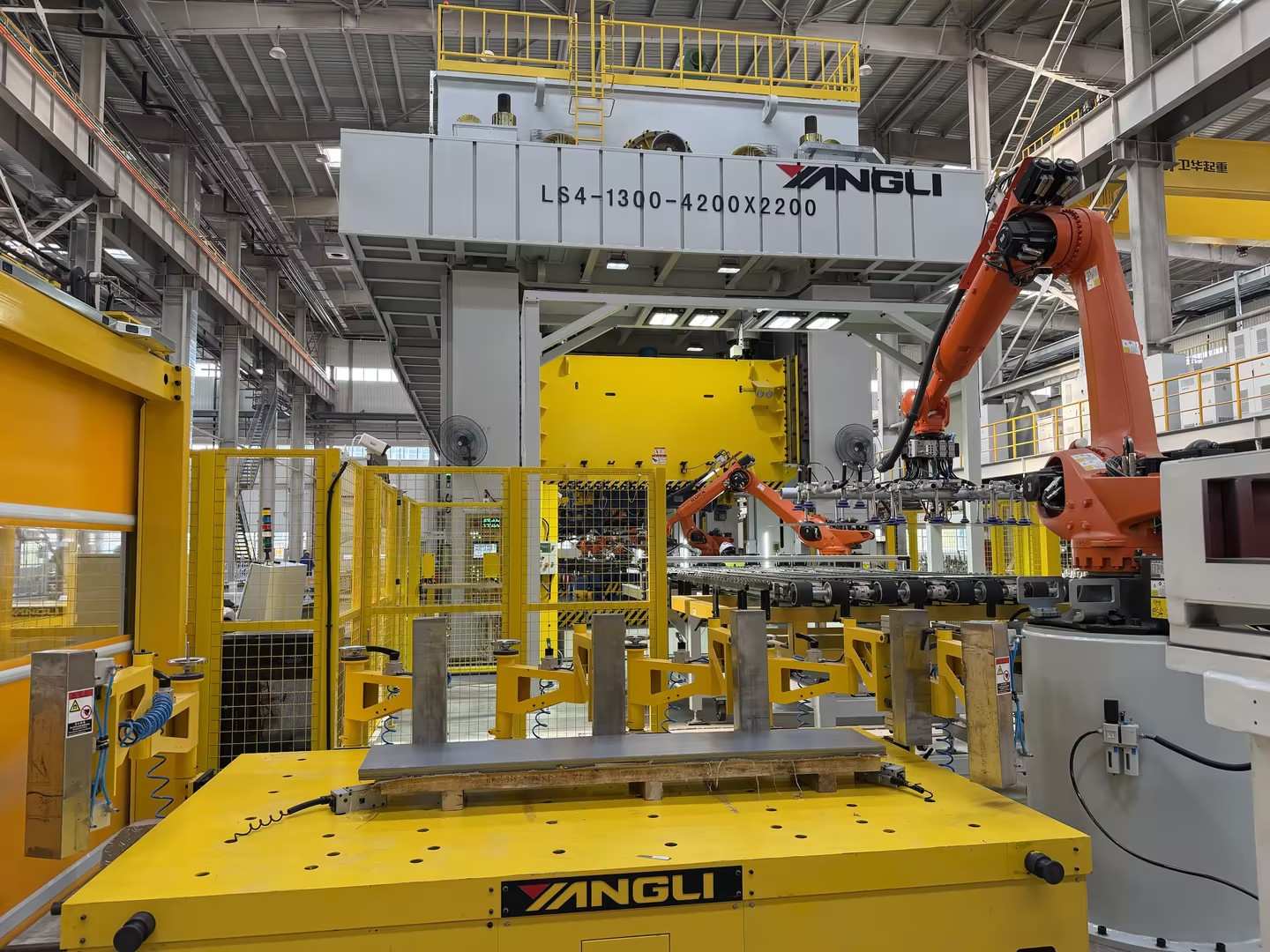
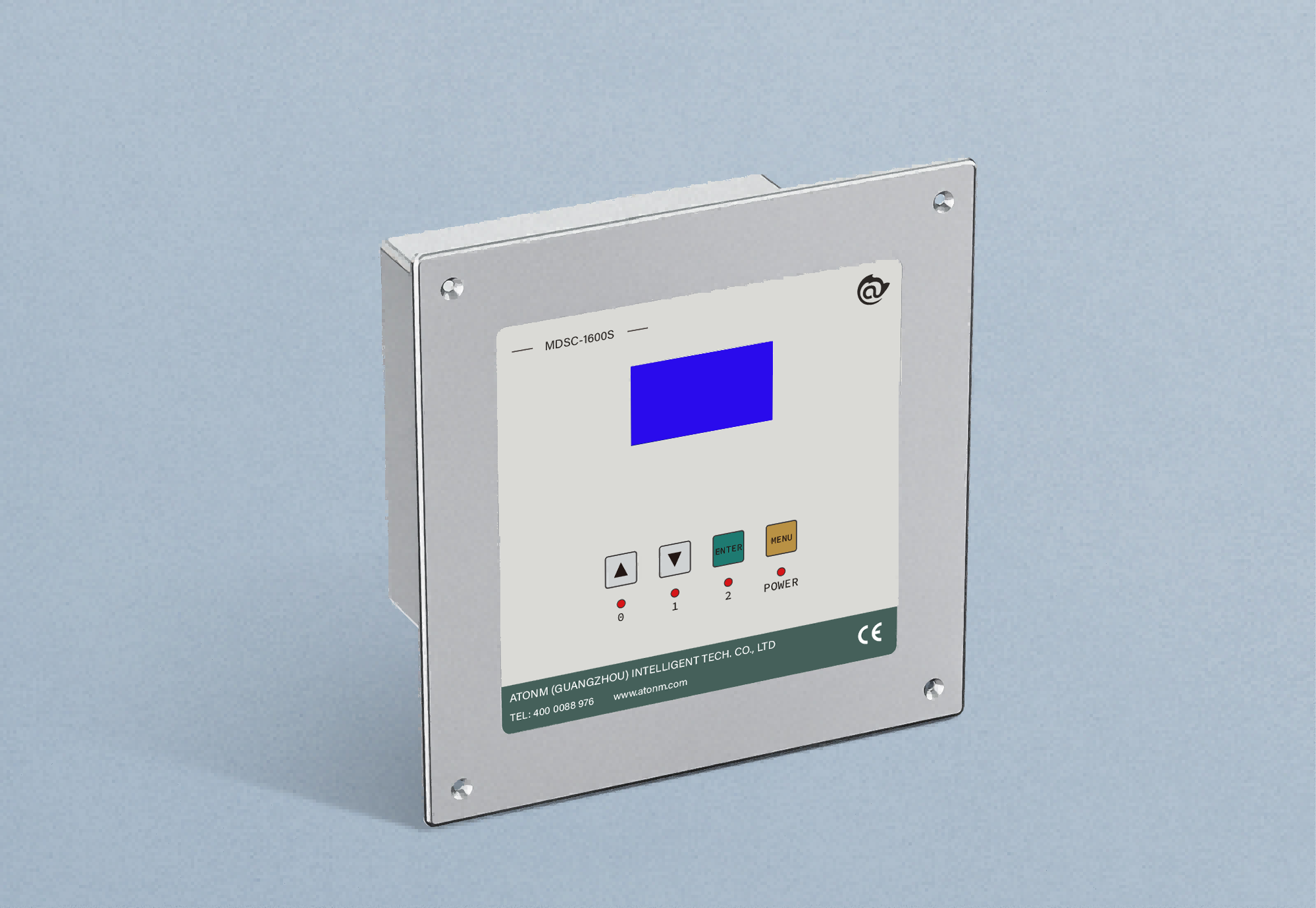
The Atorm technical team adopts a differentiated deployment strategy based on the characteristics of the production line workstations, using a "disassembly area contact type" approachMDSC-8200S dual detectorPre inspection+belt area pass through methodMDSC-1500S dual material detectorBuild a dual line of defense through re inspection to achieve full process feeding protection.
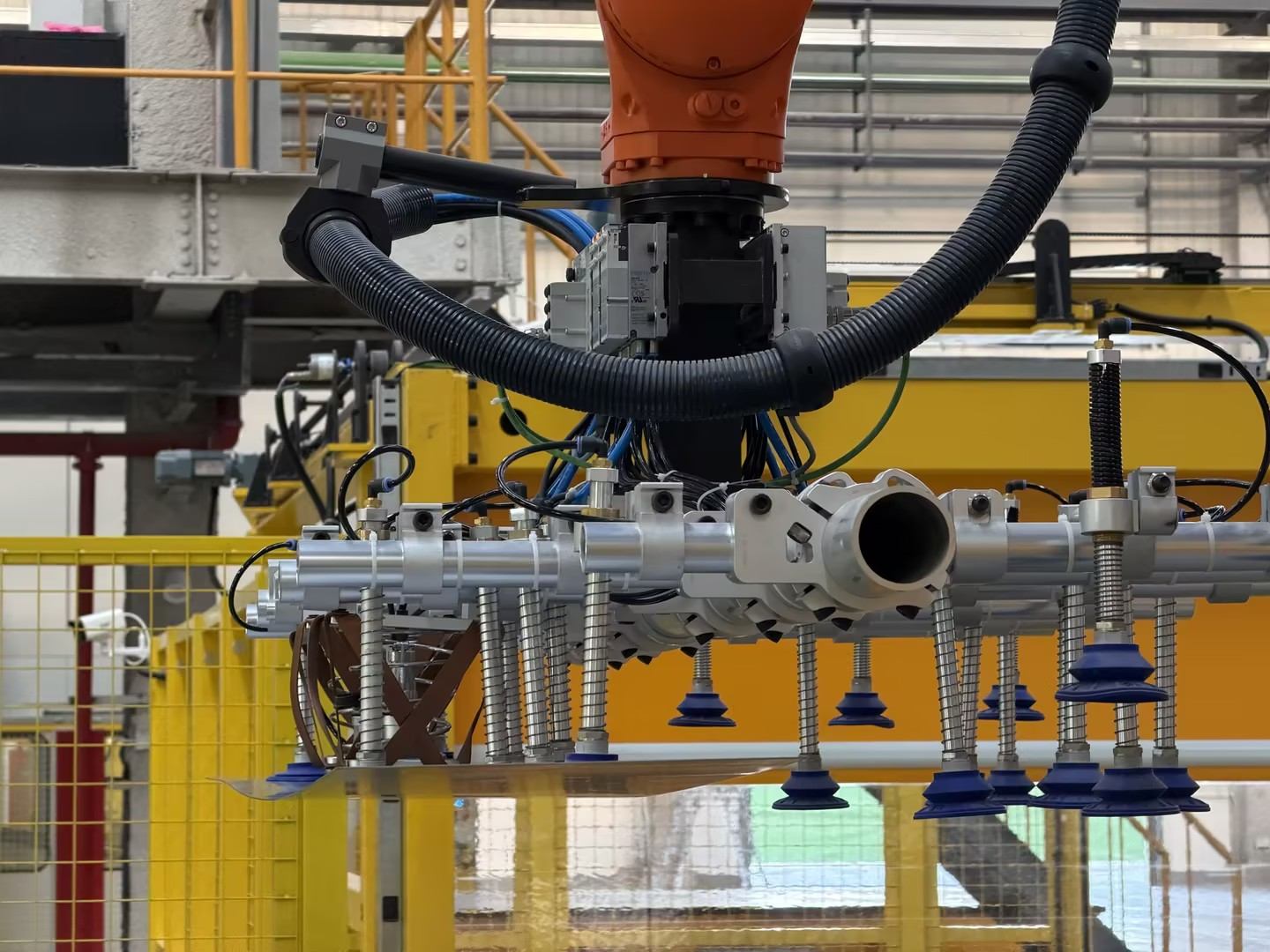
Install one MDSC-8200S contact type dual detector at the end pick of the unpacking robot arm. The device adopts the principle of electromagnetic induction, and the sensor is installed on the end effector of the robotic arm, which directly contacts the sheet metal for detection with the movement of the robotic arm.
Detection thickness range 0.2-4.0mm (magnetic metal plate)
Response speed of 200 pcs/min
2 channels (one to two design)
200 sets of formula storage
Communication methods include Profinet, RS485, and terminal control
Contact detection is suitable for dismantling and grabbing scenarios, eliminating air gap interference and ensuring stable detection in oil and dust environments;
The dual channel design allows one host to connect two sensors and simultaneously detect both sides of the sheet metal, making it more comprehensive;
200 sets of formula storage support quick switching of detection parameters for different thicknesses and materials of sheets, meeting the needs of flexible production switching.
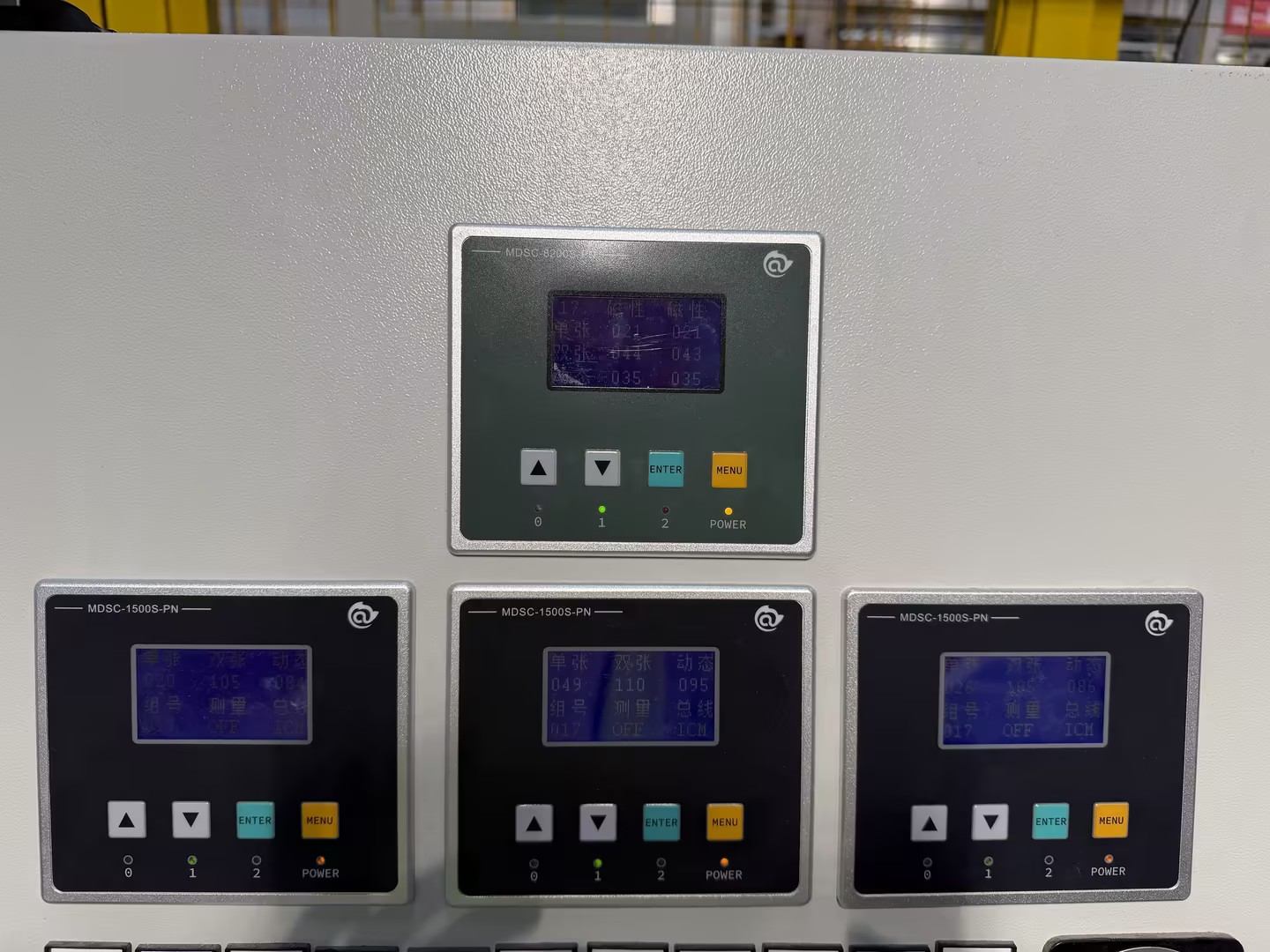
Install 3 MDSC-1500S through type dual detectors at the feeding belt/roller conveyor in front of the mold. The equipment adopts the method of emitter and receiver facing each other, and the sheet metal completes the detection while moving on the belt, without touching the sensor, without wear, and without interfering with the conveying rhythm.
Testing thickness range: 0.2-4.0mm for iron sheets and stainless steel plates, 0.2-5.0mm for aluminum sheets, and 0.2-5.0mm for aluminum plates
Response speed 1200 pcs/min
Detection method: non-contact through type
200 sets of formula storage
Communication methods: IO, Profinet
Sensor protection level IP65
Adapting to high-speed continuous conveyor conditions on belt lines through non-contact detection, it does not hinder material flow and has no risk of wear and tear;
The response speed of 1200 pcs/min far exceeds the 12 SPM cycle requirement, and the detection does not occupy any production time at all;
Full material compatibility: Carbon steel, stainless steel, aluminum, etc. can all be tested, reserving capacity for future steel aluminum hybrid production.
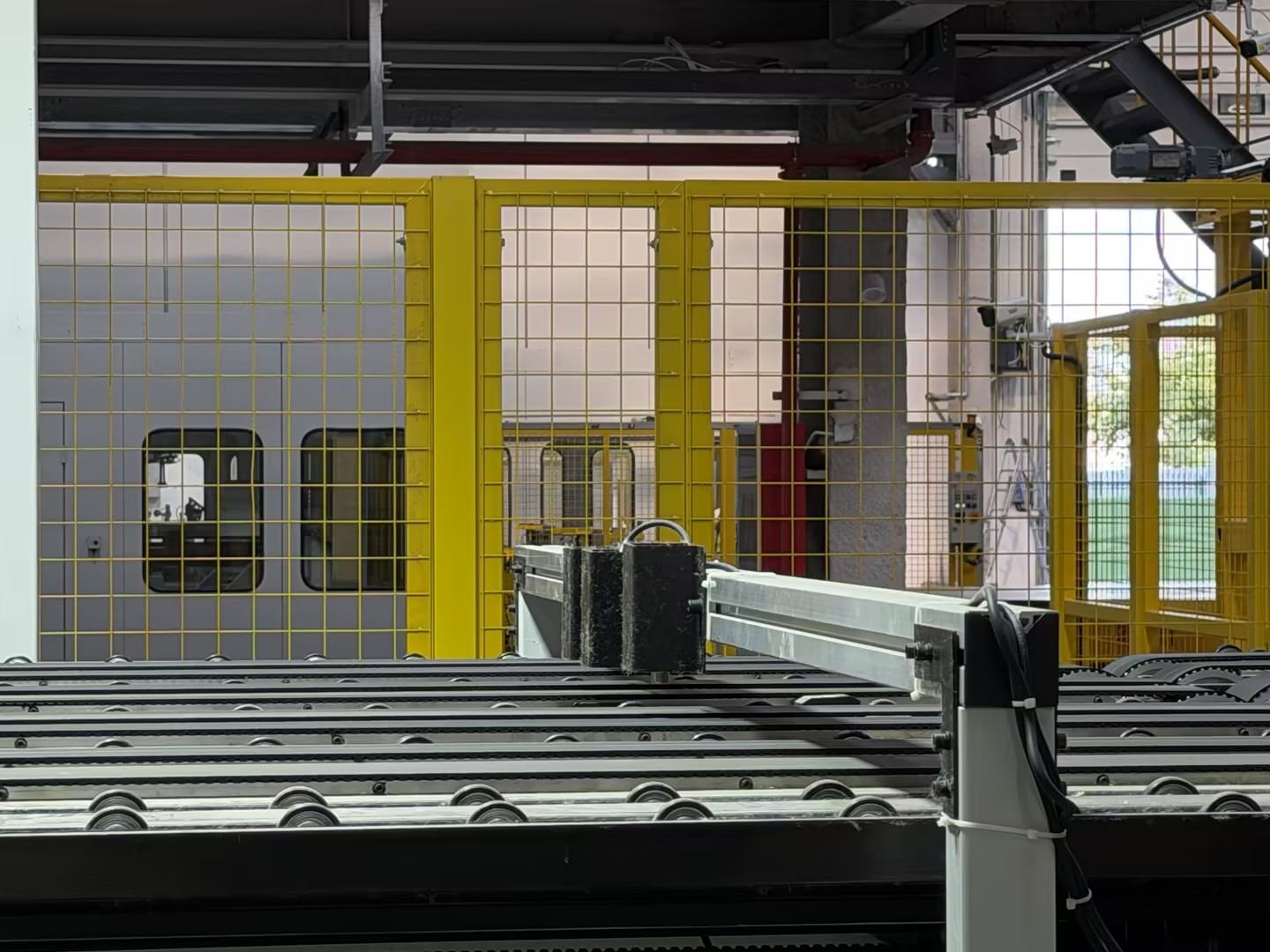
The first line of defense (unpacking area): When the robotic arm grabs the sheet metal, the 8200S contact sensor synchronously detects it. If it is judged as a single item, send an "OK" signal to allow transportation; If it is determined to be a double sheet, an "NG" signal will be sent, and the robotic arm will put the stacked material into the waste area and sound an alarm to intercept the double material from the source into the mold.
The second line of defense (belt area): During the conveyor process of the sheet metal, three 1500S pass through detectors conduct a secondary inspection of each sheet metal to form a "double safety" to prevent fish from escaping the net.
Zero double sheet entry into the mold: Double interception of disassembly initial inspection and belt re inspection, effectively solving mold damage and product quality accidents caused by stacking, significantly reducing mold maintenance frequency and downtime losses.
Perfectly matched with 12 SPM cycle times: 8200S (200 pcs/min) and 1500S (1200 pcs/min) both have response speeds far exceeding the production line requirements, with zero time consumption in the detection process and no slowing down of the production cycle.
Flexible production switching and fast switching: Both devices are equipped with 200 sets of formulas, and pre stored parameters can be called with just one click during production switching, eliminating the need for repeated debugging and adapting to the production needs of multiple models of new energy vehicles on the same line.
Localization substitution reduces costs and increases efficiency: significantly reduces procurement costs compared to imported equipment, localized technical support ensures fast delivery and operation response, and eliminates dependence on imports.
This case study focuses on the working conditions of high-speed production (12 SPM) of steel plates (0.2-3.0mm) in the stamping production line of new energy vehicles. The Atonm8200S contact type+1500S through type dual detector combination scheme is adopted to achieve full process coverage of pre inspection in the unpacking area and re inspection in the belt area. The solution not only ensures the accuracy and speed of detection, but also takes into account the needs of flexible production and cost reduction through localization, providing a replicable practical path for dual material detection and protection in similar stamping production lines. If you also have such pain points on your production line, you can contact Atorm 13342814291 and we will provide you with a solution!
Frequently Asked Questions (FAQ)
Q1: Why is it necessary to use a combination of "contact+pass" method for dual material testing, and what are the core advantages?
The core advantages of this combination method are complementary workstation adaptation, anti-interference in all working conditions, and zero leakage detection in the entire chain, which cannot be compared by a single detection scheme: ① Complementary advantages of working conditions: strong interference from air gaps and oil and dust in the disassembly and grabbing workstation, direct contact detection of 8200S directly adheres to the sheet metal, eliminating air gap interference from the root source and solving the pain point of easy false detection in disassembly scenarios; The belt conveyor station pursues interference free high-speed flow, 1500S non-contact detection without wear and obstruction of feeding, suitable for continuous conveying conditions; ② Advantages of closed-loop protection: forming a dual level defense line of source interception and process re inspection, eliminating blind spots and secondary electrostatic adhesion missed detection problems in single device detection, and achieving dual material mold zeroing; ③ Production adaptation advantages: Balancing static precise detection of disassembly stacks and dynamic high-speed detection of belts, ensuring detection accuracy without occupying 12 SPM production cycles, while adapting to high-frequency flexible production needs, perfectly matching the complex working conditions of new energy stamping production lines.
Q2: The production line changes production 3-5 times a day. Will equipment changeover and debugging take up a lot of production time?
can't. Both AtonM8200S and 1500S come with 200 sets of customizable process formulas, allowing customers to pre store testing parameters for different material specifications such as 0.2mm thin plate, 3.0mm thick plate, stainless steel, aluminum, etc. in advance. During daily production changes, operators only need to call the corresponding formula with one click on the terminal to complete parameter switching, without the need for recalibration or debugging. A single type change takes no more than 3 seconds and does not occupy any effective production time, adapting to high-frequency production needs.
Q3: Can this solution be compatible with subsequent steel aluminum mixed production lines, and will the accuracy decrease when testing aluminum plates?
It can achieve steel aluminum mixed production line, but attention should be paid to equipment adaptation differentiation. The 8200S standard combination does not support aluminum detection, and the accuracy of detecting aluminum plates does not decrease. In this scheme, the MDSC-1500S through type detector natively supports multi material detection of iron sheets, stainless steel, and aluminum plates. The thickness of aluminum plate detection can reach 0.2-5.0mm, covering common specifications of aluminum structural components and coverings for new energy vehicles; However, MDSC-8200S is only compatible with magnetic metal plates and cannot detect aluminum materials. If the production line requires full chain aluminum material testing, the dismantling area equipment can be replaced with Atonm9000 series dedicated aluminum double tension detectors. The entire defense architecture remains unchanged, and after hardware fine-tuning, full specification steel aluminum mixed line testing can be achieved, reserving sufficient capacity for subsequent process upgrades of the production line.
Keywords: dual material testing, stamping automation, new energy vehicles Atonm8200S、Atonm1500S、 Steel plate stamping and stacking inspection
Solution Design
Application Validation Support
Parameter Optimization Guidance
Commissioning Support