

Project Services
Solution Design
Application Validation Support
Parameter Optimization Guidance
Commissioning Support
By clicking on the button “I accept” or by further usage of this website you express consent with usage of cookies as well as you grant us the permission to collect and process personal data about your activity on this website. Such information are used to determine personalised content and display of the relevant advertisement on social networks and other websites. More information about personal data processing can be found on this link Cookie Policy.
Agree


Single Sensor
Double Sensor
Image Sensor
2026-01-20
With the continuous improvement of the automotive manufacturing industry's requirements for component precision, the stamping process, as a core link in automotive component production, its production stability and product qualification rate directly affect the operational efficiency of the entire production line and the quality of end products. An automotive mold company has built a new stamping production line for automotive components, mainly responsible for stamping steel and aluminum sheets for automotive components. To solve problems such as stamping mold damage and product scrapping caused by double-material stacking that may occur during production line operation, it is necessary to introduce an efficient and accurate double-material detection solution to ensure the continuous and stable operation of the production line and reduce production costs.
This project is designed for the feeding link of the new stamping production line, with the core working condition parameters as follows:
Processed Materials: Special steel and aluminum sheets for automotive components, with a thickness range of 0.6-4mm.
Production Rhythm: The medium-speed stamping production line operates at 18 SPM, which puts clear requirements on the response speed of detection equipment, ensuring that the detection process does not affect the overall rhythm of the production line.
Production Line Status: New production line; the feeding link adopts a linkage mode of robotic arm + conveyor belt, with standardized equipment installation interfaces and control logic, which can be directly adapted to the integrated deployment of detection equipment.
During the feeding process of the stamping production line, when the robotic arm grabs steel and aluminum sheets from the stack, it is prone to grabbing two or more sheets at a time (double/multiple materials) due to factors such as surface adsorption force of the sheets and irregular stacking of the stack. If double materials directly enter the stamping mold, it will cause mold extrusion damage and product deformation/scrapping. This not only incurs mold maintenance costs and material losses but also leads to production line shutdown, seriously affecting the production schedule. The traditional manual visual inspection method is inefficient, error-prone, and difficult to achieve continuous detection. Therefore, automated detection equipment must be used to solve the above pain points.
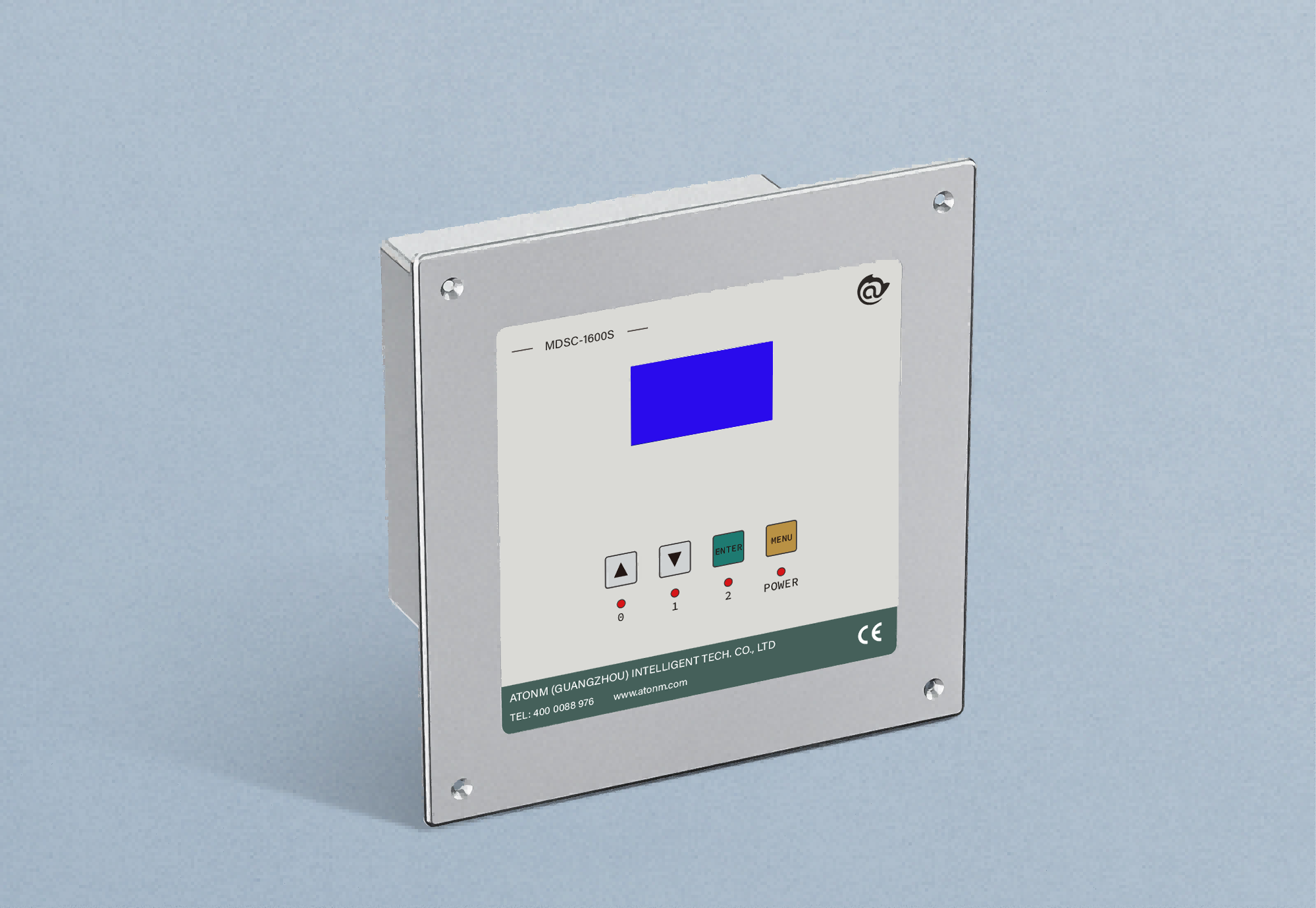
Combined with the production line working conditions, material characteristics and rhythm requirements, after extensive research and testing, the Atonm double-material detection sensor MDSC-1500S was finally selected as the core detection equipment.
This device has three core advantages, which perfectly match the project requirements:
Wide detection range: For the project's detection requirement of 0.6-4mm steel and aluminum sheets, its measurement range of 0.2-4.0mm for ferrous materials fully covers the demand. It is also compatible with various metal materials such as stainless steel, aluminum and copper, reserving space for the future material expansion of the production line.
Extremely fast response speed: The detection rate of 1200pcs/min is far higher than the production line rhythm of 18SPM (18 times per minute), ensuring no delay in the detection process.
Excellent anti-interference performance: It adopts the new-generation sensor technology and exclusive anti-interference algorithm, which can resist the influence of complex environments such as production line mechanical vibration and electromagnetic radiation, and ensure no missing detection or false detection from the technical level.
The device supports IO and Profinet communication methods, and has a built-in storage function for 200 groups of sheet materials. It can be adapted to frequent material change scenarios, with extremely high operational flexibility.
To ensure the detection effect and production line compatibility, the device adopts a modular installation layout, as detailed below:
Host installation: The sensor host is integrated and installed inside the production line cabinet. This not only saves on-site space, but also prevents the host from being affected by on-site dust and vibration, ensuring stable operation of the device. At the same time, it is convenient for operators to conduct later maintenance and parameter debugging.
Through-beam sensor installation: A pair of through-beam sensors are respectively installed above and below the conveyor belt. The installation position is between the robotic arm's material placing point and the stamping mold's material inlet. This ensures that when the steel and aluminum sheets are conveyed from the conveyor belt to the detection area, they can be completely within the detection range of the sensors. The upper and lower sensors are accurately aligned to avoid detection errors caused by installation deviations.

Based on the original feeding logic of the production line, the double-material detection link is integrated to form a closed-loop feeding control process. The specific steps are as follows:
The robotic arm grabs steel and aluminum sheets from the material stack according to the preset program, with the target of grabbing a single sheet each time, and then places the steel and aluminum sheets stably on the conveyor belt.
The conveyor belt drives the steel and aluminum sheets to move at a constant speed. When the steel and aluminum sheets enter the detection area of the upper and lower through-beam sensors, the sensors quickly detect the thickness of the steel and aluminum sheets to determine whether there is double-material stacking.
Detection result judgment and execution:
If a single steel/aluminum sheet is detected, the sensor sends a release signal to the production line control system, the conveyor belt continues to run, and the steel/aluminum sheet is conveyed to the next process (stamping mold feed inlet) to complete normal feeding.
If double materials (or multiple materials) are detected, the sensor immediately sends an alarm signal and triggers the conveyor belt stop command to prevent double materials from entering the stamping link.
Manual handling: After receiving the alarm prompt, on-site operators quickly go to the detection area, manually separate the double-material steel and aluminum sheets, and check the causes of abnormal grabbing (such as material stack arrangement, fine-tuning of robotic arm grabbing parameters, etc.).
Production resumption: After manual handling is completed, press the reset button. After the production line control system receives the signal, it instructs the conveyor belt to resume operation, and the robotic arm restarts the grabbing and feeding process, so that the production line returns to normal production status.
The Atonm MDSC-1500S sensor is seamlessly connected to the original PLC control system of the production line, opening up the transmission channel for detection signals, alarm signals and equipment control signals. The sensor detection data is fed back to the control system in real time, and the control system automatically executes commands such as release and shutdown according to the detection results. At the same time, the alarm information is synchronized to the display screen of the on-site operation platform and the sound and light alarm, ensuring that operators respond in a timely manner. The entire integration process does not change the original core control logic of the production line, and only embeds the detection function through signal linkage, ensuring the stable operation of the production line.
After the implementation of this double-material detection project, through a one-month trial operation and optimization adjustment, it has fully achieved the expected goals and brought significant benefit improvements to the production line. The specific effects are as follows:
Detection accuracy meets standards: It accurately identifies double-material situations within the thickness range of 0.6-4mm, with no missed detection or false detection, avoiding the risk of double materials entering the stamping link and providing comprehensive safety protection for stamping molds.
Adapts to production line rhythm: The sensor has a fast response speed and short detection time, which fully adapts to the production line rhythm of 18SPM, does not affect the overall production efficiency of the production line, and ensures the continuous production of the production line.
Reduces production costs: Compared with the old production line in the factory without automated double-material detection equipment, this project avoids the problems of mold damage and product scrapping caused by double materials that often occur in the old production line by accurately intercepting double materials, and greatly reduces unplanned downtime. According to statistics, compared with the same type of old production line, the material loss rate of this new production line has decreased by more than 30%, the equipment maintenance cost has decreased by 25% year-on-year, the production efficiency has always been stable above the design standard, and the cost control advantage is significant.
Convenient and efficient operation: After the equipment installation and commissioning, no complex maintenance is required, the alarm mechanism is clear, and the manual handling process is simple, which reduces the work intensity of operators and improves the efficiency of on-site emergency handling.
Based on the working condition requirements of the newly built automotive component stamping production line, this project selects the Atonm double-material detection sensor MDSC-1500S, and constructs an efficient and accurate double-material detection system through scientific installation layout and control system integration. The successful implementation of the project not only solves the double-material pain point in the feeding link of the stamping production line and ensures the stable operation of the production line, but also helps the enterprise reduce production costs and improve production efficiency, providing a replicable and promotable practical solution for the double-material detection needs of similar stamping production lines.
If your enterprise is facing the problem of double-material detection in the stamping production line and is eager to improve production efficiency and reduce operating costs, Atonm Intelligent Technology will provide you with a customized solution! Welcome to call Atonm's official customer service hotline: 133 4281 4291, or visit the official website www.atonm.com for online consultation. We will provide you with professional product introduction, scheme design and technical services, and work together to help your production line achieve efficient, stable and intelligent operation!
Solution Design
Application Validation Support
Parameter Optimization Guidance
Commissioning Support