

Project Services
Solution Design
Application Validation Support
Parameter Optimization Guidance
Commissioning Support
By clicking on the button “I accept” or by further usage of this website you express consent with usage of cookies as well as you grant us the permission to collect and process personal data about your activity on this website. Such information are used to determine personalised content and display of the relevant advertisement on social networks and other websites. More information about personal data processing can be found on this link Cookie Policy.
Agree


Single Sensor
Double Sensor
Image Sensor
2025-11-28
In automotive Stamping Production Lines, during the Sheet Metal loading process, Double Material (or multiple Sheet Metals) may be fed into the stamping Mold simultaneously due to factors such as oil film adhesion on the Sheet Metal surface, magnetic sticking, or abnormal Robot gripping parameters. Once such incidents occur, they may minimally cause Mold damage and production line shutdowns, leading to substantial economic losses; in the worst-case scenario, they may even trigger safety accidents.
To completely prevent Double Material from entering the Mold, this solution designs an automated Detection system featuring "dual Detection and precise interception". By deploying two professional testing devices at key stations, redundant protection is formed to ensure the safety and efficiency of stamping production.
The solution adopts a dual Detection mode of "contact initial Detection + through-beam re-Detection", with specific deployment as follows:
First Line of Defense (De-stacking Area):
An Atonm 9000T Contact-type Single-probe Double-sheet Detector (1-to-2 Configuration) is integrated into the end gripper of the De-stacking Robot to complete the first Detection at the moment of gripping.
Second Line of Defense (Conveying Area):
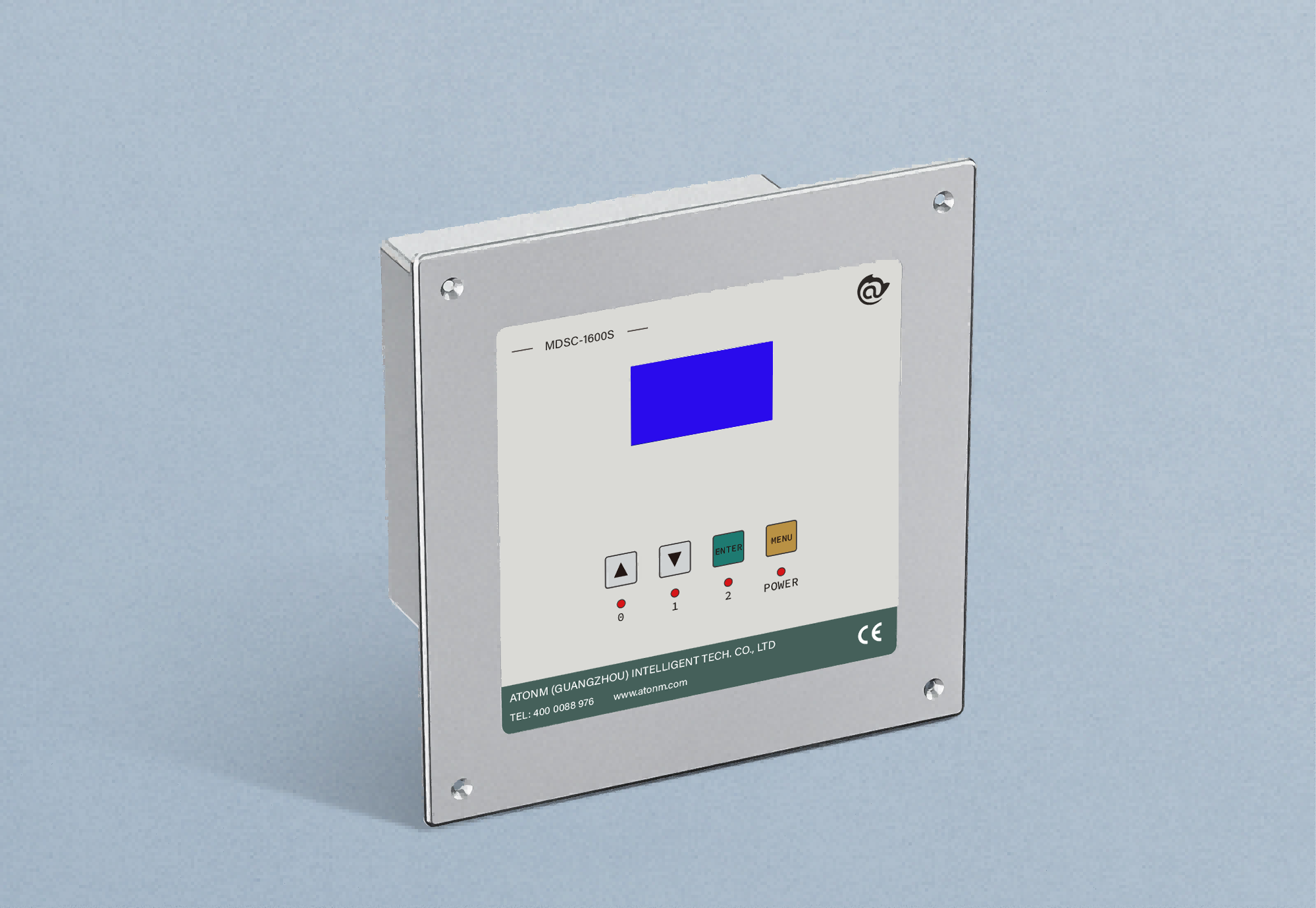
An Atonm 1600S Through-beam Double Material Detector (1-to-4 Configuration) is installed above the Sheet Metal Conveying Belt and in front of the Mold entrance, conducting non-contact secondary re-Detection on the moving Sheet Metal.
The design achieves full-process monitoring from "gripping" to "feeding", providing dual protection to ensure foolproof operation.
Deployment Location: Integrated into the end effector (suction cup frame or magnetic gripper) of the de-stacking robot.
Working Mode:
The robot moves downward to grip the topmost sheet metal from the stacked materials.
After the adsorption force is established and before lifting, the 9000T probe contacts the surface of the sheet metal and conducts detection immediately.
If it is a single sheet, the robot conveys the material to the conveying belt normally.
If it is double sheets, the system triggers an alarm immediately, and the robot stops its operation or places the double material into the NG material area to intercept the problem at the source.
Station Value: Realizes the detection and interception of problematic sheet metal at the source, avoiding subsequent invalid operations.

Deployment Location: Erected above the Sheet Metal Conveying Belt, serving as the final checkpoint before entering the Mold.
Working Mode:
The Sheet Metal transported from the de-stacking area enters the detection zone of the 1600S detector.
The detector conducts rapid detection on the passing Sheet Metal.
If it is a single sheet, the Sheet Metal passes through smoothly and is prepared for mold feeding.
If it is double sheets, the detector immediately outputs a signal, which links to the Conveying Belt for an emergency stop or triggers an interception mechanism (such as a push rod or baffle) to remove the double material from the main line, and an Alarm is activated.
Station Value: As a key review checkpoint, it ensures no missed double sheets enter the Mold, forming the final safety barrier.

Startup: The system is ready, and the robot prepares for de-stacking.
Initial Inspection (9000T Contact-type Double-sheet Detector): The robot grips the material and conducts detection simultaneously.
NG (Double Material): Alarm is activated, the material is placed into the NG area, and the process returns to the previous step.
OK (Single Sheet): The material is placed onto the Conveying Belt.
Conveying: The Sheet Metal is transported to the press machine.
Re-inspection (1600S Non-contact Double-sheet Detector): The Sheet Metal passes through the detection zone.
NG (Double Material): The Conveying Belt performs an emergency stop, the interception and rejection mechanism is activated, the system triggers an alarm, and waits for handling.
OK (Single Sheet): The Sheet Metal passes through, enters the centering table, and prepares for stamping.
Cycle: The system enters the next working cycle.

Ultimate Safety: A dual interlocking detection mechanism prevents Double Material from entering the Mold, providing the highest level of protection for expensive Mold and press equipment.
Cost Reduction & Efficiency Improvement: Fundamentally avoids Mold maintenance, part scrapping, and long-term production line shutdowns caused by Double Material, significantly improving Overall Equipment Efficiency (OEE) and production capacity.
Full Automation: No manual intervention is required throughout the process; it automatically identifies, alarms, and intercepts, realizing intelligent production and reducing reliance on human resources.
High Reliability: The combination of contact and non-contact methods forms technical complementarity at different stations, resulting in extremely strong system robustness.
High Return on Investment (ROI): A single successful Double Material interception can avoid huge losses, leading to an extremely short equipment investment payback period.
This solution, through the collaborative work of the Atonm 9000T and 1600S Double-sheet Detectors, builds a seamlessly connected and rapidly responsive Double Material protection network at the de-stacking point and Mold entrance. The system is committed to providing solid technical support for the "zero Double Material accident" goal of automotive stamping production lines, and is a key configuration for modern intelligent stamping workshops to improve production safety and reliability.
Solution Design
Application Validation Support
Parameter Optimization Guidance
Commissioning Support