

Project Services
Solution Design
Application Validation Support
Parameter Optimization Guidance
Commissioning Support
By clicking on the button “I accept” or by further usage of this website you express consent with usage of cookies as well as you grant us the permission to collect and process personal data about your activity on this website. Such information are used to determine personalised content and display of the relevant advertisement on social networks and other websites. More information about personal data processing can be found on this link Cookie Policy.
Agree


Single Sensor
Double Sensor
Image Sensor
2025-10-22
An automation integrator undertook the transformation project of a fully automatic stamping line for automotive parts. This production line mainly processes 3mm-thick stainless steel stamping parts, which are used to produce key structural parts of automotive chassis. Previously, the production line suffered from mold damage caused by stacked materials 2-3 times a month. Each shutdown for maintenance took 4-6 hours, resulting in a cumulative direct economic loss of over 2 million yuan per year. At the same time, the defective rate remained high, seriously affecting production capacity and market competitiveness. Therefore, an accurate and efficient double-sheet detection solution was urgently needed to realize real-time monitoring and abnormal interception in the feeding process.
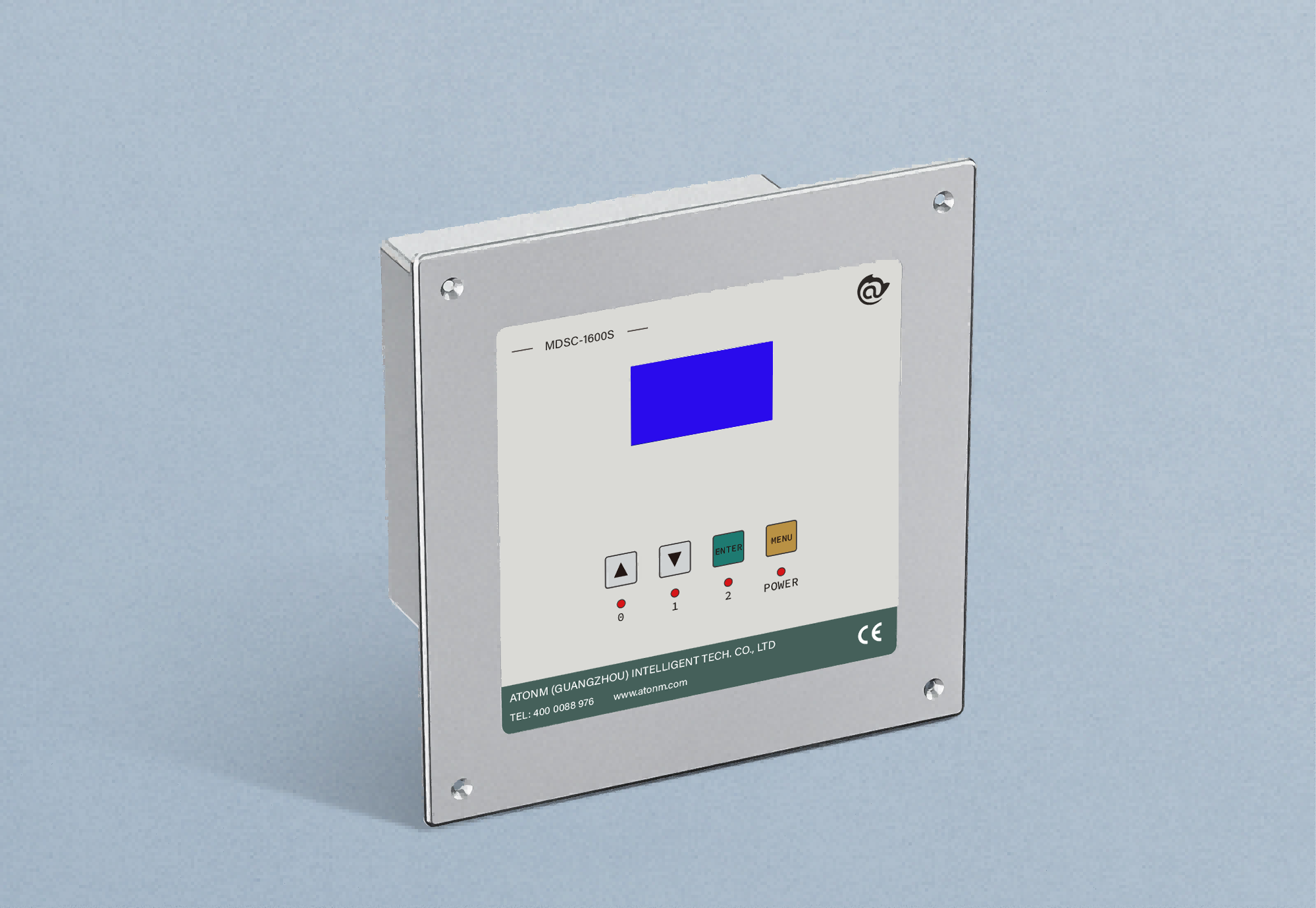
In response to the customer’s production line characteristics (3mm stainless steel plates, robotic automatic feeding, visual alignment process), 2 sets of Atonm contact-type single-probe metal double-sheet detectors (model: MDSC-8200S) were selected as the core detection equipment, with 4 matching sensors used for two detection processes respectively.

Two double-sheet detection controllers are embedded in the control cabinet. The first set of sensor probes is integrated and installed on the end effector of the manipulator, and the second set of sensor probes is installed on the visual alignment table.
When the manipulator's end effector grabs the sheet, the first sensor immediately triggers detection, and detects the sheet based on the principles of eddy current + magnetic induction.
If the first detection determines that there are double/multiple sheets, the controller sends an alarm signal within 120ms, links with the PLC to control the manipulator to pause feeding, and transfers the abnormal sheet to the waste area.
After the first detection is qualified, the manipulator moves the sheet to the visual alignment table according to the preset path, and places it in the detection area directly below the second sensor of the centering table.
The second sensor starts a second detection to confirm again whether the sheet is a single sheet.
If the second detection is qualified, a "single sheet" signal is fed back, the visual alignment system starts positioning and calibration, and then the sheet is grabbed and enters the stamping process; if unqualified, the abnormal handling process is executed.
The equipment supports the Profinet communication protocol. After two sensors are connected to the same host, they seamlessly connect to the existing Siemens PLC of the production line, realizing real-time interaction between the two sets of detection data and the production system. Through the upper computer, 200 built-in sheet material recipes can be called, enabling quick switching of parameters for different batches of sheets without repeated teaching.
Accurate Detection Capability: As a dedicated double-sheet detection equipment for magnetically conductive metals, it covers a detection thickness range of 0.2-4.0mm, perfectly matching the detection needs of 3mm stainless steel plates. Based on the principle of electromagnetic induction, it can accurately capture thickness changes and eliminate misjudgments caused by material thickness deviations.
Efficient Dual-Channel Design: Adopting a two-channel controller architecture, one host can connect to 2 sensors at the same time, enabling dual-station or double detection without additional hosts.
Stable and Reliable Performance: Upgraded stacked material detection algorithm and excellent anti-interference processing capability eliminate the impact of external interference factors on detection results, ensuring more stable detection performance.
Flexible System Adaptability: Supports multiple communication protocols such as Profinet, RS485, and IO, and can seamlessly connect to mainstream PLC systems such as Siemens and Mitsubishi.
200 Groups of Stored Recipes: Built-in function to store 200 groups of sheet material recipes. Parameters for different batches of sheets can be quickly switched through the upper computer without repeated teaching and calibration.
Convenient Operation and Maintenance Support: The host is installed in an embedded manner, equipped with an LCD Chinese display panel and a key operation area to display detection data and equipment status in real time; it has a self-diagnosis function, which automatically alarms and indicates fault points when the sensor fails or the cable is abnormal. Combined with the brand's 24-hour technical response service, the operation and maintenance troubleshooting time is greatly shortened.
Through the application of the 8200S double-sheet detector, the problem of mold damage caused by stacked materials in the customer's production line has been completely solved; at the same time, the defective rate has decreased significantly, production continuity has been greatly improved, and the production capacity per unit time has increased by about 15%. In addition, the stable operation and convenient maintenance of the equipment have further reduced management costs, providing strong support for the enterprise's competition in the automotive parts market.
Solution Design
Application Validation Support
Parameter Optimization Guidance
Commissioning Support