

Project Services
Solution Design
Application Validation Support
Parameter Optimization Guidance
Commissioning Support
By clicking on the button “I accept” or by further usage of this website you express consent with usage of cookies as well as you grant us the permission to collect and process personal data about your activity on this website. Such information are used to determine personalised content and display of the relevant advertisement on social networks and other websites. More information about personal data processing can be found on this link Cookie Policy.
Agree


Single Sensor
Double Sensor
Image Sensor
2025-10-14
1、 Project Background
With the large-scale expansion of the new energy vehicle industry, a leading automotive battery company has invested in building a new highly automated production line, focusing on the precision manufacturing of battery shell components. One of the core processes of this production line is the mechanical arm feeding stamping process for 1.2mm thick aluminum sheets (non-magnetic metal). In order to ensure production accuracy, efficiency, and equipment safety after production, a reliable dual sheet detection scheme needs to be deployed during the mechanical arm feeding stage. If aluminum sheet stacking (dual/multiple sheets) enters the stamping mold, it will directly cause mold jamming, aluminum sheet scrap, and even equipment shutdown, affecting the production capacity ramp up and quality stability goals of the new production line.
2、 Core requirements and design pain points of production line
Accurate adaptation of non-magnetic aluminum sheet testing: The new production line uses 1.2mm standard aluminum sheets, and the testing equipment needs to be optimized for the characteristics of non-magnetic metals to ensure that the accuracy of single/double sheet judgment is ≥ 99.9%, avoiding subsequent losses caused by stacking from the source.
• Compatible and efficient feeding cycle design: After the new production line's robotic arm grabs the material, it needs to immediately determine whether it is a single or double sheet. If traditional shooting sensors are used, additional movement of the sheet material to the middle of the sensor for detection will waste feeding time and slow down the production line cycle. Therefore, it is necessary to support the deployment of single-sided probes that can detect when grabbing the material, without the need for additional movement paths.
Matching high cycle automation integration: The production line cycle is 12spm, and the detection equipment needs to have fast response capabilities, while supporting linkage with MES systems and robotic control systems to achieve full process automation of "detection alarm shutdown".
Low maintenance and fast debugging requirements: After the new production line is put into operation, it needs to quickly enter a stable operation stage. The detection equipment needs to have the convenience of "installation and use" debugging, while resisting electromagnetic interference from stamping equipment and high-frequency motors around the production line to reduce later maintenance costs.
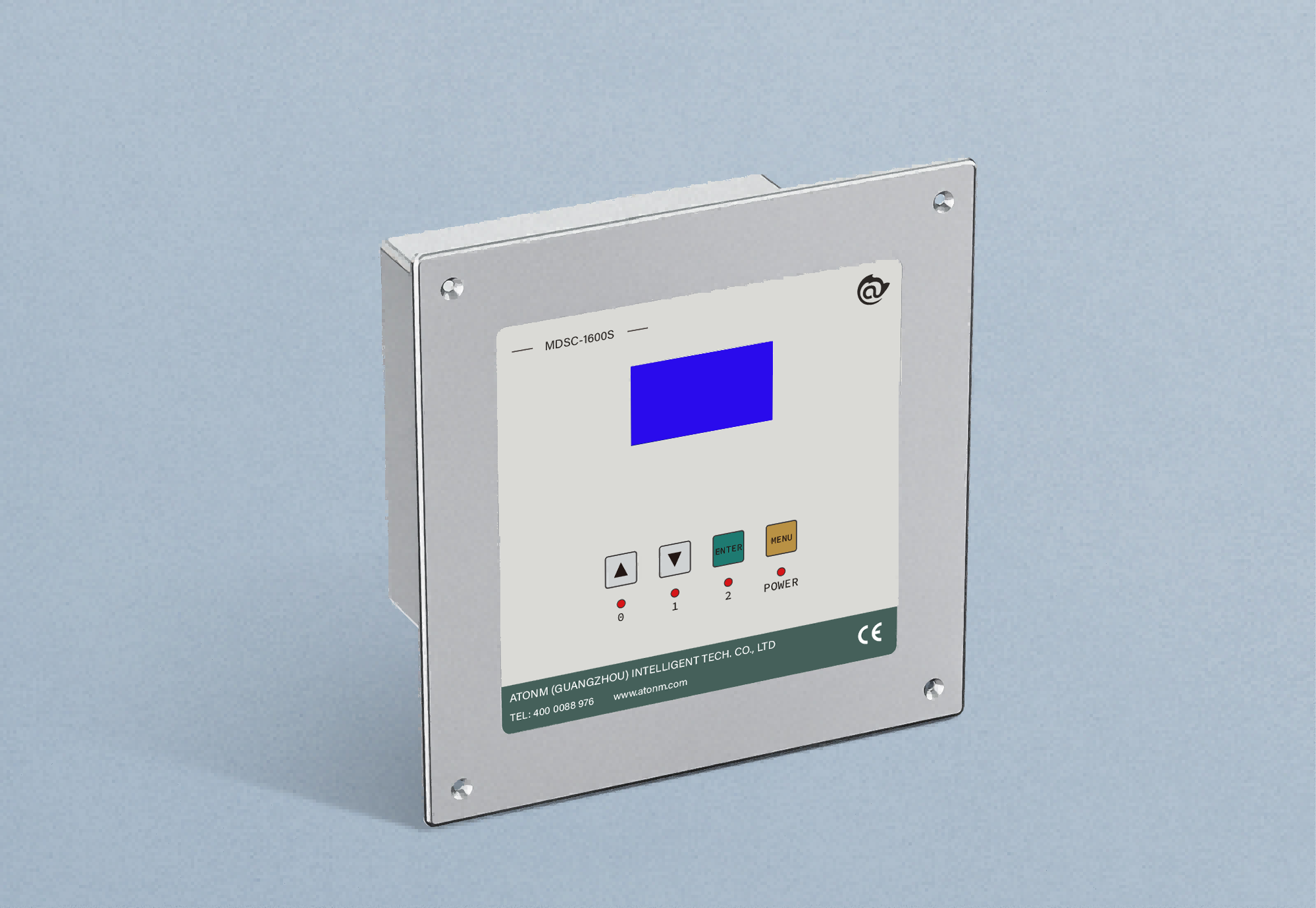
3、 Solution: AtonmMDSC-8100S Dual Material Detection Sensor
(1) Core matching points for product selection


(2) New production line deployment plan
1. Pre installation and integration of sensors: Reserve installation space on the side of the mechanical arm material picking end, fix the SE-8300SC-M42 single probe sensor, and adapt the 16 meter standard wiring cable to the production line wiring plan to avoid later modifications.
2. Integration of host and control cabinet: Reserve installation space in the production line control cabinet according to the product opening size (121mm × 105mm), connect the host to a DC24V/500mA power supply, and complete communication debugging with the robotic arm PLC and MES system in advance.
3. Pre production simulation debugging: before the production line trial production, the debugging equipment can quickly identify the single and double sheets after the manipulator grabs the sheets. If it is a single sheet, it will be normally released to the next process; If it is detected as a double sheet, the equipment immediately sends a signal, the robotic arm stops releasing and re grasps the material for testing, ensuring a smooth process during the simulation testing phase before it is officially put into production.

4、 Implementation effect
After the new production line is put into operation,MDSC-8100S Dual Material Detection SensorThe core effect of achieving "zero trial and error cost" startup is as follows:
Pre avoidance of quality risks: Since production, there have been no mold jamming or aluminum scrap caused by stacking, fully achieving the initial goal of quality control for the new production line.
Efficient promotion of production capacity ramp up: The detection response speed matches the production line pace, without any interruption in feeding caused by detection delays. The production line reached full capacity in just 15 days, 3 days ahead of schedule.
• Controllable operation and maintenance costs: The anti-interference design of the equipment (3mm alloy shell+4-layer circuit board) ensures stable operation, with no downtime caused by detection equipment failures within 3 months of production, significantly reducing operation and maintenance manpower and spare parts costs.
Intelligent management implementation: Through deep linkage with MES system, real-time monitoring of detection data and automatic statistics of single and double sheet detection frequency can be achieved, realizing full process traceability of the feeding detection status of each aluminum sheet and strengthening the intelligent management level of the production line.
5、 Customer feedback
The new production line chose Atorm from the design stageMDSC-8100S Dual Material Detection SensorIt is precisely because of the convenience of single probe installation and the accuracy and speed of non-magnetic metal detection that we value. Since its launch, there have been zero failures and misjudgments in the testing process, which not only helps us avoid potential equipment and quality risks, but also accelerates the process of capacity ramp up, fully meeting the core requirements of efficient and stable new production lines. ”Evaluation by the project leader of the new production line of the automotive battery enterprise.
6、 Project support
If your new car battery production line also faces the need for precision and efficiency in aluminum sheet double sheet testing, please feel free to contact Atorm (Guangzhou) Intelligent Technology Co., Ltd! We will provide customized integration solutions, equipment 3D models, and full process debugging guidance to help your production line start efficiently and run stably.
Solution Design
Application Validation Support
Parameter Optimization Guidance
Commissioning Support