

Project Services
Solution Design
Application Validation Support
Parameter Optimization Guidance
Commissioning Support
By clicking on the button “I accept” or by further usage of this website you express consent with usage of cookies as well as you grant us the permission to collect and process personal data about your activity on this website. Such information are used to determine personalised content and display of the relevant advertisement on social networks and other websites. More information about personal data processing can be found on this link Cookie Policy.
Agree


Single Sensor
Double Sensor
Image Sensor
2025-05-13
A lithium battery manufacturing enterprise conducts lamination operations using copper-aluminum sheets with a thickness of 0.01mm and dimensions of 75×60mm during production, with the production line speed requirement reaching 40 sheets per minute.
Due to the narrow internal space of the laminating machine, traditional double-sheet detection equipment is difficult to install. Moreover, the copper-aluminum sheets are extremely thin, making conventional detection methods unable to meet the accuracy requirements. This results in frequent occurrences of undetected double-sheet issues, which seriously affect the production quality and efficiency of lithium batteries.

Detection Accuracy Challenge
The copper-aluminum sheets, with an ultra-thin thickness of 0.01mm, show almost no noticeable difference when double-layered. Traditional detection equipment struggles to identify double sheets accurately. Undetected double sheets entering subsequent processes will affect battery performance and increase the defective rate.
Space Constraint Dilemma
The internal structure of the laminating machine is compact, leaving limited installation space for detection equipment. Many standard-sized detectors cannot be installed; even forced installation may interfere with the normal operation of other components of the laminating machine.
High-speed Production Line Pressure
With the production line running at a speed of 40 sheets per minute, the detection equipment is required to respond rapidly, completing detection and feeding back results in a short time. Otherwise, production downtime will be caused by detection delays.
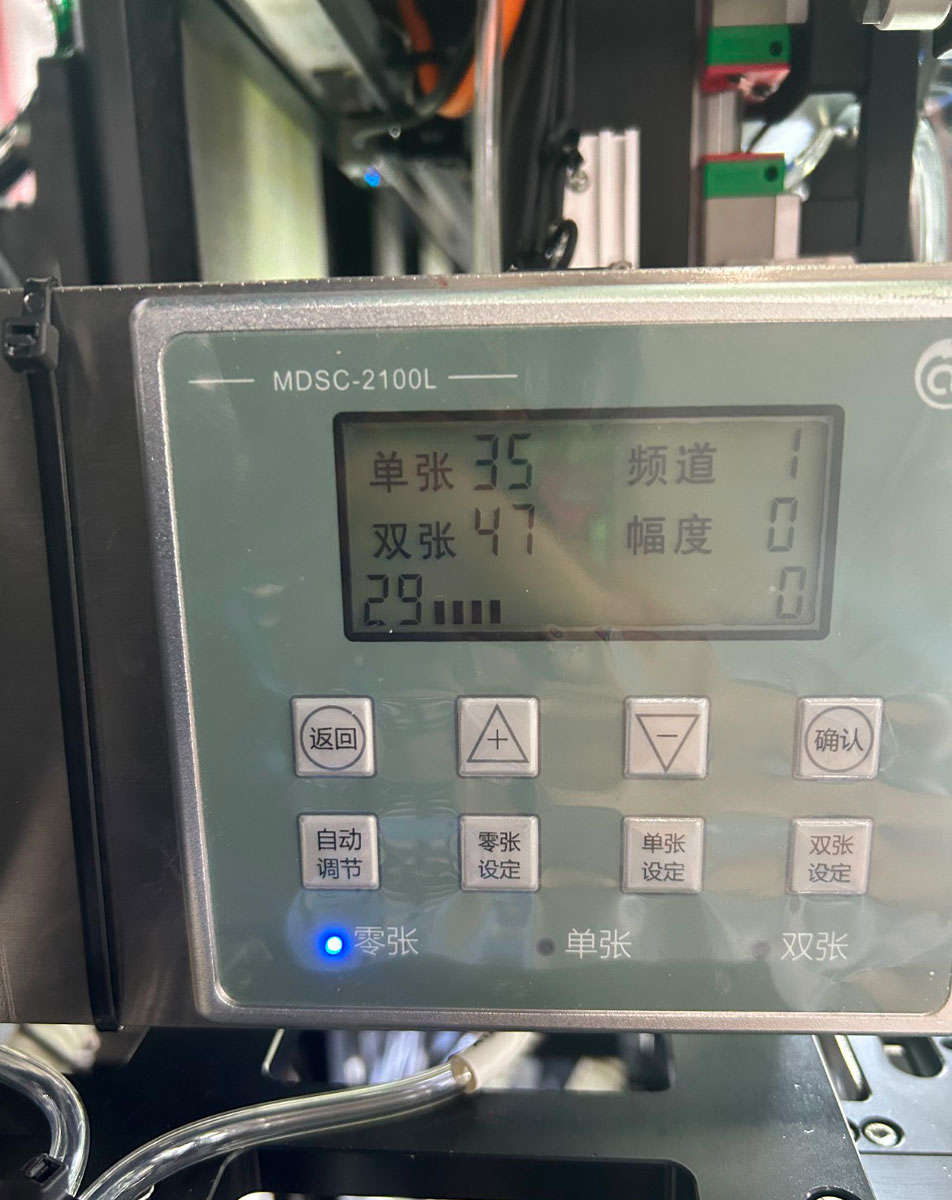
The enterprise adopted the Atonm Double-Sheet Detector MDSC-2100L. This device is specially designed for thin materials in the lithium battery industry, equipped with customized high-sensitivity small-probe sensors, and is a contact-type double-sheet detector, making it ideal for installation in equipment with compact internal structures.
Accurate Detection
Tailored to the characteristics of copper-aluminum sheets, the MDSC-2100L can accurately identify double-sheet conditions with high detection precision, effectively eliminating the problem of undetected double sheets.
Easy Installation
Its compact design allows easy installation in the narrow space inside the laminating machine without requiring large-scale modifications to the equipment, thus saving installation costs and time.
Rapid Response
The response speed can reach up to 1200 sheets per minute, far exceeding the production line's requirement of 40 sheets per minute. This ensures timely detection and result feedback during high-speed production, maintaining production continuity.
Quality Improvement
After implementing the MDSC-2100L Single/Double-Sheet Detector, the rate of undetected double sheets dropped dramatically. This led to a significant reduction in the defective rate of lithium batteries, effectively improving product quality and strengthening the enterprise's competitiveness in the market.
Efficiency Enhancement
The device’s ultra-fast response speed fully meets the demands of the high-speed production line, minimizing production downtime caused by detection delays and substantially increasing overall production efficiency.
Cost Reduction
The decline in defective rates and improved efficiency have allowed the enterprise to effectively control production costs, including reduced raw material waste and fewer equipment maintenance cycles, bringing substantial economic benefits.
Solution Design
Application Validation Support
Parameter Optimization Guidance
Commissioning Support